
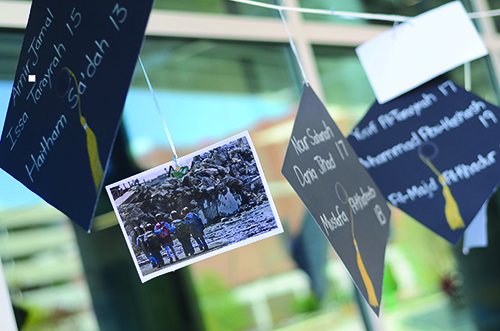
 SJP shows images of Palestinian children passing through a military checkpoint to get to school at the “Education Under Occupation” event. Photo by Ian Keel Alice Grissom - Contributor
ealiceg@uab.edu
In the shade of the Hill Student Center Amphitheater, Students for Justice in Palestine at UAB held their first annual event, “Education Under Occupation,” on Tuesday, Nov. 1.
The event featured traditional Palestinian foods, such as hummus and falafel, which SJP at UAB President Ruaa AbuAishah described as having been culturally appropriated by Israelis in a perceived attack on Palestinian culture.
“Education Under Occupation” focused on the plight of Palestinian students during the decades-long Israeli-Palestinian conflict. SJP members said that over 500 students were killed in a 50-day conflict between Israeli forces and Hamas, the democratically elected militant group that controls the Gaza Strip. The names of over 40 of the deceased students were ironically listed on graduation caps in their display.
“These kids haven’t done anything wrong to deserve the situation they’ve been born into and, as someone who, thank God, lives a very comfortable lifestyle, I feel like it’s our duty to do what we can to help make their lives a little bit easier. I’ve seen first hand how small actions can go a long way so I try to do what I can and being part of SJP is a great way to do that,” SJP treasurer Bayan Karassi said of the display.
There were also posters featuring tales and photographs of students being detained, delayed and persecuted at mandatory checkpoints, and photographs of students struggling on their way to school. The International Solidarity Movement, a pro-Palestinian group, described the trials of Palestinian students’ first week of school, including long waits at checkpoints, overcrowded classrooms and exposure to tear gas.
Not all students even have the opportunity to make it to the classroom, according to the United Nations Children’s Fund. Their report, cited in an Education Under Occupation handout, said that only an estimated 70 percent of children have access to a primary school, compared to 93 percent for American children.
In an interview with rethinkingschools.org, Zakaria Odeh, executive director of the Civic Coalition in East Jerusalem, attributed this phenomenon to the deliberate isolation of Palestinian neighborhoods and the continuation of time-consuming checkpoint practices that often prevent students from even arriving at schools. He also cited the Israeli-controlled materials with which even Palestinian students must be taught.
Palestinian students are not the only ones to suffer due to military action, however. Many Israeli schools are the victims of bombings and other attacks on the part of the Hamas-controlled government, according to the Global Coalition to Protect Education from Attack.
SJP at UAB wants to challenge this educational reality by constantly promoting awareness, according to AbuAishah, who said the group intends to hold at least one more event this semester and others next semester. SJP was encouraged by the turnout, which exceeded their expectations. Over sixty students signed in at the event, with more simply stopping by to learn more.
“If those who came to the event learned about Palestine and what its people are going through, or changed their opinion from what the media might have told them, then that would be serving our purpose,” Karassi said. “I guess you could say we just want people to be aware and hear a different perspective about the Israeli-Palestinian conflict rather than relying on the media only.”
This marked the first independent event of the newly rejuvenated SJP, an organization dedicated to promoting awareness of Israeli aggressions against Palestinians. AbuAishah, leader of the group since its reorganization in the spring of 2016, works to spread recognition of the cause.
Despite the less-than-favorable reputation SJP has on a national scale due to allegations of violence and conflict, AbuAishah said she is determined that SJP at UAB will continue to peaceably spread awareness and educate students on Palestine.
She was inspired to relaunch the organization when she moved back to Birmingham after spending a year in the Palestinian territory of Turmus Ayya.
“At the time, the political prisoners in administrative detention were becoming vocal and their resistance through hunger strikes deeply affected me,” AbuAishah said. “It was also just things like having to deal with checkpoints and the humiliation that came with all that. Even my American nationality couldn’t help me because I also carried a Palestinian passport.”
In addition to being pro-Palestine, SJP at UAB partners with the Social Justice Advocacy Council in events to perpetuate dialogues concerning human rights, or, as AbuAishah put it, to “call out hate crimes.”
“SJP’s main purpose as of right now is to raise awareness and shine a light on the Palestinian people who are suffering under the occupation,” Karassi said.