
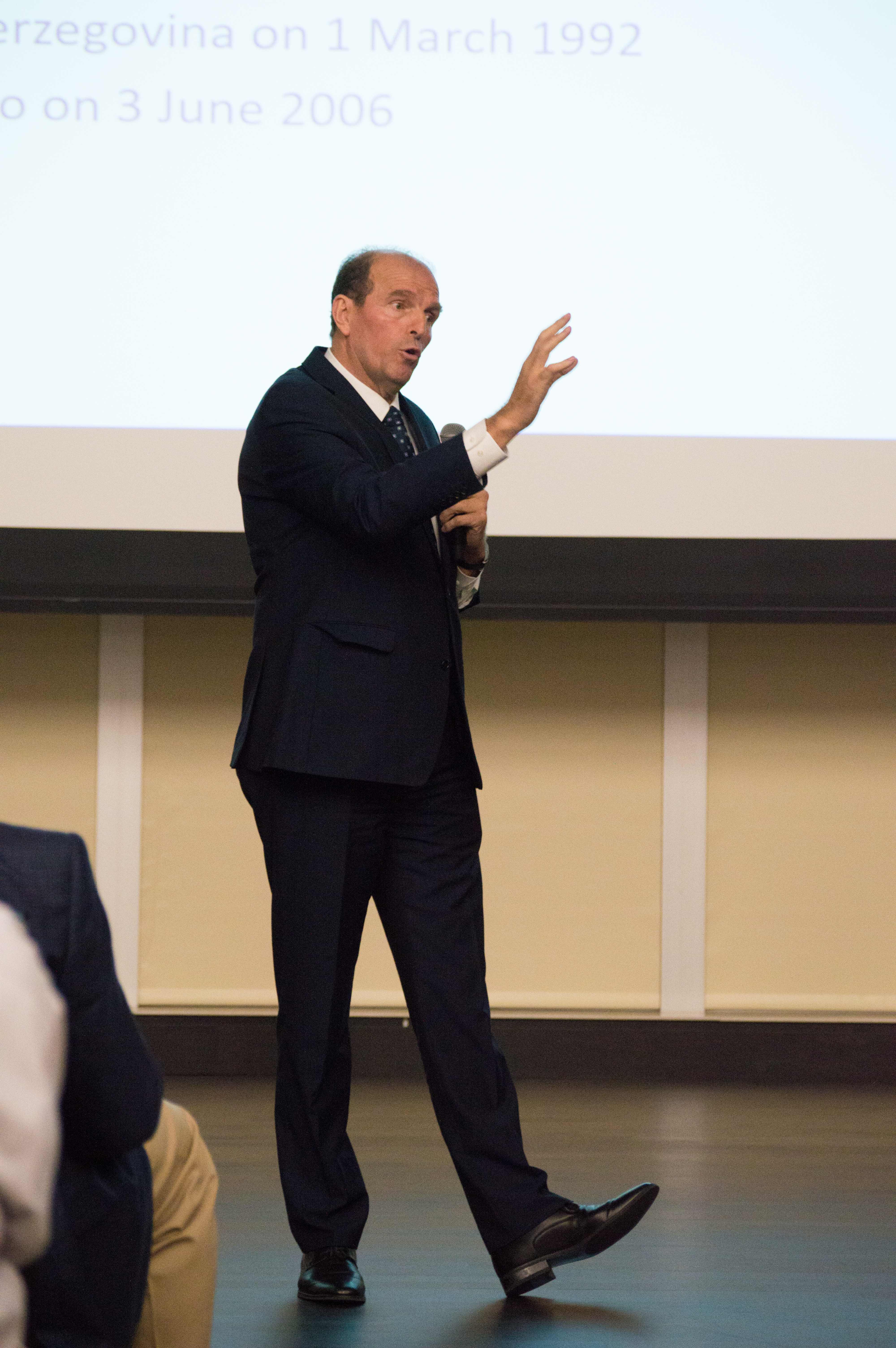
 Ahmet Shala discusses inclusion with students. Photo by Fred StephensSurabhi Rao -Features Editor
features@insideuab.com
On Monday, Nov. 7, the former ambassador from the Republic of Kosovo to Japan brought his tale of genocide, war, crime and hate to spread a message at UAB about inclusion.
Ambassador Ahmet Shala, currently a visiting professor at the James Madison University in Virginia, was hosted by the UAB Institute for Human Rights. His background in Kosovo over the past few decades has given him the opportunity to lecture on topics such as marketing models and human rights.
Shala said he was in his prime during the events of the Republic of Kosovo that lead to and after their independence, and was a pivotal part of the process of improving the economy there. He established a notable school system titled “The Cambridge School.”
He began the talk by describing Kosovo and its history. Kosovo is comparable in land size to about one-tenth of Alabama, with population about three-sevenths the size of Alabama’s. Kosovo is in the Balkans near Italy.
In 1990, according to bbc.com, Yugoslav President Slobodan Milosevac stripped Kosovo of its autonomy and imposed Serbian administration on the territory, which prompted Albanian protests.
After Yugoslavia was dismantled in 1991, Kosovar Albanians launched a passive resistance movement but failed to secure their independence from Serbia. In 1996, the rebel Kosovo Liberation Army stepped up attacks on Serbian authorities in Kosovo.
In 1999, after efforts to resolve the conflict had failed, NATO forces began a bombardment of Serb targets and Yugoslav and Serbian forces responded with a campaign of ethnic cleansing against Kosovar Albanians, prompting an exodus that led to a refugee crisis. Following a peace agreement the same year, a UN sponsored administration took over, and Yugoslav and Serbian forces withdrew.
Kosovo unilaterally declared its independence in 2008. Serbia and several other states still protest the U.S. and other states recognition of Kosovo’s declaration of its status as a sovereign and independent state, according to the CIA.
“For six weeks I did not know if my wife and kids were alive or dead,” Shala said of the conflict. “Still, even if a person killed my kids and my wife, I would not kill them. I do not have it in me and then I would be just like them.”
During the Serbian era of ethnic cleansing, schools and other public amenities were closed. Shala showed a video of Serbian policemen that looted Albanian houses.
“We would have lectures in garages,” Shala said. “For eight years, education buildings were empty but we were not allowed to teach there.”
Shala also showed a video of a silent protest in the center of a town of Kosovo on February 3, 1998. Protesters came to sit on their knees silently for one minute and call for peace and freedom, something Shala said was largely ignored.
“By 1989, 400,000 people left Kosovo as a result of unbearable conditions. My brother left, too. I was offered a job in London, but I didn’t take it,” Shala said.
Tina Kempin Reuter, Ph.D., the director of the Institute for Human Rights at UAB, was born and raised in Switzerland, and her mother was the mayor of Maennedorf, a town that accepted refugees during the exodus of Kosovar Albanians.
“I remember driving to the train station and sharing with refugees from Kosovo, because they had nothing,” Reuter said. “At first, we just took them home because we had not prepared for them.”
Shala was the first minister of economy and finance, and made substantial progress through this platform following the country’s establishment.
He established taxes lower than any other country in Europe, and Kosovo’s economy has been improving since his work began.
“I was talking to a local before becoming minister, and he said he would not pay taxes if they were above 30 percent, or he would only pay some taxes. I said to him I will keep the taxes at 10 percent, but he must pay in full,” Shala said.
Literature suggests that this genocide and the war were a result of differences in religious beliefs, but Shala believes that the war can be attributed to the desire to take advantage of Kosovo’s natural resources and exploit its territorial access.
“The literature says whatever will benefit it. This was an economic war,” he said. “Kosovo is of interest because Montenegro, Albania, and Greece are a port for minerals.”
For some audience members, Shala’s talk was their first exposure to the plight of Kosovo.
“Sadly, I knew nothing about Kosovo or the genocide before this talk. All of these events occurred during my lifetime, but I never learned about them,” Rebecca Massey, a junior anthropology student, said. “The fact that an ethnic genocide took place so recently and many of us were never taught is baffling to me. I think that in such divisive times in America, it is important that we remember the importance of educating ourselves on global issues.”
To conclude his talk, Shala called on students to stand up for oppressed people everywhere.
“For countries that don’t fill global responsibility, we are in danger. Please stand whenever you know something is not right,” he said. “You Americans, you should know how much you mean for those that are oppressed.”