
 Infographic by Sarah FaulknerMark Linn - Copy Editor
copy@insideuab.com
Finals week is almost upon us, and for most students it’s time to start hunkering down and cramming for tests. But there’s both an art and a science to preparing for finals, and that goes beyond just studying. Fortunately, The Kaleidoscope is here to help you end the semester on a high note.
The weeks leading up to finals are also a busy time for the tutors and academic advisors at the Vulcan Materials Academic Success Center. Lisa Kerr, interim director of the VMASC, has some tips for students getting ready for finals. According to Kerr, preparing for finals should begin with sitting down to make a list of what the student needs to do to finish out the semester on a high note.
“Now’s a really good time to make sure that you are identifying what needs to be done,” Kerr said.
“Literally sit down and in one uniform space and identify what you need to do in order to complete the semester successfully. So list out every class, list out every assignment that’s necessary or final, just to pull everything that you have going on together.”
She also said that students shouldn’t just focus on memorizing the answers to the questions that will be asked on the finals, but take the time to understand why the questions are being asked and understand the concepts behind them.
“So before you just sit down and start reviewing, memorizing, cramming the material, take a moment to stop and think and reflect on what types of questions were asked in this class previously,” Kerr said.
It’s also important to make sure that you can focus on studying without distractions.
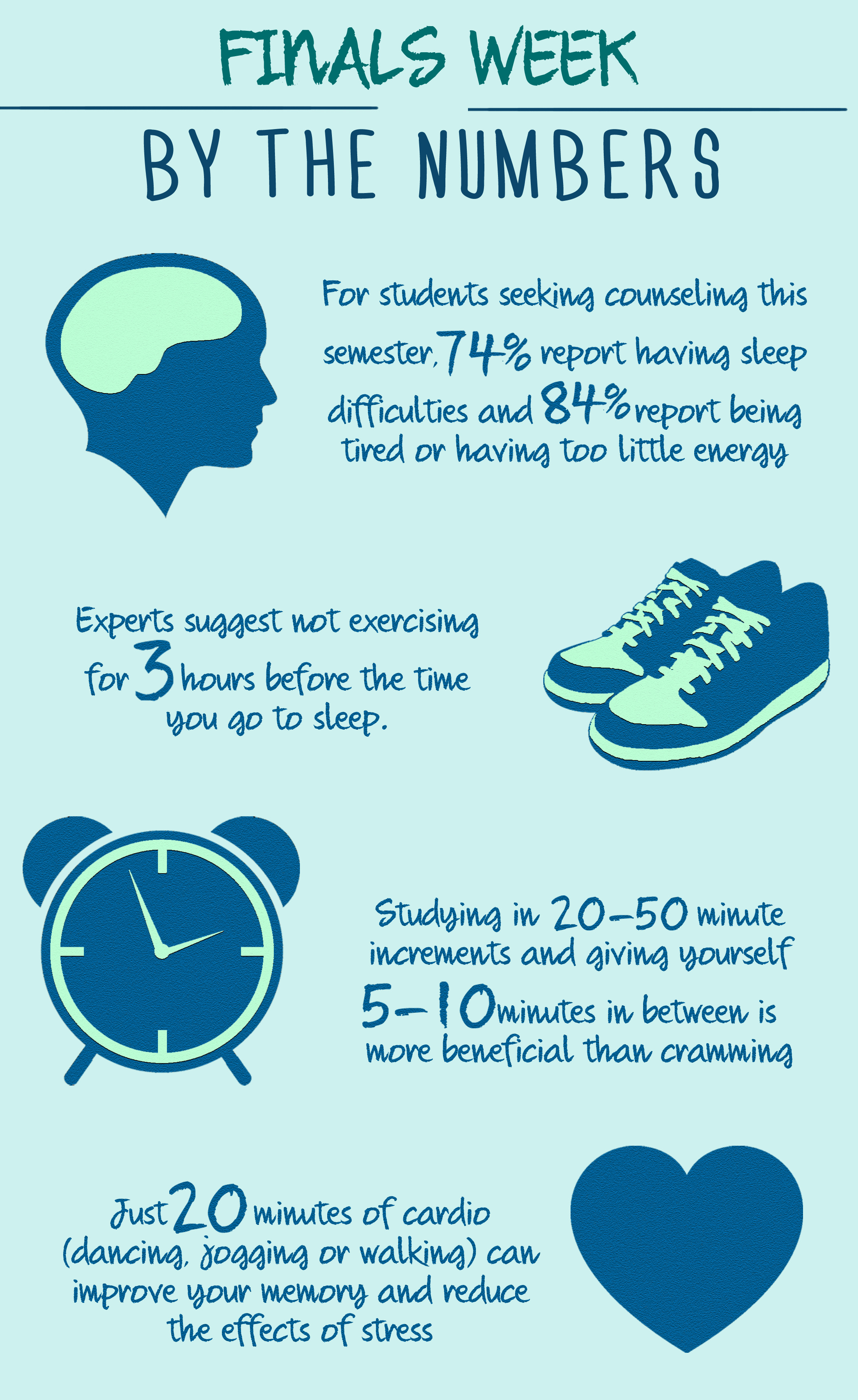
“Clear away your distractions, just get rid of them,” Kerr said. “So turn your computer off, put your phone away - I know that sounds absolutely crazy, but turn off your phone for 90 minutes and plan to study for 45 minutes, take a 5-10 minute break, study for 45 minutes and then check your phone.”
One thing that might help and shake things up from your usual method of cloistering yourself in Sterne is studying with a group of friends or classmates. The key to group studying is making sure that your group is as committed to actually studying as you are — a focused and passionate study group can be a great help, but a group that would rather get together to watch funny cat videos probably won’t do much to help you prepare.
“There are tons of benefits to studying with people in a group,” Kerr said. “You can really test each other, challenge each other, support each other. But it can also be drastically awful if you’re not focused. It depends on the group that you’re studying with.
Of course, finals are a stressful time no matter how much you’ve prepared, and a big reason for that is that finals week is akin to what clinical psychologist Josh Klapow, Ph.D., calls a “reverse holiday.”
“You have a period of time a week that for all students most of the communication to them, most of what they’re focused on, most of their daily routine is now around being evaluated, taking a test,” Klapow said. “So what happens is for so many students is that wherever they look, most of their classes are review sessions, memorizing lots of information, making sure that their grades are good and they’re finishing everything up. When they talk to their friends, they’re all doing the same thing. So everything is focused on this evaluation process, so it takes on a life of its own .It creates more cues for stress than just the tests themselves.”
One of the keys to managing the stress brought on by finals is acknowledging that you are stressed, and taking steps to make sure you aren’t overwhelmed.
“Stress isn’t inherently a bad thing,” Klapow said. “It gets you focused, it gets the adrenaline going. It can put you in a position to study harder, to focus on what you need to do.”
According to Klapow, one of the tricks to managing your stress is making sure that finals don’t swallow up all of your other daily habits. Don’t stop going to the gym or taking breaks and make sure you get plenty of sleep.
“Sleep is absolutely essential for physical and mental well-being. Sleep deprivation directly impacts your cognitive functioning, including your ability to focus, retain information (e.g. study), reason and problem-solve,” director of counseling and student health Angela Stowe said. “Many students believe that staying up and studying will help them perform better on tests or exams. The research actually indicates that not only do students not perform better, but actually may perform worse. Additionally, pulling all-nighters can lead to increased stress and has also been linked to heart problems and depression.”
Karen Gamble, Ph.D., a researcher in the Department of Psychiatry who studies circadian rhythms, echoed the importance of sleep.
"Sleep and circadian rhythms (the timing of sleep and hormones) are critically important to stress, health and cognitive performance. In addition, your immune system is compromised when the sleep-wake cycle is shifted by jet lag or even staying up much later than normal," Gamble said. "...Even if sleep deprivation or disruption of the circadian clock doesn’t make you 'feel' stressed, your body may still suffer. This could be one reason why students sometimes come down with a cold or flu right after finals...staying up late to cram for a test may impair learning and memory. You are better off to plan ahead and get a good night sleep before your exams."
If you need a little extra help de-stressing before finals, stop by the VMASC on Thursday, Dec. 8 from 7 to 10 p.m. for free pancakes and toppings along with other de-stress activities. Quiet study areas and tutors will also be on hand to help with the home stretch before finals.