
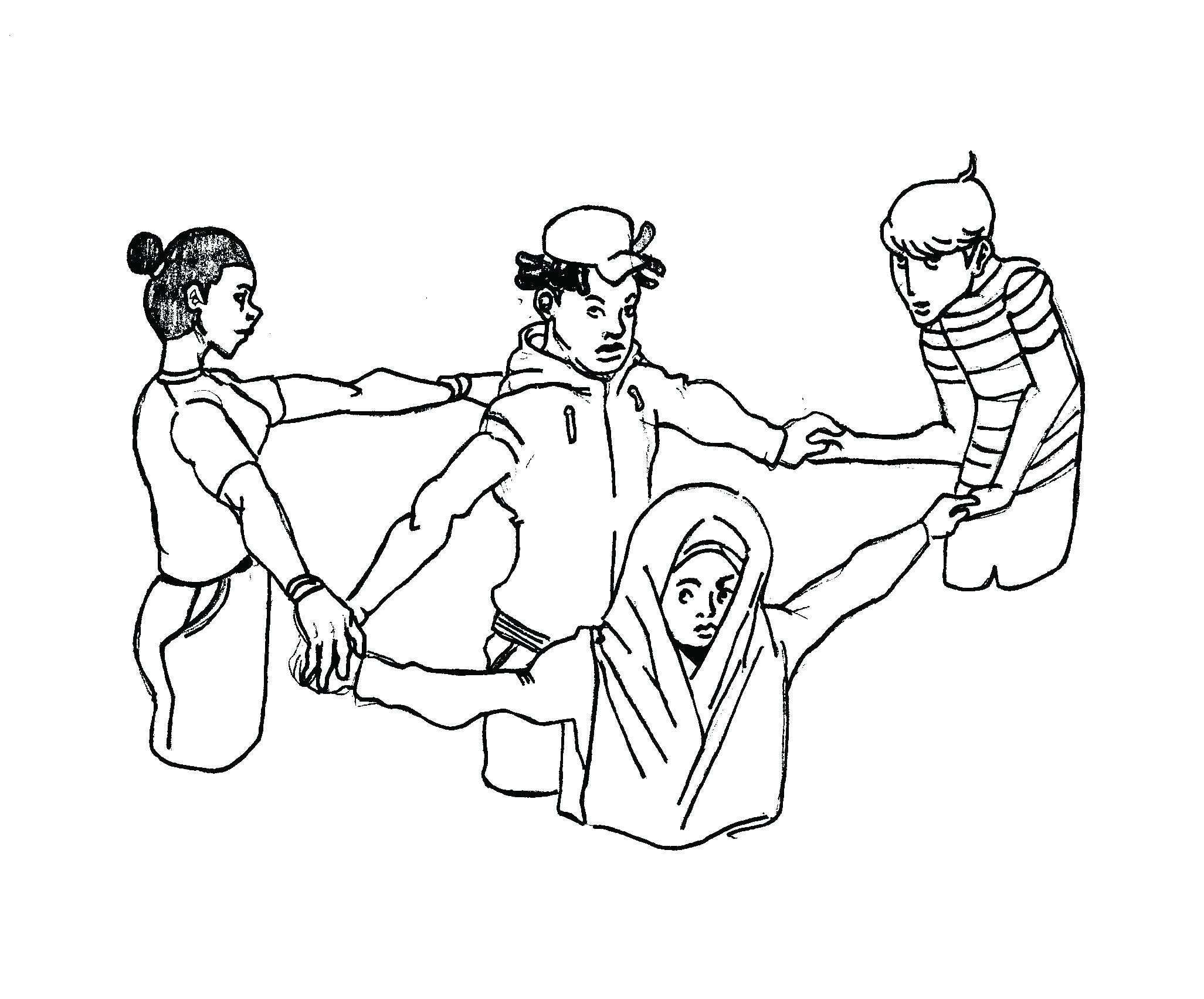
 Illustration by Corey BrightAaron Stuber - Opinions Columnist
abstuber@uab.edu
Ohio State University suffered a devastating attack to their community this past Monday, Nov. 28.
In the span of only two short minutes, Abdul Razak Ali Artan hospitalized 11 students during his attack. While it is still trying to be ascertained whether or not the event was an actual terrorist attack, a look at his Facebook showed comments of him being “sick and tired” of seeing fellow Muslims “killed and tortured,” according to reports from the federal law enforcement officials assigned to the case.
Even though this attack hasn’t been determined to be terrorism, people are still going to ask the question: Why? Why would someone want to attack innocent civilians when they are not the ones making commands?
Even though we have asked this question time and time again, there seems to be an esoteric difficulty of pinpointing an answer. As a matter of fact, it is more than likely possible that an answer is just never going to be within our reach.
Even though the current understanding of terrorism is not fully developed, many psychologists have attempted to put together what they believe is reliable data. Make no mistake though, they realize their data on the complexities of terrorism are more of a theory than good science. It’s kind of hard to psychoanalyze someone who is already dead.
According to the American Psychological Association, people who are most open to radicalization and terrorist recruitment generally exhibit feelings of anger and disenfranchisement. They feel their current political involvement does not give them power to affect real change. But probably the most important factor is the belief that violence against a nation or state is not immoral, and that action is the most important motive in change instead of talking out against the problem.
Yet as psychologists attempt to understand the nature of terrorism, it becomes increasingly difficult. Of around 300 court cases analyzed by the New York Times, a mere 10 percent of terrorists were affected by mental illness, and only 11 percent had been incarcerated. Two of perhaps the most comforting explanations go out the window.
As history is observed and current psychological data is compiled, it can be learned that the “why?” in terrorism may never be found, but the question “How does one become involved?” can give us insight into the process of how people are indoctrinated, how their beliefs are reinforced and how they are led to believe that the cause they might possibly die for is worth it.
By understanding how, it might just be possible to prevent terrorist ideology from being spread to the people. Arie Kruglanski, Ph.D., is a distinguished professor of psychology at the University of Maryland. Kruglanski’s research has shown that from our understanding of how terrorist cults come to fruition, de-radicalization techniques may be possible.
Through Kruglanski’s research, it may be possible to de-radicalize those who have been led to believe terrorism is an answer. Through an intellectual component, an emotional component and a social component, terrorists can possibly enter society changed for the better.
For example, Kruglanski’s work has been used in Egypt to stop the bloodshed and prevent any attacks by terrorist group Al-Gama’a al Islamiyya since 2003. By having their issues genuinely listened to, the group was more willing to listen to clerics of the Islamic faith on the true position of violence in the Quran. The group was given emotional support such as concern for their children’s education with the hope that good education would curb the possibility of propagating more terrorism.
Even though terrorism is an atrocious act by man, we cannot simply disregard the issue once the perpetrator is dead. For anything to truly change, we must first garner an understanding for the cause of the problem and then seek to change it.
The only thing that makes this difficult is the acts are not fully explicable, even by the perpetrators themselves, but perhaps one day we will have enough information to finally stop senseless violence.