UAB Research Leading to Innovative Discovery
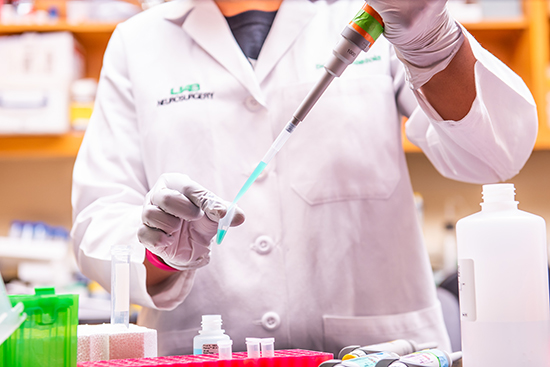 Research is foundational to UAB’s mission. UAB secures more research funding every year than all other universities in Alabama combined, bringing high-impact innovations, jobs, and tremendous economic benefit to Birmingham, Alabama, and beyond. For FY22, UAB ranks among the top 5 percent of U.S. universities based on all federal research and development expenditures and in the top 1 percent of all public, private, and international organizations funded by the National Institutes of Health (NIH).
UAB is among the youngest universities in the United States to be ranked as a Tier 1 research university. From its start, UAB has embodied a spirit of discovery that advances knowledge, solves real-world problems, and drives economic development. The collective strength of UAB’s research enterprise generated more than $715 million in total research grants and extramural awards, up $67.8 million from the previous year. This represents a 10.5 percent increase for the year and a nearly 50 percent increase — an additional $237 million — over the past five years. Research at UAB spans the spectrum and mingles disciplines to investigate, reveal, and apply the knowledge that changes individuals’ lives and communities’ fates.
UAB’s research operations are an essential driver of the university’s total economic impact. In FY22, UAB directly spent more than $231.2 million on research activity in academic and clinical environments. Research at UAB generates local and statewide impacts through the spending of UAB and the employment of research faculty, staff, and students.13 UAB’s research expenditures — an indicator of activity and growth — and indirect and induced economic activity resulting from those expenditures totaled nearly $429.6 million during FY22. UAB’s spending of research dollars represents only the tip of the iceberg as a growing ecosystem of companies in the biomedical, advanced manufacturing, information technology, and bioscience industries generates millions in additional economic impact annually throughout the state because of UAB. While beyond the scope of this study, research commercialization, spin-off companies from research conducted at UAB, and companies attracted to Alabama to partner with UAB generate billions in additional economic impact not included in the $12.1 billion annual impact.
Generating Economic Activity
In FY22, the direct spending of UAB Research, in combination with the indirect and induced impacts of dollars being re-spent throughout the economy, generated $429.6 million in overall economic impact to Alabama ($231.2 million in direct impact and $198.4 million in indirect and induced impact).
Providing and Supportng Jobs
In FY22, UAB Research directly employed 4,312 researchers (full-time or part-time positions). This direct employment generates additional spending throughout the region that in turn supports additional indirect and induced jobs created when UAB Research, its employees, and visitors spend in the region and state. In total, UAB Research supports 5,494 jobs throughout Alabama.
Generating State and Local Government Revenue
State and local government revenues attributable to UAB Research’s presence totaled approximately $10.2 million in FY22.
Commercializing Research
Research and innovation provide benefits beyond the economic and employment impacts generated by UAB operations. Not included in this economic impact of UAB Research is the impact of commercialization activities such as patents, licensing, and spin-off companies. Significant additional economic expansion and employment are created through the commercialization of research activities within Alabama executed by the university and its collaborating partners.
In October 2013, UAB streamlined many of its commercialization operations and procedures, including the UAB Research Foundation (“UABRF”) and the UAB Institute of Innovation and Entrepreneurship, and in 2015, their joint operations were rebranded as the Bill L. Harbert Institute for Innovation and Entrepreneurship (“HIIE”). While the UABRF remains the assignee of all intellectual property developed at UAB and is the legal entity for all licenses and other transactions, the HIIE was created to foster an entrepreneurial community and innovative ecosystem. The HIIE not only has integrated the more traditional technology transfer activities of the UABRF but also functions as a resource center for UAB as it continues to advance its role in innovation, entrepreneurship, and economic development.
The HIIE serves as a nexus for UAB innovation and includes the engagement of faculty and students in creating new and experiential learning opportunities across disciplines in business and entrepreneurship. The HIIE can facilitate the rapid development of innovative ideas, products, and technologies and better prepare faculty, students, and researchers to be leaders and entrepreneurs in an increasingly technology-driven ecosystem.
UAB’s partnership with the Bill L. Harbert Institute for Innovation and Entrepreneurship provides valuable opportunities for entrepreneurs across the UAB ecosystem to commercialize inventions, learn the legal and intellectual property aspects of entrepreneurship, and secure support for their entrepreneurial projects. UAB’s partnership with the Birmingham Entrepreneurial Center has produced the most extensive high-tech business incubator in the Southeast — Innovation Depot, home to 138 client companies with a sales impact of $1.7 billion during the past five years and approximately 2,623 people working at the facility.
Standout Numbers for 2022:
$5.6 million in revenue generated
8th straight year of profitability
8 U.S. patents issued
4 startups launched
53 innovative fellows
108 intellectual property disclosures
7 UAB startups received grants from Alabama Innovation Corporation15
39 licenses executed
417 inventors engaged
UAB Collat School of Business’ entrepreneurship program has earned the top award in a national competition of entrepreneurship programs. The United States Association for Small Business and Entrepreneurship (USASBE) honored UAB’s program with the prestigious 2022 Model Emerging Program Award at the association’s annual conference in January 2022. USASBE is the country’s premier professional organization for entrepreneurship educators and has been promoting entrepreneurship education worldwide for 40 years.