
How do you plan to pay for college? It's something everyone has to think about, no matter your background or situation. Guidance on financing your education is available on the UAB Graduate School website.
Detailed tuition and fees information can be found on the UAB Students page.
Teaching Assistantships and Fellowships
You may be considered for one of a limited number of adjunct teaching positions once you have completed 18 hours of graduate work. The availability of these positions is based solely on the needs of the department. Contact the graduate program director for further information.

Have a question you don't see answered here? Ask us!
-
What is the nature of the program?
It is primarily intended for professionals in the field, though traditional students are welcome. We anticipate that many students will already have a job in the communication industry. You will take courses that provide you with a theoretical, conceptual, and methodological background. We then ask you to apply the program to your own context, either toward a position you currently have or one that you desire. There is a thesis option (academic, Plan I) and a non-thesis project option (professional, Plan II). In Plan I, you write a substantial paper about how this program applies to the position that you are seeking or how it can improve your work in your current position. In Plan II you will complete a project that demonstrates to your advisor that you are capable of conducting Master’s level work.
-
I work 9 - 5; will I be able to take the courses?
Yes. The courses are offered primarily at night and on weekends.
-
How long will it take?
We anticipate that most students will take two calendar years since most will be unable to take three courses per term.
-
Is there financial aid?
Only through regular university channels. There are graduate teaching assistantships. After you have successfully completed 18 graduate hours, you are able to apply for a part-time position teaching in the department. For more information, contact the graduate director.
-
Do I have to take the GRE?
In most cases no. You do not need to take any standardized test for admission to our graduate program. You must take the test if you are interested in applying for one of our GTA positions.
-
Are there required general courses?
No. You do not have to retake any math, science, English, or other courses of that type. All of the courses in the graduate program are communication courses, although you may be able to take some courses outside the department with the permission of your advisor and the graduate director.
-
Can I take the courses online?
At present, the answer is no. That may change. We would recommend that you attend class for the first four courses, and by that time we will have more information about alternative learning methods.
-
Do I need an undergraduate degree in Communication to be admitted?
No, but you must have a communication-related background. Degrees in sociology, psychology, and the like are quite similar. An undergraduate minor is another alternative. Obviously, if your undergraduate degree is in physics, you might have to take some communication undergraduate courses first.
-
How many people will be in a class?
Most courses will have 12-15. However, a few classes may have up to 30.
-
How is this different from an undergraduate degree?
It takes less time to complete and is much more abstract. We will not teach how to write a newspaper article, to organize a public relations event, or how to work a camera. We expect that if you need to know those things, you already do. This degree is about the decision-making and thinking processes that take place in higher levels of communication corporations or communication departments of companies.
-
Will I have to take a foreign language?
No.
-
Will I have to take a math course?
No, but you may have to take a methods course that includes a significant amount of information about statistics.
-
What course should I take first?
CM 601: Foundations of Communications Management is a good place to start. It will outline for you the academic and professional elements of the discipline as well as give you an overview of the other courses. Your advisor will help you choose your first classes.
-
What is the deadline for application?
This will change from semester to semester, but the UAB Graduate School recommends that your entire application package be complete at least six weeks before the beginning of the semester. Usually, the most time-consuming part of the application process is getting your GRE scores to the school. This requires that you sign up for the test, take the test, and have your test scores forwarded to UAB. This process can take months.
-
Can I start the program without being admitted?
Yes, you may enroll as a non-degree seeking student. There are little paperwork and a minimal application fee. In most cases, you can register for classes on the same day you apply. Once your application is complete and you are approved for the program, all hours taken as a non-degree student will count towards your degree.
You must be aware, however, that non-degree seeking students are limited to 12 hours of study. UAB will not allow you to register for the graduate class after you have completed 12 hours.
Starting as a non-degree seeking student does not in anyway obligate the department to accept you as a degree-seeking student once your application is complete. If your grades, test scores, or letter of reference are substandard you will not be admitted to the program. The fact that you already have taken classes is irrelevant.
-
What are the requirements for admission?
We require a minimum undergraduate GPA of 3.0 and a strong letter of reference. It is usually a good idea to get at least one or two letters from someone familiar with your academic performance (i.e. professors).
-
I don't quite meet the requirements for application; can I still get into the program?
Yes, if your scores or GPA are close, then you can be admitted on academic probation.
-
What kind of grades do I need to graduate?
Generally, graduate students are expected to make As and Bs. A grade of C in graduate school is comparable to an undergraduate F.
-
When I finish this degree, can I go somewhere else for my PhD?
Probably. It will depend on your record in this program and recommendations from your professors.
-
How do I apply?
All graduate applications are handled through the UAB Graduate School. Do not send your materials to us here in the department. Once your package is complete the Graduate School will forward a copy to us for evaluation. The Graduate School is responsible for notifying you once a decision is reached regarding your application.
-
I have more questions I would like answered. Who do I talk to?
You should contact the Department’s Graduate Director. The current director is Dr. Amsbary; you can reach him at
This email address is being protected from spambots. You need JavaScript enabled to view it. .
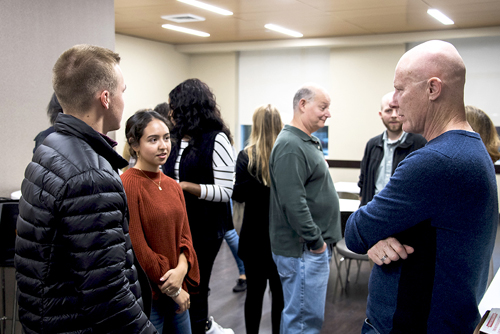 A graduate degree is granted in recognition of high attainment in a particular field of study, rather than in simple recognition of a certain number of courses taken or years in residence. It, therefore, requires independence of spirit and accomplishment — and it also depends upon close collaboration between student and teacher.
As soon as you arrive on campus you should schedule a conference with the Graduate Director, who will help you learn about your new environment and help plan a preliminary program of study. Within the first few weeks of the semester, you will be assigned a temporary faculty advisor, who will be a principal source of information about the Department and the University.
During your first year, you will have ample opportunity to become acquainted with the faculty and learn of their particular interests and abilities. By the end of the year, you should select an academic advisor from among the graduate faculty. It is your responsibility to determine which faculty member will be the best match for your educational goals. Keep in mind that many factors, particularly the number of advisees he or she already may have, may make it impossible for a given faculty member to accept this role.
While your advisor will assist you in achieving your academic goals, it is your ultimate responsibility to make sure that you are in compliance with all University and Departmental policies.
Advisor Responsibilities
- To help you devise a program of study and complete the Program of Study worksheet with the Graduate Advisor's approval.
- To assist you in forming an advisory committee to help develop a final project (either Plan I or II). It is your responsibility to obtain the consent of the faculty members who will serve on the committee. The committee must be formed before you take your comprehensive Qualifying Exam. All committee members must have an appointment with the UAB Graduate Faculty. The Graduate Director and Department Chair will be de facto members of all committees.
- Plan I: the committee will include your academic advisor, one other member from inside the department, and one UAB faculty member outside the Department of Communication Studies.
- Plan II: the committee must consist of at least three faculty members, including your academic advisor and two other faculty members from the department.
- To prepare and administer, with the help of the advisory committee, a comprehensive examination. Members of the committee from the department will submit exam questions. The outside member may submit questions but is not required to do so. This examination will be read and evaluated by the committee.
- To assist (in consultation with the advisory committee) in developing your Plan II final project or Plan I thesis, and chair the final defense.
- To keep the department, the Graduate Director, and the Graduate School informed about your progress.
Upon mutual consent, a student may change advisors or members of the committee. The Graduate Director should be notified if the committee membership changes for any reason. No record of the reason for change will be created.
The Department of Communication has funding available for academic scholarships and awards for each academic year.
-
James McCroskey
Eligibility: Any Communication Studies student. Preference will be given to graduate students.
Amount: Variable depending on available funds and number of applicants. -
William Self
Eligibility: Any Communication Studies student. Preference will be given to graduate students.
Amount: Variable depending on available funds and number of applicants.
How to Apply
You can apply for these scholarships through the UAB BSMART system.
Other Scholarships
The university and UAB's College of Arts and Sciences offer many other scholarships to incoming and current students. You can explore these options and apply through the UAB BSMART scholarship system.