
-
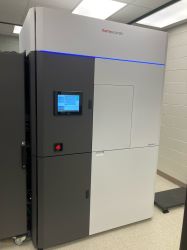
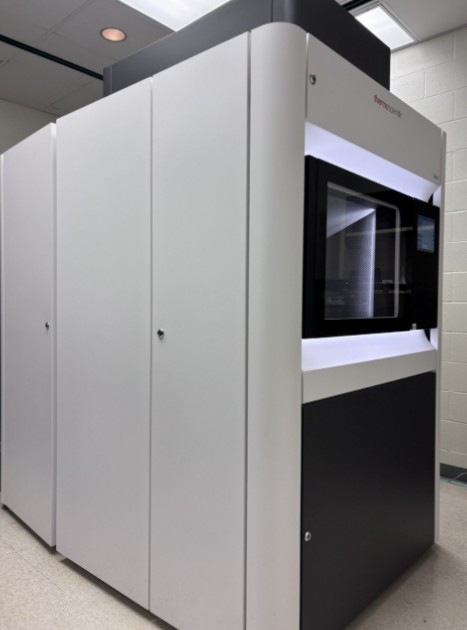
Thermo Scientific Glacios 2
Overview:
The Glacios 2 cryo-TEM is optimized for high-throughput screening, single-particle data collection, and cryo-electron tomography (cryoET) of cryogenic samples.
Features:
- Falcon 4i direct electron detector
- Ceta 16M CMOS camera
- SmartEPU with Quality Monitor, Multigrid, and
- Tomography 5
- 12-sample Autoloader
- Aberration-free image shift (AFIS)
- Fringe-free imaging (FFI)
- Accelerating voltage: 200kV
- Spherical aberration (Cs): 2.7mm
Normal Magnification Pixel Size (Å/pix) Benchmark Resolution (Å)+ 73,000x 1.92 92,000x 1.53 120,000x 1.166** 2.64 150,000x 0.94 190,000x 0.7159** 2.10 * 190,000 x magnification maximizes the field of view relative to the area exposed with the electron beam, covering the greatest area on the sample grid in the shortest time possible.
** Pixel sizes calibrated by comparison of a benchmark apoferritin reconstruction to a high-resolution x-ray crystal structure. Other pixel sizes are measured using a standard cross-grating replica grid.
+ Single-particle reconstruction of equine spleen apoferritin (Sigma Aldritch).
-
Thermo Scientific Talos F200C
Overview:
The Talos F200C is suited for room-temperature imaging of negatively stained samples; screening, single-particle data collection, or cryo-electron tomography (cryoET) of cryogenic samples; and microcrystal electron diffraction (microED).
Features:
- Apollo direct electron detector
- Ceta-F CEMOS camera
- EPU
- Tomography 5
- SerialEM
- Accelerating voltage: 200kV
- Spherical aberration (Cs): 2.7mm
Normal Magnification Ceta-F pixel size (Å/pix)* Apollo pixel size (Å/pix)* 13,500 2.284 17,500 1.808 22,000 6.7 1.415 28,000 5.2 1.116 36,000 4.1 0.8932 45,000 3.3 0.7038 57,000 2.6 0.5594 73,000 2.0 0.4394 92,000 1.6 0.349 120,000 1.3 150,000 0.99 190,000 0.77 * Pixel sizes are physical resolution (4k x 4k) for the Ceta-F and super-resolution (8k x 8k) for the Apollo by default.
-
Plunge-Freezing Systems
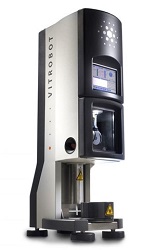 Overview:
The Vitrobot automates the process of blotting and plunge-freezing samples for cryo-TEM imaging to improve consistency and reproducibility. Typical specimens include proteins, viruses, vesicles, bacteria, and cells.
Features:
- Humidity and temperature control
- Double-sided blotting
Gatan Cryoplunge
Features:
- Single- or double-sided blotting
-
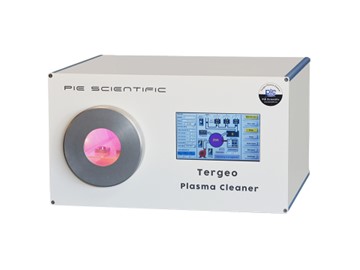
PIE Scientific Tergeo EM Plasma Cleaner
Features:
- 20 customizable template recipes
- Inlets for three process gases
- Water vapor attachment for steady supply of hydrophilic functional groups
- Remote plasma generation for gentler cleaning/modification of TEM grids
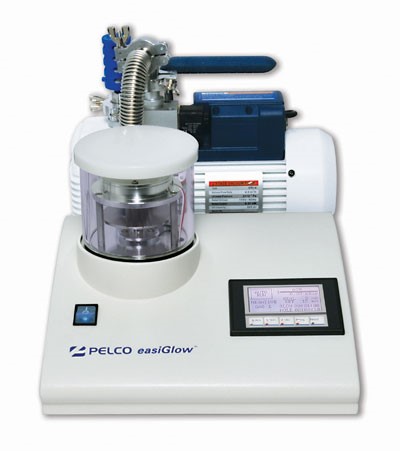
- Pelco EasiGlow Glow Discharge System
-
Side-Entry Cryogenic Sample Holders
Gatan Model 626
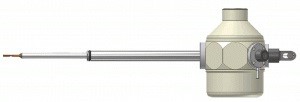 Features:
- ~4hr liquid nitrogen holding time
- ≥3.4Å resolution
Gatan “Elsa” Model 698
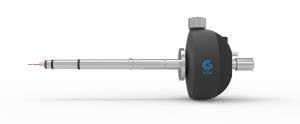 Features:
- Ultra-low profile for high tilt angles
- ~8hr liquid nitrogen holding time
- ≥2.3Å resolution
Simple Origin Model 201
 Features:
- Dual grid holder: one standard TEM grid and one Autogrid
- ~810hr liquid nitrogen holding time
- ≥2.4Å resolution
-
Computer Hardware
GPU server (Jupiter)
Overview:
Jupiter is a multi-GPU computing server acting as the main cryoSPARC worker node used for on-the-fly data processing, which matches the pace of data collection on the Glacios 2.
Features:
- 4 x NVIDIA GeForce RTX 4060 Ti 16GB GPUs
- 32-core 64-thread AMD EPYC 7543P Milan CPU
- 256 GB SuperMicro DDR4 RAM
GPU workstation (Saturn)
Overview:
Saturn utilizes a single cutting-edge GPU for tilt-series processing and tomographic reconstructions as well as single-particle data processing.
Features:
- NVIDIA RTX PRO 6000 Blackwell Max-Q Workstation Edition 96GB GPU
- 32-core 64-thread AMD Ryzen Threadripper Pro 9975WX CPU
- 256 GB Kingston DDR5-6400 MHz ECC Reg. RAM
Our rates are established per unit for supplies and per hour for usage of instruments and labor provided by the CEMF. External academic and commercial users are charged an additional 50% and 200% of the internal rates given below, respectively. Time and materials used are recorded in the Facility Billing System (FBS), which generates itemized invoices reflecting the actual costs incurred during use of the facility. Internal UAB users are charged directly and automatically after allowing at least five business days for review of invoices. External users may pay via check or bank transfer.
Services are provided and billed by the CEMF in accordance with NIH policy (NOT-OD-13-053). Notably:
- “All billing and cost recovery must be based on services provided (i.e., after service has been provided and expense has been incurred). Billing in advance of the work or receipt of pre-payment is not allowable.”
- “Rates are charged to internal institutional users on a consistent basis, regardless of funding source(s) consistent with the concept of ‘one service, one rate’”
Any charges for usage of the CEMF are corrected to exclude time or materials lost because of personnel error or instrument failure. Otherwise, we cannot retroactively reduce or discount our rates due to undesirable outcomes. We make every effort to set realistic expectations, act transparently, and provide cost effective services. Upon request, we can recommend project-specific strategies in consideration of funding constraints.
Example usage scenarios:
-
Negative stain sample screening
Negative staining and room temperature imaging (NSEM) of two samples on the Talos to assess suitability for cryo-EM. NSEM is optional but encouraged for protein samples. Vesicles can be readily identified, though staining and drying will distort their sizes and shapes.
Service or Material Rate Quantity Subtotal Talos F200C microscope usage (hourly) $ 45.00 1.5 $ 67.50 Specialist assistance (hourly) $ 60.00 2 $120.00 Continuous film sample grids (each) $ 6.00 4 $ 24.00 $ 211.50 For protein samples, NSEM single-particle data collection and processing can be a cost-effective approach to understanding “low resolution” information about the specimen such as multimeric complex formation, structural variability/flexibility, or the overall shape of the protein.
-
Cryo-EM sample freezing
Plunge-freezing of four grids per sample for cryo-EM screening, data collection, or shipment to an external facility. Four grids per sample allow for some testing of freezing conditions as well as replicates in case any single grid becomes unusable. For biochemically validated specimens conforming to recommended sample conditions, this is typically sufficient for imaging and/or preliminary data collection. For challenging specimens, repetition and optimization of both the sample and freezing conditions will be necessary.
Service or Material Rate Quantity Subtotal Vitrobot Mark IV usage (hourly) $ 50.00 0.75 $ 37.50 Specialist assistance (hourly) $ 60.00 1.5 $ 90.00 Holey film sample grids (each) $ 12.00 8 $96.00 Total: $ 223.50 Overall total: $ 435.00 -
Cryo-EM sample screening or manual imaging
Screening of eight cryo-EM sample grids including identifying ideal conditions and manually imaging. When a selection of publication-quality images is the final objective, manual imaging is typically more extensive and the final step of the cryo-EM workflow.
Service or Material Rate Quantity Subtotal Glacios 2 microscope usage (hourly) $ 60.00 4 $ 240.00 Specialist assistance (hourly) $ 60.00 3.5 $ 210.00 Autogrid clip rings (each) $ 15.00 8 $ 120.00 Total: $ 450.00 Grand total: $ 885.00 -
Cryo-EM data collection
Extended semi-automated imaging of one or more grids for the purpose of single-particle or tomographic reconstruction. These cases are separated because configuration of overnight tilt-series collection will tend to involve significantly more manual review of targeted areas than single-particle data collection.
Single-Particle Data Collection
Service Rate Quantity Subtotal Glacios 2 microscope usage (hourly, capped to 8hrs/day) $ 60.00 20 $ 240.00 Specialist assistance (hourly) $ 60.00 2 $ 120.00 Total: $ 360.00 Grand total: $ 1,245.00
Tilt-Series Data Collection
Service Rate Quantity Subtotal Glacios 2 microscope usage (hourly, capped to 8hrs/day) $ 60.00 20 $ 240.00 Specialist assistance (hourly) $ 60.00 4.5 $ 360.00 Total: $ 480.00 Grand total: $ 1,485.00
-
Complete schedule of UAB internal user fees*
Service Rate Glacios 2 microscope usage (hourly, capped to 8hrs/day) $ 60.00 Talos F200C microscope usage (hourly, capped to 8hrs/day) $ 45.00 Specialist assistance (hourly) $ 60.00 Vitrobot Mark IV usage (hourly) $ 50.00 Individual user training (daily) $ 500.00 Small group (2-3) user training (daily per person) $ 350.00
Material Rate Autogrid clip rings (each) $ 15.00 UltrAuFoil gold sample grids (each) $ 20.00 Holey film sample grids (each) $ 12.00 Continuous film sample grids (each) $ 6.00 VitroEase buffer kit (uL of stock used) $ 1.00
Note: External academic and commercial users are charged an additional 50% and 200%, respectively.