University of Alabama at Birmingham (UAB) researchers are studying Streptococcus pneumoniae, a bacterium that can cause serious infections, including pneumonia and meningitis, to better understand how it survives and causes disease.
Moon Nahm, M.D., Endowed Professor of Emeritus in the Department of Medicine at UAB and founder of UAB startup SunFire Biotechnologies, has studied pneumococcal infections and vaccines for decades. His current research focuses on the sugar coating, or capsule, that encloses the pneumococcal bacterium. 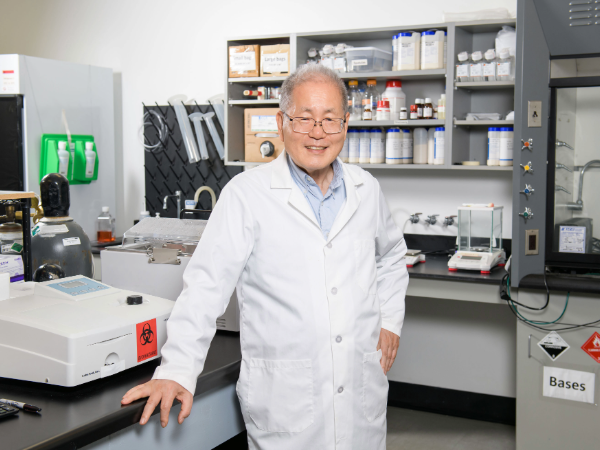 Moon Nahm in his lab at SunFire Biotechnologies.
Nahm compares the capsule to the coating on an M&M. The coating helps protect the bacterium from its environment and the human immune system, allowing it to survive and cause disease. Pneumococci without the capsule do not cause diseases, and the human immune system is generally effective against one type of capsule. But, just as M&Ms come in different colors, the pneumococcus can produce various capsule types and evade the human immune system, Nahm said.
His team is studying the molecules that connect individual sugar molecules together to form the capsule. Understanding this process could eventually help researchers find ways to disrupt the capsule synthesis and make the bacterium more vulnerable to the immune system or medical treatments.
“In the last year or so, we have been working on some molecules that link together these sugar molecules to make a long sugar chain,” Nahm said. “Hopefully, in the future, we can disrupt those links so that the bacteria cannot produce the sugar coat that protects them.”
As National Immunization Awareness Month in August highlights the importance of vaccination and infection prevention, Nahm said continued research is essential to developing new tools to fight infectious diseases.
“Research doesn’t progress quickly. It takes decades,” Nahm said.
He emphasized that research is only one part of preventing infection and that people should continue using established tools, including vaccines and appropriate medications when necessary.
Nahm’s ongoing work seeks to build a deeper understanding of pneumococcus and its protective mechanisms, potentially opening new avenues for future approaches to preventing and treating infections.
For more information about his research,
-- Aug. 28, 2026