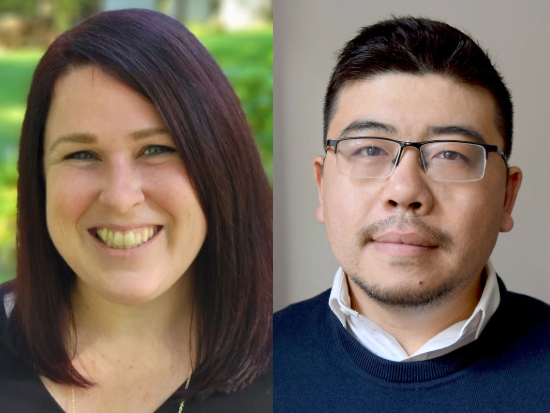
 Kirstie Cummings, Ph.D., and HaoSheng Sun, Ph.D., have been selected for the 2026-2027 FCIDD McNulty Civitan Scientist Award.
Given on behalf of the FCIDD McNulty Civitan Scientist Committee and the Civitan International Research Center, the award provides $75,000 per year for three years to fund interdisciplinary clinical or fundamental science research aimed at enhancing our understanding of typical and atypical brain development, including autism spectrum disorders, intellectual disabilities, neurodevelopmental disabilities and malformations, impaired cognitive development, and the effects of environmental toxins on brain development.
Cummings and Sun’s collaborative study will combine state-of-the-art transcriptomics, anatomical circuit tracing, and functional assessments of connectivity and plasticity to uncover how the brain wires itself for emotional memory in the weeks and years after birth — and what happens when that wiring goes wrong.
Wiring the brain's threat detector
The prefrontal cortex and basolateral amygdala are two brain regions essential to forming and storing emotional memories. Together, they help the brain judge what's safe, what's threatening, and what's worth remembering. But exactly how the connections between them are established after birth, and how disruptions to that process contribute to neurodevelopmental disorders, has remained largely unmapped.
Cummings, an assistant professor in the Department of Neurobiology, studies these circuits at the level of anatomy and function. Sun, an assistant professor in the Department of Cell, Developmental, and Integrative Biology, studies the molecular machinery that times development itself.
“Our study will reveal how synaptic connections between prefrontal cortex and basolateral amygdala, two brain regions that are indispensable for the formation and storage of emotional memories, are established in the postnatal brain,” Cummings said.
“In this way, we can gain a multifaceted view of how these emotional memory circuits, which are disrupted in several neurodevelopmental disorders, are established during typical neurodevelopment.”
Dialing in development
Sun's path to this collaboration started with a small but powerful class of molecules: microRNAs. Unlike genes that switch fully on or off, microRNAs fine-tune gene expression, making them well-suited to guide the kind of gradual, staged changes that unfold as tissues and organs mature after birth.
“My interest in microRNAs (miRNAs) really took shape when I realized how much of postnatal development depends on precise, dynamic gene regulation, and how little we understood about the mechanisms controlling that timing,” Sun said.
“During my postdoctoral work, I became fascinated by the fact that microRNAs can fine-tune gene expression without switching genes fully on or off, which makes them uniquely suited to the kind of gradual, staged changes we see as tissues and organs mature after birth.”
Sun's lab identified several microRNAs in worms, or C. elegans, that control how neurons mature across their lifespan. Manipulate those microRNAs, and adult worms start behaving like younger ones — or vice versa.
“These miRNAs are extremely well conserved from worms to mice to humans, but their role in neuronal maturation in mammals is not well understood, hence our collaborative project proposal,” Sun said.
“Understanding neuronal maturation could have important clinical implications, as neural disorders have peak onset at very specific periods during postnatal development — childhood for neurodevelopmental disorders, adolescence for psychiatric disorders, etc.”
Why the brain takes its time
Cummings and Sun are drawn to the same underlying puzzle from different directions: what makes the prefrontal cortex take so long to develop, and why does that long developmental window leave it so vulnerable?
“Prefrontal cortex is what makes humans human, and this region exhibits one of the most protracted developmental trajectories of all brain regions, yet we know little about the mechanisms underlying its postnatal development, despite dysfunction of these processes in several neurodevelopmental disorders,” Cummings said.
“We are joining forces with Dr. Sun, who is an expert in the molecular regulation of neurodevelopment, and harnessing our lab's tools in circuit neuroscience to tackle big, unknown questions about brain development and how these processes may go awry in neurodevelopmental disorders.”
Sun sees the same clinical stakes, but from a different vantage point. Where Cummings looks at circuits, Sun’s focus is on molecules.
“I think microRNA biology sits at this really compelling intersection of basic developmental science and translational medicine,” Sun said.
“Understanding how microRNAs orchestrate the neuronal maturation process could eventually help us identify new therapeutic targets for neurodevelopmental and psychiatric disorders or even develop diagnostic markers for these disorders.”
Cummings and Sun credit UAB's research infrastructure with making their partnership possible, from the shared imaging and sequencing cores that let their two labs work side by side, to a culture that actively encourages neuroscientists and molecular biologists to cross paths and combine expertise.
“UAB has a number of valuable resources from which we have benefitted and which drives our collaborative work forward,” Cummings said.
From circuits and molecules to anatomy and timing, Cummings and Sun are betting that the answer to how the brain wires itself lies where their two fields meet. Over the next three years, their work could reshape how scientists understand not just typical brain development but also the earliest roots of disorders that emerge when it goes off course.