This is the second in a three-part series outlining the 50-plus-year history of the UAB Department of Neurology. Read part 1 here.
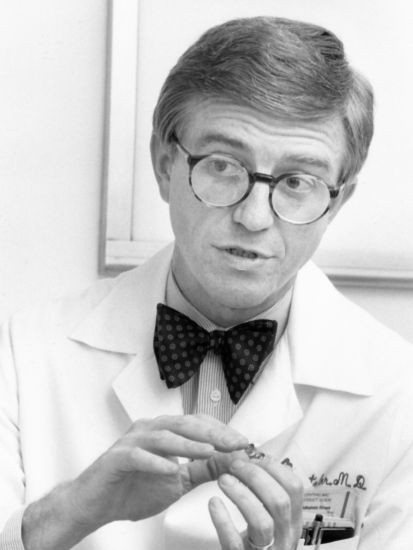 John Whitaker, M.D.When the Department of Neurology became an independent department in the mid-1970s, it was still a relatively small operation. The foundation had been laid by a handful of neurologists committed to patient care and the growth of a young specialty.
The decades that followed would transform that foundation into one of the nation's largest and most respected academic neurology programs, defined by visionary leadership, pioneering clinical and research programs, and a commitment to training the next generation of neurologists.
Building an academic department
By the time John Whitaker, M.D., arrived as chair in 1985, the department was poised for a new era. For many in the department, Whitaker's arrival marked a turning point.
Paul Atchison, M.D., is a clinical associate professor in the Department of Neurology who joined the faculty in 1992. Atchison completed medical school at UAB in 1986, followed by a neurology residency. Atchison remembers that his first neurology rotation as a medical student coincided with Whitaker's first month as chair.
“One reason I did my neurology residency here was that the month I took neurology, starting my senior year of medical school, happened to be the very first month that Dr. Whitaker was chairman,” Atchison recalled.
Whitaker quickly established a culture grounded in education, clinical excellence, and academic rigor. Morning reports became a cornerstone of training, bringing residents and faculty together to review cases and discuss clinical reasoning.
“I was very impressed with him,” he continued. “He set up a very good educational system with our morning report. It was generally with him, and it was 30 minutes long, and it was a good way to start the day and talk about the patients that had come in the last 24 hours.”
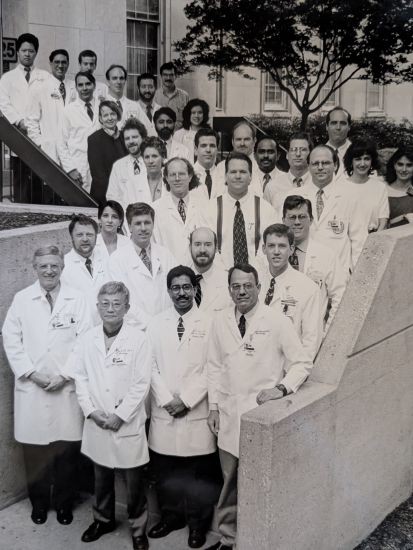 UAB Neurology faculty in April 1997Dan Marson, J.D., Ph.D., is an emeritus professor in the Department of Neurology who joined the faculty in 1990 when the department was housed in Jefferson Towers.
“He was an exceptional neurologist, researcher, and administrator,” Marson said. “He was really one of the most distinctive men I've ever had the privilege to work with. He was fair, objective, tough. He was a tough administrator, but he led by example.”
Whitaker's vision extended beyond clinical care. According to Atchison, he was deliberate about recruiting faculty who could help grow the department through grant funding.
"He was trying to grow the faculty in a careful way, trying to find people who had true interest in academic medicine and research," Atchison said.
Marson recalls that when he arrived in 1990, there were only about 10 faculty members.
“We gathered for the department holiday and resident graduation parties every year that were held either at Dr. Whitaker's house or at Dr. Shin Oh's house,” Marson reflected.
Shirley Gibbs, clinical program director II who joined the department in 1999, remembers the department's size at that time as significantly different from what it is today.
“I remember knowing everyone in the department, which was much smaller when I started,” Gibbs said.
Education takes center stage
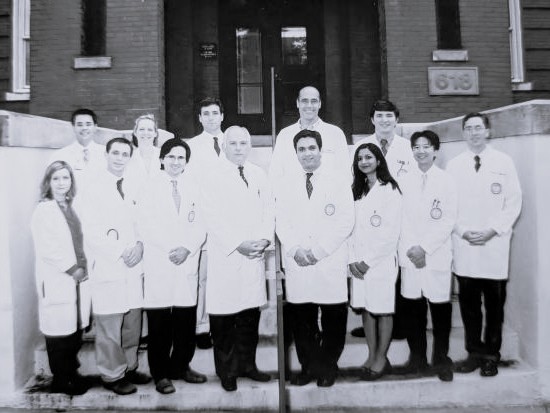 UAB Neurology residents in 2005One of the most significant milestones of the Whitaker era came in 1993, when neurology gained a formal place in the medical school curriculum.
"In 1993, Dr. Whitaker was able to secure a neurology clerkship for the junior medical students, which had never existed before in the history of the medical school," Atchison said.
The move elevated neurology's visibility among medical students and helped strengthen the department's educational mission.
At the same time, residency training continued to evolve. What had begun decades earlier as a small program training only a handful of residents each year steadily matured into a nationally recognized training environment.
Khurram Bashir, M.D., Distinguished Professor in the Department of Neurology and director of the residency program, started on the UAB faculty in 1997. According to Bashir, the first official record of the residency program dates to 1957, but records picked up again in the late 1970s, when the program hosted two residents per year.
James Halsey, M.D., the first chair of the department, was also the first director of the residency program, succeeded by Whitaker and faculty members including Atchison, Alison O’Neill, M.D., and Robert Slaughter, M.D.
“Alison got the residency to where we had four residents a year,” Bashir said. “So, from the late 1970s to mid-to-late ‘90s, we had four residents in a class.”
In 2007, Bashir recalls a turning point in his own career when then-chair Ray Watts, M.D., called to inform him that Slaughter was leaving the department.
“He said, ‘I know you didn't ask for it, but I am going to name you as the interim program director for one year. Are you interested?’ And I said, ‘No,’” Bashir recalled, adding that he eventually agreed to do it for one more year as Watts searched for another program director.
That one year turned into a career-defining decision.
“I've done it ever since then,” Bashir said.
In Bashir’s time as program director, the residency class gradually increased from four residents per year to now 11 residents per year. In addition, in Bashir’s tenure as program director, he has witnessed growth from the department offering three fellowships to now 11 fellowship and training programs.
“That's been, I think, wonderful for the institution, for the program, for everything,” Bashir said.
The department's educational reputation has expanded alongside its size. Applications have increased dramatically, and nearly half of the department's faculty are former trainees who chose to remain at UAB after completing residency or fellowship.
"We used to be a good regional program in the Southeast," Bashir said. "Now we are competing for residency applicants nationally with some of the top programs in the nation.”
The rise of specialized neurology
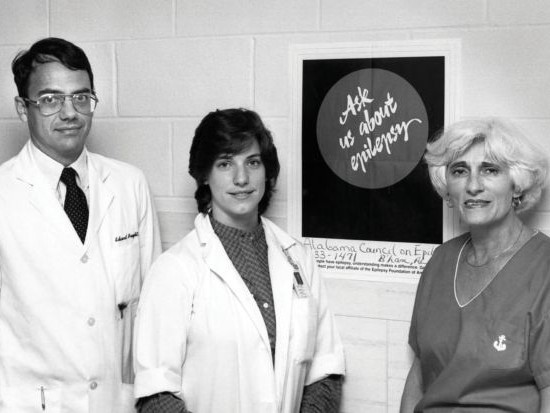 UAB Epilepsy team, including Edward Faught, M.D.As the department grew into a training hub for neurologists, it also evolved clinically as subspecialty programs emerged and expanded. While Whitaker brought expertise himself in neuroimmunology and multiple sclerosis, specialties including epilepsy, stroke, neuromuscular disease, neuro-oncology, memory disorders, and neuropsychology were being established and would eventually develop into nationally recognized programs.
Atchison remembers when he first started out as a faculty member that the epilepsy monitoring unit, for example, was just getting off the ground under the leadership of Edward Faught, M.D.
The multiple sclerosis program offers another example of growth. According to Bashir, the roots of the program trace back to Jim Halsey, M.D., who established an early multiple sclerosis clinic when treatment options remained limited. Later, Whitaker expanded those efforts into a formal Multiple Sclerosis Center and research program.
That work positioned UAB among the first institutions to participate in a landmark clinical trial in 1989 that helped redefine treatment for multiple sclerosis.
"UAB was one of the 11 centers that participated in the very first clinical trial of a new drug in MS," Bashir said. "That led to the development of the first drug to be approved for MS."
Other programs experienced similar growth. In neuropsychology, Marson recalled arriving in 1990 when the department consisted of roughly 10 faculty members.
“When I joined the faculty, there was not a division of neuropsychology,” Marson said.
Within a few years, an Alzheimer's Disease Center, neuropsychology fellowship, and independent neuropsychology division had been established.
"The critical factor for neuropsychology arising as an independent division was Dr. (Lindy) Harrell's Alzheimer's Disease Center and her related program project grants," Marson said.
Meanwhile, neuro-oncology experienced a similar trajectory. When Burt Nabors, M.D., Distinguished Professor and director of the Division of Neuro-Oncology, joined UAB in the mid-1990s, care for patients with brain tumors was already taking place, but the field was still relatively small and lacked much of the infrastructure that would later define the program.
A major turning point came through participation in the New Approaches to Brain Tumor Therapy consortium, a National Cancer Institute-funded network led by Johns Hopkins University that connected UAB with other leading academic centers conducting clinical trials for patients with primary and metastatic brain tumors.
“This allowed us access to clinical trials and our ability to offer patients with brain cancers novel and unique therapy greatly advanced,” Nabors said.
According to Nabors, the collaboration also helped elevate the program's academic profile and created opportunities for fellowship training, research growth, and faculty recruitment—trends that would continue department-wide under future leadership.
A defining moment
In August 2001, the department suffered a devastating loss when Whitaker died unexpectedly following a cycling accident.
For many faculty and staff, it remains one of the most memorable moments in department history.
"The surprising death of Dr. Whitaker really was a low point for the department and us all," Gibbs recalled.
"It was obviously a big event,” Nabors added. “I think everybody was very shocked."
Beyond personal grief, the loss raised an important question.
"What direction does the department go?" Gibbs said, recalling the reaction of faculty and staff at the time. "Who would be the next leader to grow the department in every area?"
The answer arrived in 2003 with the recruitment of Ray Watts, M.D., the next chair of the Department of Neurology.
Growth accelerates under Watts
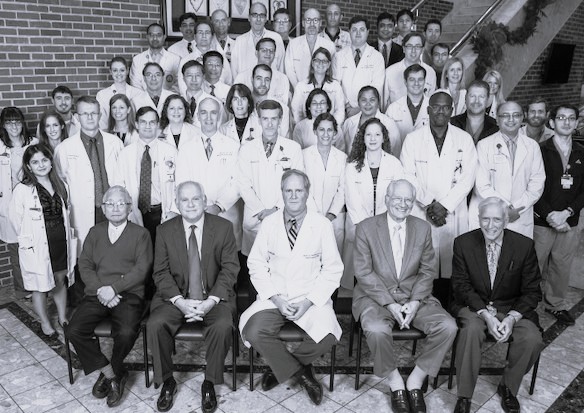 UAB Neurology faculty in 2013If Whitaker built the clinical and academic foundation, many faculty members view Watts’ leadership as the period when growth accelerated dramatically.
“As part of Dr. Watts’ recruitment, we made a significant number of changes at that time,” Bashir said.
Watts emphasized recruitment, infrastructure, philanthropy, and research expansion. One of his early initiatives involved bringing faculty and programs together into shared spaces, helping create a stronger departmental identity.
"We started having more research space," Bashir said. "We started to have more faculty. And that kept growing."
The department also began formalizing its organizational structure. Although subspecialty groups existed for years, they became Board of Trustees-recognized divisions during this period.
“And all the divisions have grown tremendously since then,” said Bashir, who was the inaugural division director of Neuroimmunology and Multiple Sclerosis. “When we became a division, I was the only faculty member in the division.”
Atchison spoke to Watts’ exceptional leadership during this period.
“I can't say enough good things about him because the thing about Dr. Watts is, you could tell he's got the big vision, and he's one of those people where you always felt comfortable with him,” Atchsion said.
Watts later became dean of the Heersink School of Medicine and then president of UAB, a testament to the “big vision” Atchison described. In 2011, departmental leadership passed to David Standaert, M.D., Ph.D., a professor in the Department of Neurology and vice chair for research at UAB, whose tenure brought another wave of growth – particularly in faculty and research.
“It probably began to make that transition with Dr. Watts, and became pretty intense with Dr. Standaert,” Nabors said. "I think Standaert's really the one who leapfrogged us as far as faculty growth and faculty attention to research," Nabors said.
Positioned for what's next
From its formal establishment as a department to the present day, the Department of Neurology’s story is one of significant growth across all mission areas while building a reputation of excellence in the process.
“The department has consistently benefitted from strong leadership, Marson said. “From Dr. Whitaker to Dr. Watts, to Dr. Standaert.”
As chair of the department for 16 years, Standaert played an active role in that expansion, bringing it to the globally recognized program that it is today.
“I'd have to say that's maybe been one of the keys to our phenomenal growth,” Atchison reflected. “It's the leadership.”
As the department approaches its next chapter, the foundation established through decades of innovation and collaboration positions it to tackle new challenges and opportunities in neurology.
And that raises the next question: what will the future look like? That story begins with the department as it stands today—and the vision for where it is headed next.
Stay tuned for part 3 of this three-part series outlining the 50-plus-year history of the UAB Department of Neurology.