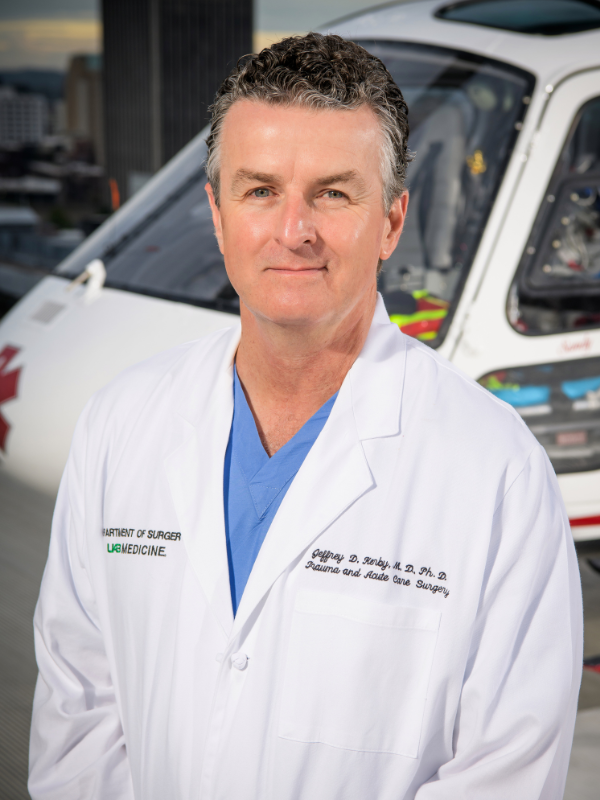
In 2022, Jeffrey D. Kerby, M.D., Ph.D., took on the role as chair of the American College of Surgeons (ACS) Committee on Trauma (COT), becoming only the 21st chair in the 100-year history of the COT.
Over his four-year tenure in the role, Kerby, the director of the UAB Division of Trauma and Acute Care Surgery, traveled to eight countries, traversed back and forth to Washington, D.C., and Chicago countless times, and made lasting positive change for the future of trauma care globally.
Kerby became involved with the COT in 2016, joining the central membership and eventually taking on leadership roles as Membership Committee chair and member of the Executive Committee prior to becoming chair of the COT. The COT is the preeminent organization focused on improving trauma care through its education, quality improvement, best-practice creation, advocacy, and injury prevention programs. Its vision is to “eliminate preventable death and disability across the globe” with it mission to develop programs leading to trauma outcomes across the continuum of care.
From the beginning of his tenure, Kerby realized both the responsibility and opportunity that came with being named chair of the COT.
“Being COT Chair a highly visible role within the trauma community,” Kerby said. “I looked at my role as utilizing the platform provided by the American College of Surgeons to affect positive change in trauma care.”
To tackle this lofty goal, he honed in on several areas that he was passionate about and where he believed he could advance the mission of the COT.
Rural trauma care: reaching patients where they are
For example, Kerby was laser-focused on working to create a national trauma system, in which every single injured American, no matter where they live or how close they are to a major trauma center, can get lifesaving critical care.
He realized the development of a rural trauma program could help get the country closer to a national system.
Trauma patients in rural communities face barriers to quality care in distance and time. Nationwide, nearly 60 million people live over an hour from a Level I or II trauma center. Time is precious for survival and good outcomes, and there is a need to “extend the window of survivability” so that patients injured in rural areas can arrive alive to definitive care.
“The main idea is to reduce disparities in outcomes between patients in rural versus urban environments,” Kerby said. “Where you live should not determine if you live after injury.”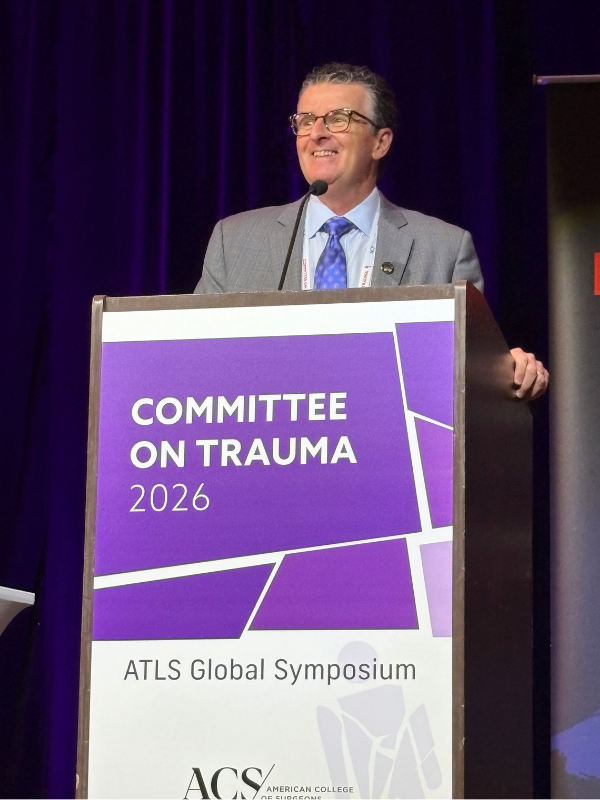
Kerby explains that the COT has a rigorous verification process and quality improvement program for Level I, II, and III trauma centers. (UAB has been continuously verified for 27 years.)
However, for centers that are small, rural, and resource-limited, there is no formal verification process, with limited data collection and quality improvement programs.
For the trauma system of a state to function well, all centers that provide trauma care must have standardized care and a way to continuously improve.
The COT’s ideas for a rural trauma program? To develop education programs for healthcare workers in lower resource areas; creating a quality program that could include verification and benchmarking, with standards that are rural-specific; and fostering a community of practice that links the individual hospitals together virtually by offering resources, networking, and case reviews.
Part of Kerby’s research for the rural trauma program came from travels to several countries Africa and South America, where he was able to learn how trauma care was delivered in different trauma care settings. His trips gave him a perspective on the struggles - and wins - in trauma care globally.
“If we're truly going to realize our vision to eliminate preventable death and disability from trauma across the globe, we've got a lot of work to do, not only internationally in those areas that desperately need trauma infrastructure,” Kerby said. “We also have to address it domestically in our rural environments, where resources are low, and access to trauma care is lacking.”
In February 2026, the American College of Surgeons Board of Regents approved funding for the Rural Trauma Program, and it is now beginning to be operationalized. Kerby says this is a “huge win” for improving trauma outcomes nationally.
An Alabama model inspires military preparedness
Another way to get the U.S. closer to a national trauma system? The creation of a network of Regional Medical Operations Coordinating Centers, or RMOCCs, that would be the unit of action for a National Trauma and Emergency Preparedness System (NTEPS) developed by the COT. Kerby’s military background as a combat trauma surgeon in the Air Force gives him a unique perspective on the need to establish a medical readiness platform that is continuously operational and can surge for major disasters and other incidents.
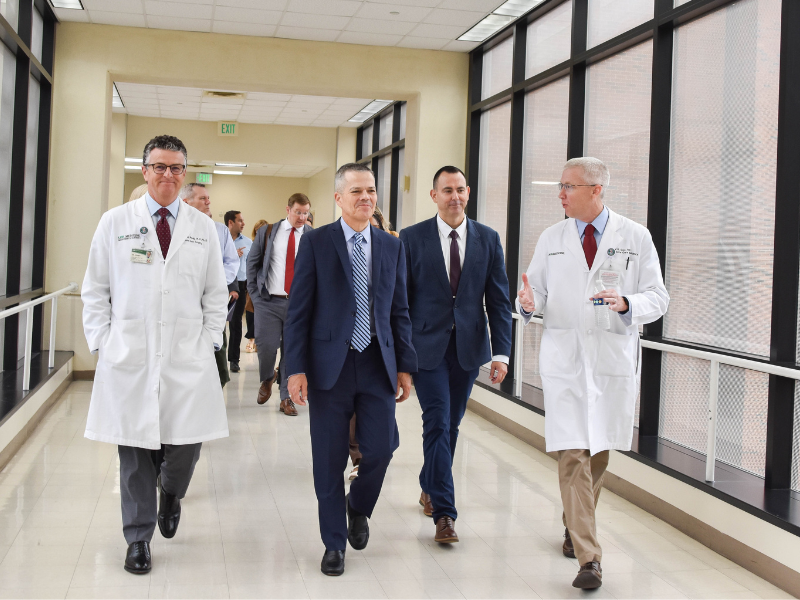 Dr. Jeffrey Kerby, left, during a visit from Lt. Gen. John. J. DeGoes, Surgeon General of the United States Air Force and U.S. Space Force. Learn more about the visit here.RMOCCs are local or regional organizations that manage the response to mass casualty events (whether that be a surge of wounded soldiers or a natural disaster) by providing coordination across multiple centers of care, much like air traffic control. This type of coordination can save more lives by integrating emergency management, public health, and acute medical care systems and level-loading patients across the system, rather than overwhelming a single center or causing major disruptions to the U.S. healthcare system.
Alabama has been a trailblazer in this type of approach: since 1996, the first-of-its-kind Trauma Communication Center has been coordinating trauma patient triage and care distribution. When an injured patient meets trauma system entry criteria, first responders in the field call the TCC who helps them determine where to take the patient based on injury severity. This ensures every patient, no matter how rural or close to a hospital they are, can get the appropriate level of care as soon as possible. This is particularly vital during a disaster or mass casualty incident.
The TCC, which initially began in the seven-county area around Birmingham that comprised the Birmingham Regional Emergency Medical Services System (BREMSS) proved its worth early, decreasing absolute mortality from trauma by 12% in the first years of operation. Its ability to respond to mass casualty events was tested in both 1998 and 2011, when tornados ripped across the state, injuring hundreds of people. The TCC operated as intended, level-loading patients across the health system based on their injuries and hospital capacity with extreme accuracy.
Since 2007, the TCC has been a statewide resource, and coordinates care for an average 16,000 trauma patients annually.
Kerby says what Alabama has done successfully through the TCC is as a model that should be expanded on a large scale for the entire country.
He and a group of co-authors published an overview of RMOCCs in September 2025 in the Journal of the American College of Surgeons making the case that RMOCCs “promote readiness for daily trauma care and mass casualty incidents.”
The COT worked with the National Institute for Defense Health Cooperation (NIDHC), which codified a plan included in the 2026 National Defense Authorization Act called the Joint Military Civilian Medical Surge Plan. The plan will establish functioning RMOCCs in 15 – 20 communities strategically located across the country with funding provided by the federal government.
Kerby says one of the things he’s most proud of from his time as chair is making sure the COT had a “seat at the table” to bring their NTEPS plan to the discussion.
“We’re starting to get the building blocks now of a national trauma system through that process,” Kerby said. “I’m very proud of the fact that we’ve been able to integrate ourselves into the discussion, and to see our NTEPS plan accepted and become an anchoring component of the approach.”
A “common language” for trauma care globally
During Kerby’s time as chair, an 11th edition of the Advanced Trauma Life Support course (ATLS) was developed, though he stresses the project was already underway when he started.
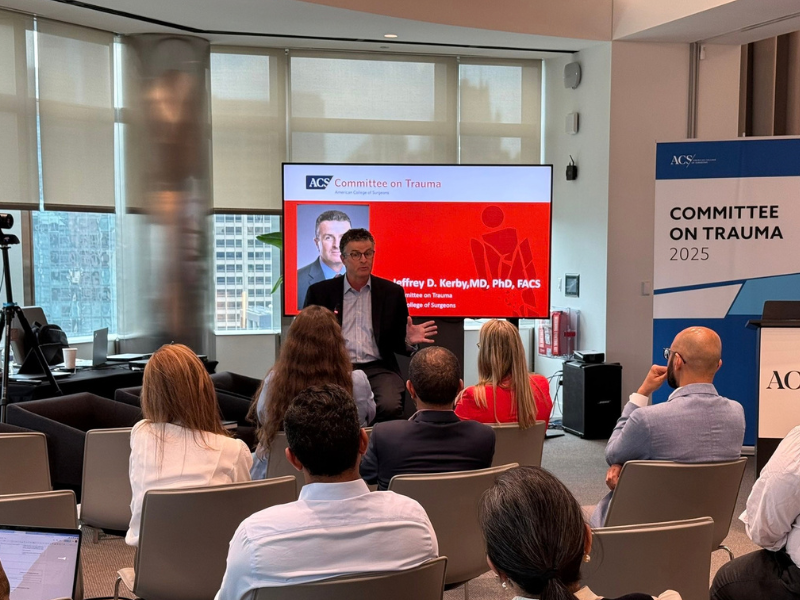 The ATLS course was developed in 1978 to standardize the initial treatment of traumatic injuries, whether it’s provided at a Level I trauma center like UAB, or a rural or resource-limited hospital, and whether it's provided by a trauma surgeon or a doctor who infrequently sees trauma cases.
Kerby says between 50,000 to 70,000 learners take ATLS courses annually, in at least eight different languages and in over 90 countries. At least half the courses are taught outside of North America. With its emphasis on a common “language” for trauma care, the COT calls it the “highest level of trauma care education for the global community.”
The newest edition reflects a “complete overhaul” of the educational content to bring it up to date with evidence-based practice. Surgeons from across the world volunteered for the project - over 200 surgeons from 20 different countries came together to work on the content.
“My job was to assist in setting the vision and the priorities, and help navigate a few issues to get it across the finish line,” Kerby said. “We had an incredible group of highly engaged surgeons, education specialists and instructional designers that came together to develop and incredible revision for ATLS that will carry forward the mission of trauma education for years to come.”
Encouraging frontline surgeons to highlight local needs and ideas
As chair, Kerby served as leader for the COT’s 100 central members and 17 regional committees consisting of nearly 500 members worldwide.
The COT was founded with a regional focus, with the 18 founding members in 1922 being selected from geographically diverse areas. The idea of the founding COT chair, Charles Scudder, was to use the regional membership not only to disseminate and operationalize the work of the committee, but to have emerging ideas and issues feed back to the central committee to inform future needs.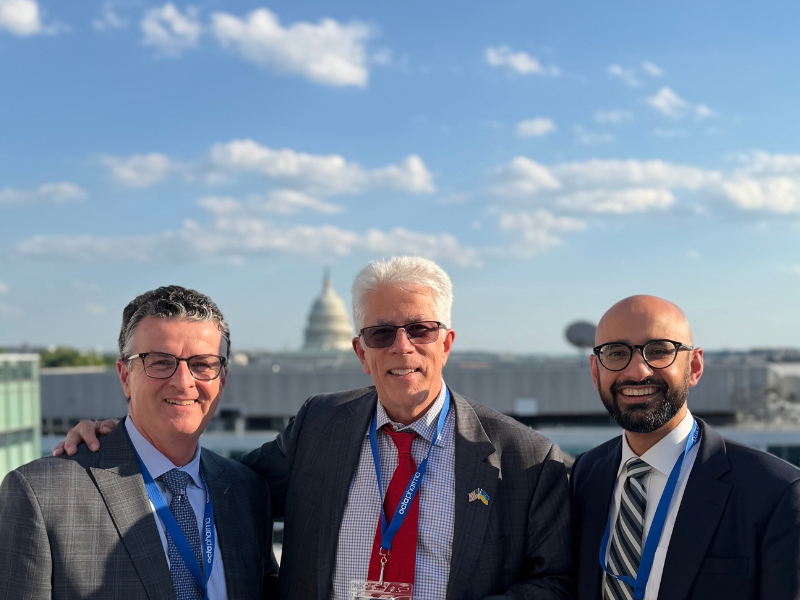 Drs. Jeffrey Kerby, John Holcomb, and Zain Hashmi.
Kerby wanted to tap back into the ethos of “having an ear to the ground” of what issues frontline trauma surgeons felt needed to be addressed . He developed “Spotlight Discussions," where any member, regional or central, could propose a topic they wished to highlight, allowing for eventual development of solutions to address the issues deemed of highest importance. The format, which he calls a “program incubator,” has been popular, with members hosting 10-15 discussions at each of last four spring and fall national meetings.
Spotlights have covered a broad range of issues ranging from prehospital care, pediatric and burn care, to team dynamics and injury prevention opportunities. One session on utilizing telehealth in trauma care (teletrauma) was led by Zain Hashmi, M.D., an assistant professor in the UAB Division of Trauma and Acute Care Surgery, which resulted in a COT white paper on teletrauma and development towards a teletrauma program in Alabama, which was launched in 2025.
Kerby explains that encouraging regional COT members to bring issues to the Committee allows for advocacy and program implementation at both a national and local level.
One major development that Kerby has elevated on a national scale is the need for prehospital blood, which is proven to save lives but is severely underutilized.
“If ambulances across the country carried blood for bleeding trauma and non-trauma patients, we have the opportunity to save 10,000 to 20,000 lives a year,” Kerby said.
Kerby called a press conference at the American College of Surgeons Clinical Congress, which he moderated with John Holcomb, M.D., a professor in the division.
Awareness for the issue has been steadily rising, and now 400 ground EMS agencies nationwide have begun carrying blood.
“Member engagement was a big priority for me as chair, to make sure people felt like the COT was a place they could come and have somebody listen and develop solutions to those problems,” Kerby said. “It’s really been a great way to give our members a voice and a platform to address emerging issues in trauma care.”
What’s next?
After his tenure as chair ended in March 2026, Kerby immediately began serving in a staff role as medical director of trauma education for the ACS. He will continue to shape trauma care nationally and globally by providing guidance for the growing portfolio of ACS trauma education initiatives.
With four years packed with travel, leadership, and progress on his goals, Kerby says the past few years have gone by quickly.
“My professional colleagues allowed me a great honor, to have temporary custody of an institution with a powerful platform to affect meaningful change for trauma care,” Kerby said. “I am proud of what we were able to accomplish over the past four years. It was the best job, and I will be forever grateful to them for that opportunity.”