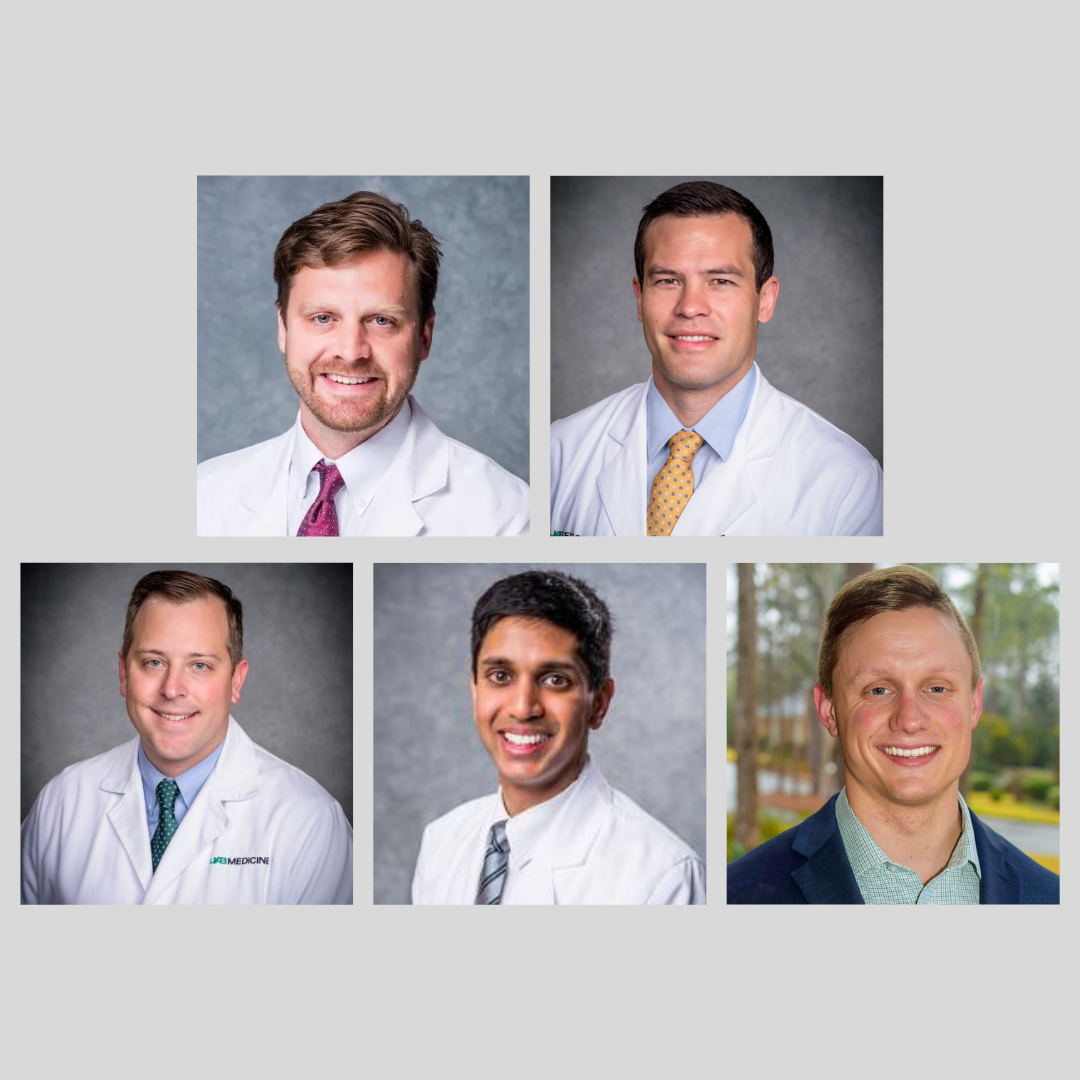
 Drs. Eugene Brabston, Aaron Casp, Thomas Evely, and Amit Momaya, faculty members in the Department of Orthopaedic Surgery, and Dr. Pearce Lane, Orthopaedic Surgery resident, are authors of a recently published article titled “Repair of a Radial Tear of the Meniscus Augmented With a Biocomposite Scaffold.”
While meniscal tears are common in the United States, and surgery is required for certain tear patterns, radial meniscus tears do not always completely heal. In fact, 38% of radial meniscus tears fail to heal because of tear characteristics, biology, surgical technique, and inadequate rehabilitation. To address this, there have been recent efforts to incorporate biological augmentation to increase the potential for full healing of the meniscus.
This article specifically describes and shows an all-inside, meniscal radial tear repair augmented with BioBrace– a biocomposite scaffold designed to mechanically reinforce tissue and biologically enhance healing.
According to the article, “The rationale for biologic augmentation is that it has the potential to improve the biologic integration and vascular regenerative capabilities of the native meniscus while also offering initial mechanical reinforcement at time zero.”
The article discusses the steps of repairing a radial tear of the meniscus augmented with BioBrace and has accompanying videos and figures for readers to reference. It also discusses the advantages and disadvantages to using BioBrace. In conclusion, the article finds that the use of BioBrace augmentation for repairing radial tears in the meniscus shows promise in enhancing healing capabilities while providing initial mechanical reinforcement.