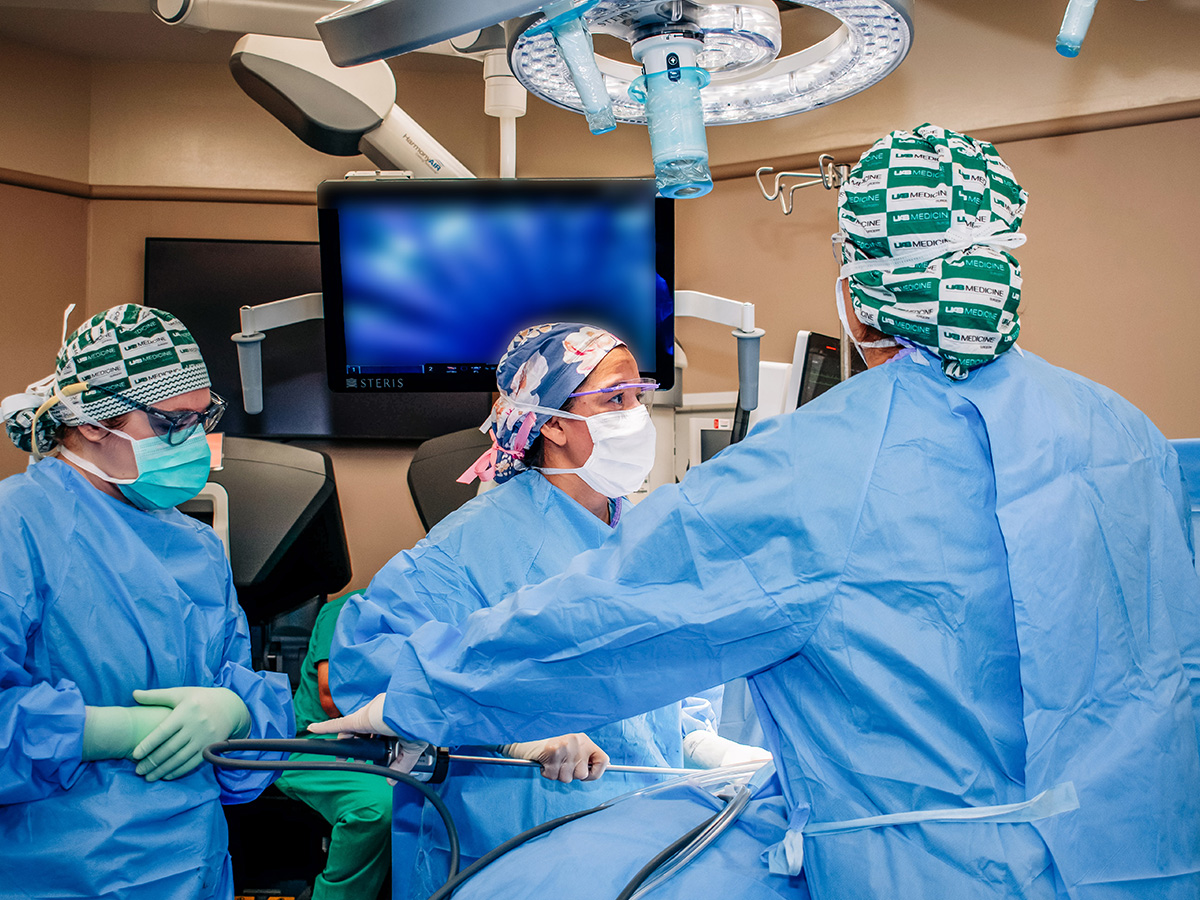
 Margaret Romine, M.D. (center) performs UAB's first NKR kidney transplant.The University of Alabama at Birmingham has joined the National Kidney Registry (NKR), connecting Alabama patients to a nationwide network responsible for nearly one-third of all living donor kidney transplants in the United States.
UAB performed its first NKR cases in February 2026.
The NKR uses advanced matching technology to connect donor–recipient pairs across the country, helping patients who have incompatible living donors find suitable matches elsewhere. UAB Medicine, which averages more than 300 kidney transplants annually, is now the only institution in Alabama participating in the NKR, expanding opportunities for living donor kidney transplantation. Nationally, approximately 28–29 percent of living donor kidney transplants last year were facilitated through the NKR.
Improved donor–recipient matching is associated with longer graft survival and more durable transplant outcomes. According to Division Director of Transplantation Jacqueline Garonzik Wang, M.D., Ph.D., the expanded network and enhanced matching algorithm not only improve outcomes but also honor donors by maximizing the life‑saving potential of every gift.
“Living donors embody the best of humanity and medicine,” said Garonzik-Wang, who also serves as co-director of the UAB Comprehensive Transplant Institute. “Our partnership with the NKR allows us to honor this generosity by providing our donors with robust safeguards, seamless coordination and long-term protection. This also provides our recipients with improved access to transplantation with the possibility for the best matching and thus best outcomes.”
For donors, the NKR enables remote donation and the option to donate as a voucher donor, allowing them to give at a time that best fits their circumstances. Garonzik-Wang says this flexibility is especially valuable when the donor is the recipient’s primary caregiver, as it allows the donor to recover before the recipient undergoes surgery. For recipients, the NKR greatly increases the chance of finding an optimal match, which is associated with longer graft survival and may reduce the intensity of lifelong immunosuppression.
“The partnership between the NKR and UAB Transplant’s program is an exciting development and provides a great opportunity for our patients on the recipient and donor side of things,” said Margaret Romine, M.D., assistant professor in the Division of Transplantation who performed the first NKR cases at UAB. “It provides resources unable to be offered before now and there is only room to expand from here.”
The NKR’s large national pool and advanced matching algorithms significantly expand access for patients who have historically faced the greatest barriers to living donor transplantation.
“This includes highly sensitized patients with a calculated PRA greater than 80 percent, who now make up 22.7 percent of NKR transplants compared to just 4.3 percent in standard living donor transplants,” said Shikha Mehta, M.D., medical director of the Kidney and Pancreas Transplant Program and professor in the UAB Division of Nephrology. “Although they remain 83 percent less likely to match than PRA‑0 candidates, the NKR offers these individuals their strongest opportunity for a successful living‑donor transplant.”
Mehta says blood type O candidates, traditionally the most difficult to match and 67 percent less likely to find a compatible donor than type A candidates, also benefit from the growing number of nondirected type O donors in the NKR, which helps prevent the backlog commonly seen in this group.
Retransplant candidates experience similar advantages; they represent 25.6 percent of NKR transplants, a significantly higher proportion than the 11.5 percent seen in standard United Network for Organ Sharing (UNOS) living donor transplants. Additionally, patients who have willing but incompatible donors—particularly those with ABO or HLA incompatibilities who hope to avoid desensitization—gain access to a national matching pool capable of identifying compatible donors more effectively than traditional local options.