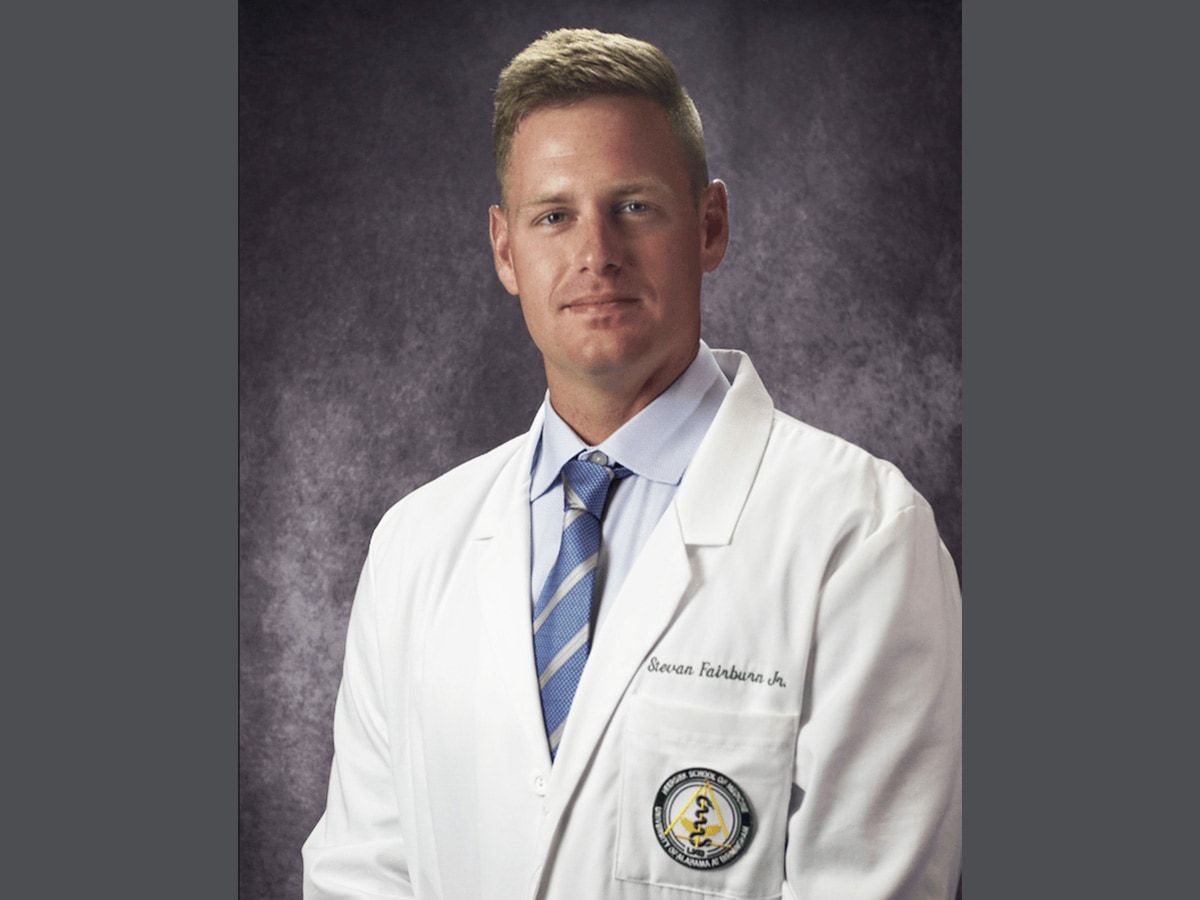
 Stevan Fairburn, M.D., came back to Alabama to become a doctor. He is leaving with something the medical world is just now beginning to understand.
Fairburn recently became the first student to earn a Master of Science in AI in Medicine degree from the University of Alabama at Birmingham’s Marnix E. Heersink Institute for Biomedical Innovation, all while simultaneously completing medical school, stepping toward the operating room with one foot in clinical care and the other in the future of healthcare.
For Fairburn, medicine has always been a calling rooted in service rather than just science.
“Showing up in the moment is what matters most,” Fairburn said, emphasizing that the core of healthcare lies in helping patients navigate fear, uncertainty, pain and survival.
Now, artificial intelligence is emerging as a critical tool to enhance that mission, offering thoughtful, practical means to deliver more effective care when patients need it most.
As healthcare systems across the world wrestle with burnout, workforce shortages, information overload and rapidly evolving technology, Fairburn represents something larger than a single graduate from a new M.S. program.
From Tuscaloosa to Colorado
Fairburn grew up in Tuscaloosa, Alabama; but his path to medicine was anything but direct.
Rather than staying close to attend college in Alabama, he traveled west to Colorado Springs to attend the United States Air Force Academy. At that time, he planned to become a fighter pilot. Engineering fascinated him. Aviation inspired him. The mission felt meaningful.
After arriving at the Academy, something more persistent began to surface.
Fairburn is a new kind of physician emerging at the intersection of medicine, technology and human connection, and you could be next.
“I realized I really enjoyed service-oriented missions,” Fairburn said. “Flying a jet did not fill my cup in that way.”
Medicine, on the other hand, did. More specifically, surgery did. The idea of becoming an Air Force surgeon offered something uniquely compelling to him. It was the opportunity to serve at both the national and deeply personal levels. He would be able to protect people on a broad scale while also meeting individual patients in some of the most vulnerable moments of their lives.
He switched his focus to biochemistry and prepared for medical school. Eventually, he returned home to Alabama to attend medical school at the UAB Marnix E. Heersink School of Medicine.
At the time, he had no idea a single flyer taped to a wall would fundamentally reshape his future.
“I was convinced when I went to the Air Force Academy that I was going to fly and be an engineer,” he said. “I can safely say I am neither of those things now.”
The flyer on the wall
It was 2023, and AI had suddenly become impossible to ignore.
AI chats had gained traction just months earlier. Headlines exploded with predictions about the future. Some people viewed AI as revolutionary, while others found it daunting. Most people, Fairburn included, were simply curious.
“I was listening to podcasts and hearing everybody talk about AI,” Fairburn said. “But I did not really understand what was happening underneath the surface.”
Then one day, while riding an elevator at UAB, he noticed a flyer advertising a course on AI in medicine through the newly established Marnix E. Heersink Institute for Biomedical Innovation.
“I was like, this is really interesting stuff,” he said. “I would love to learn more about it. So, I thought maybe I would just take a class and see.”
He completed the AI in Medicine Graduate Certificate program while balancing the already demanding medical school workload. Fifteen additional credit hours. Long nights. Extra projects. Additional research.
“The thing that I would work the extra hour on, that was AI,” he said. “That was what drove me.”
The deeper he went, the more he recognized a familiar feeling from childhood. He compared it to sitting on the floor building with building blocks, fascinated by the final structure alongside the architecture underneath it. The systems. The logic. The invisible framework that determines how everything functions.
“The goal is not to remove people from healthcare. The goal is to remove friction so healthcare professionals can focus more fully on judgment, empathy, communication and care.”
“Understanding why an answer is being generated the way it is being generated, I think that stuff is fascinating,” Fairburn said. “That is when I realized this is something I could really see myself researching, teaching and building around.”
What intrigued him most was not the fantasy of AI replacing physicians. In fact, he believes the opposite.
“You cannot take the clinician out of medicine,” Fairburn said. “AI is not going to replace doctors. But it can help them empathize more with patients. It can give them back the extra five minutes to really connect with the person sitting in front of them.”
Going beyond the certificate
By the time Fairburn had completed the certificate program, UAB had officially launched the full Master of Science in AI in Medicine.
Unexpectedly, he was already halfway there. The credits aligned, and the curriculum matched. The opportunity was suddenly a real possibility.
There was only one more step: convincing medical school leadership to let him pursue a second graduate degree simultaneously.
“I basically went to them and said, ‘Hey, I am already halfway through this. Are they going to make me stop now?’” he said.
What followed became one of the most intellectually transformative experiences of his education.
The program moved beyond headlines and hype into the mechanics of how artificial intelligence works. Fairburn studied neural networks, model architecture, implementation science, responsible deployment, bias evaluation and healthcare integration. He learned the difference between an AI system that sounds convincing and one that can safely function in a clinical environment where lives are at stake.
Most importantly, he learned how physicians can shape the future of AI rather than simply react to it.
His capstone project reflected exactly where his clinical interests and technological interests intersected. Fairburn developed an AI model to give clinicians real-time access to their documents at the point of care.
The extra five minutes
This fall, Fairburn will begin his general surgery residency at Wake Forest University School of Medicine while serving on active duty in the United States Air Force.
He knows he will encounter institutions with varying levels of AI adoption and very different comfort levels with the technology. Some environments will be highly innovative. Others might remain cautious or skeptical.
He sees that challenge as part of his role moving forward.
“UAB, through the institute, is one of the most forward-thinking environments in AI and medicine,” Fairburn said. “Part of my job now is becoming a translator. Understanding where people are in their comfort level and helping them see where AI can meaningfully reduce pain points.”
For Fairburn, the conversation always comes back to the patient.
Medicine is experiencing a burnout crisis. Physicians can be overwhelmed by documentation, administrative complexity, inbox management and increasing productivity pressures. Many entered medicine because they wanted to care for people deeply and personally, yet the system often pulls them away from the bedside and toward the computer screen.
As founder of GuidelinesIQ, Fairburn is working to bring AI-powered clinical decision support directly into patient care settings, helping clinicians access the right information at the right time.
Fairburn believes AI can help reverse that trajectory if implemented responsibly.
“When AI frees up five or 10 minutes for a clinician, I want that time spent in the room,” he said. “Not scheduling another patient, but actually connecting with the person in front of you.”
As a future surgeon, he understands exactly how meaningful those moments can become. Patients entering surgery are often frightened, overwhelmed and vulnerable. Sometimes the most important thing a physician can offer is not speed or efficiency, but presence.
AI, he believes, can help make room for that presence again.
The first of many
Fairburn will spend the next decade in operating rooms, military hospitals and clinical training environments while continuing to navigate a field evolving almost daily. AI will continue changing and innovating. Healthcare will continue adapting. New tools will emerge. Old assumptions will disappear.
Fairburn no longer sees AI as something happening to medicine from the outside. He sees it as something physicians themselves must help shape. He is still learning, experimenting and asking questions. However, he is no longer the medical student who almost walked past a flyer on a wall.Fairburn recently launched his own startup, GuidelinesIQ, from experience in the operating room and AI in medicine education. Fairburn’s startup deploys a platform for AI-powered clinical decision support that delivers real-time, institution-specific guidance at the point of care. The company serves hospitals and healthcare systems seeking to improve consistency and efficiency in clinical decision-making. Clinicians use the platform during patient care to access localized, up-to-date guidelines, with expansion across departments and use cases.