Research Findings Behind the Technology Q&A with Researcher
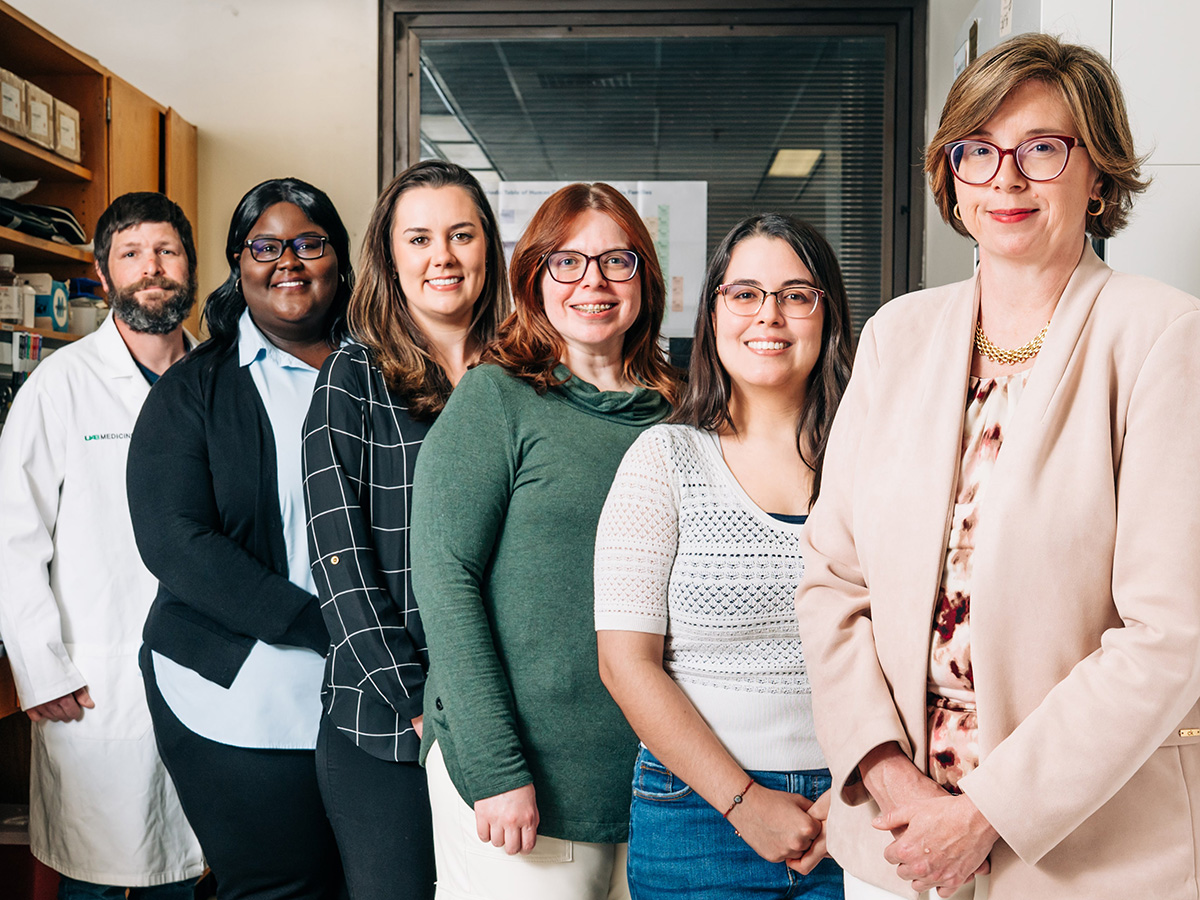 From R-L, Paige Porrett, Brittney Knott, Emma Wright, Samantha Fry, Rebecca Asiimwe, and Daniel Epstein.Early pregnancy depends on a remarkable act of coordination. Before the placenta can nourish a growing fetus, the embryo must securely “land” and connect with the mother’s blood supply — a process guided by a specialized group of immune cells called uterine natural killer cells, or uNK cells.
A new peer-reviewed study from the University of Alabama at Birmingham, supported by the National Institutes of Health and published today in Science Translational Medicine, has uncovered a critical role in successful pregnancies for an immune switch called NFAT that helps uNK cells take up residence in the uterus and perform that critical guidance work. When the switch is turned down, fewer natural killer cells make their way to the uterus — and pregnancy complications may follow.
“This discovery opens an entirely new window into how the immune system supports healthy pregnancy,” said Paige Porrett, M.D., Ph.D., lead author of the study and professor of surgery and obstetrics and gynecology, as well as the Vera Hauptfeld‑Dolejsek Endowed Professor of Transplant Immunology in UAB’s Marnix E. Heersink School of Medicine. “Seeing NFAT act as a residency switch in uterine NK cells was a surprise, and it gives us a concrete lead on why some pregnancies veer toward complications.
“This opens up a whole new world of research.”
Why this matters
The findings offer fresh insight into the biology behind preeclampsia, implantation failure, inadequate placental blood flow and some early pregnancy losses — conditions that affect many pregnant patients, not only those who have undergone organ transplantation.
The team’s expertise in uterus transplantation provided a unique opportunity to study the immune environment in pregnancy. But the mechanism they uncovered appears to be a fundamental part of human placental development.
“This isn’t just a transplant story,” Porrett said. “We used transplant as a lens, but the biology may map onto normal pregnancies and high‑risk ones. The benefits of this work are potentially for all pregnant patients.”
Key findings at a glance
• A new immune switch:
Researchers identified NFAT as a key regulator that allows uterine NK (uNK) cells to become tissue resident — a step required for anchoring and supporting healthy placenta formation.
• Direct clinical relevance:
Loss of specific tissue resident uNK subsets was linked to maternal vascular malperfusion — a pattern seen in preeclampsia, poor placental blood flow and other pregnancy complications.
• How the pathway works:
Early residency signals (AP 1–driven programs) and later adhesion pathways (integrins activated by TGF β) appear to depend on NFAT activity.
• Medication signal:
In laboratory models, exposing healthy uNK cells to tacrolimus — an NFAT blocking drug used widely in transplant patients — reduced key adhesion molecules needed for uNK residency, mirroring patterns seen in complicated pregnancies.
What the researchers found
UAB scientists discovered that NFAT controls whether uNK cells become “tissue‑resident,” a necessary step that allows them to remain in the uterine lining and remodel maternal blood vessels for early placental growth.
Until now, NFAT was known for its role in T cells but had never been described in the context of uterine NK cells or pregnancy.
“This is a new pathway for immune cells to become resident that we didn’t know about before,” Porrett said. “We now show in humans that the biology we’ve only ever seen in mice applies. As a result, this opens a whole new world of research.”
Technology made the invisible visible
The team used single‑cell RNA sequencing, a powerful modern tool that measures the activity of every gene in individual cells. This level of detail allowed researchers to see gene programs shift across thousands of cells — something older approaches could not capture, especially in tissues as dynamic as the uterus.
“Single‑cell sequencing let us see, cell by cell, the gene programs that were changing,” Porrett said. “You need that granularity to identify a pathway like this.”
Rethinking widely used medications in pregnancy
The study also raises important scientific questions about tacrolimus, a standard immunosuppressive medication taken by nearly all solid‑organ transplant recipients.
While tacrolimus is highly effective at preventing rejection — and prior studies have long shown it does not increase birth‑defect risk — the new findings suggest that lowering the NFAT signal using this medication may raise the risk of placental complications.
“Tacrolimus works incredibly well, but now we’ve identified a biological reason to reconsider how we use it during pregnancy,” Porrett said. “We have to do the hard work of finding safer alternatives for pregnant patients while still preventing rejection.”
Researchers emphasize that no medication changes should be made based on this study alone. Instead, the findings provide a mechanistic foundation for the next phase of research: identifying alternative drugs or timing strategies that protect both the pregnancy and the transplanted organ.
“It’s a balance,” Porrett said. “Tacrolimus is a workhorse, and any change must be evidence‑based.”
What this discovery opens the door to
• Better early‑warning biomarkers:
Potential to develop blood or tissue markers that reflect uNK “residency signatures” (NFAT / AP‑1 / TGF‑β activity; adhesion and integrin profiles) for earlier detection of placental dysfunction or preeclampsia risk.
• Targeted therapies:
Future treatments may aim to support uNK residency, either by adjusting immunomodulatory exposures (like tacrolimus) or by designing therapies that protect or enhance the adhesion/integrin pathways essential for placental development.
What comes next
Beyond transplant recipients, the researchers say the work opens new avenues for understanding pregnancy complications in patients who are not immunocompromised. The team plans to map how immunosuppressive drugs affect other immune and non‑immune cell types in the uterus — including stromal and epithelial cells — to understand the broader biological landscape.
“These human data are powerful, but they’re largely associative,” Porrett said. “We need to validate causality and understand how other uterine cell types respond. That’s the hard work ahead — and it’s how we turn a discovery into better outcomes.”
Porrett’s co-authors for the study, “Inhibition of NFAT after human uterus transplant promotes loss of tissue resident NK cells and attendant pregnancy complications,” include from UAB Rebecca Asiimwe, Brittney Knott, Morgan E. Greene, Emma D. Wright, Markayla Bell, Daniel Epstein, Stefani D. Yates, Samantha Fry, Emily Boydston Procópio, Stephanie Clevenger, Jayme E. Locke, Brian E. Brocato, Constantine M. Burgan, Richard Burney, Nitin Arora, Virginia E. Duncan, Holly E. Richter, Deidre Gunn and Shawn C. Little; Michael V. Gonzalez, University of Pennsylvania; and Aharon G. Freud, The Ohio State University.
Support came from the National Institutes of Health grants R01AI177369, R01AI145905, R01CA208353, F31HD114429 and T32GM135028; UAB Center for Women’s Reproductive Health; UAB AMC 21 grants; startup funding from the UAB Heersink School of Medicine; and American Cancer Society Research Scholar Grants #RSG-23-1153857-01-IBCD.
Q&A with Paige Porrett
Researchers at UAB have uncovered a previously hidden immune pathway showing how a molecule called NFAT helps uterine natural killer cells support early placenta development — a discovery that reshapes our understanding of pregnancy health and complications like preeclampsia. This Q&A with Paige Porrett, M.D., Ph.D., explores how the finding emerged, why it matters, and what it could mean for future diagnostics and treatments.
What was discovered?
• Researchers at the University of Alabama at Birmingham discovered that a molecule called NFAT acts as an “on-off” switch to help immune cells settle into the uterus and support placenta development. When this switch is not working well, those immune cells might be less present near the developing placenta, which could potentially affect how they interact with it and may jeopardize pregnancy health — a relationship that is still not fully understood. This finding gives scientists a new understanding of how the immune system helps pregnancies get off to a healthy start.
What surprised you most about identifying NFAT as a key switch for uNK cell residency, and why has this mechanism not been clear before now?
• What surprised us most was finding NFAT — a molecule best studied for effects in another immune population (T cells) — acting in a completely new way in uterine natural killer cells. No one had seen this before because older techniques could not capture all the information necessary to determine how individual immune cells take up residence inside tissue. With single‑cell technology, we finally had the resolution to see this hidden pathway for the first time.
How does discovering NFAT’s role in uNK cells change our understanding of how complications like preeclampsia develop?
• For the first time in humans, we can directly link issues in uterine natural killer cells to complications like preeclampsia and other placental disorders. Now that the pathway is identified, how loss or dysfunction of this pathway occurs can help us investigate whether this pathway may contribute to other high-risk pregnancies.
What does this research suggest, if anything, about how we might one day screen, prevent or treat placental problems linked to uNK cell dysfunction?
• It is too early to discuss screening or treatment because actual uterine tissue is still needed to see these changes, and we cannot collect that safely during pregnancy. But this discovery provides a clear target, and in the future, we may be able to detect these signals using advanced imaging or other tools that do not require tissue sampling. This research helps us understand what targets we might need to detect and evaluate with tools of the future.
Your team used single‑cell sequencing and other advanced tools. What did this allow you to see that older methods would have missed?
• Single‑cell sequencing lets us zoom in on each individual cell and read every gene that cell has turned on or off, which is something older methods simply cannot do. That gave us the sensitivity to spot whole gene programs changing over time in this very dynamic tissue, not just one molecule. Without that level of resolution, this pathway in uterine NK cells would have stayed completely hidden.
Do these findings change how we think about medications like tacrolimus in pregnancy, and does it raise questions for future dosing/timing studies?
• Yes. While these findings do not change treatment today, they raise new questions about how tacrolimus may affect pregnancy pathways. The drug is very effective at preventing rejection and is not linked to birth defects, but now we have reason to study whether its dose or timing can be refined. The next step is careful research to explore alternatives or lower exposure options that still protect the transplanted organ.
What is one important insight about uNK cells or placental development that clinicians or the public should know?
• This is an opportunity to build awareness. Many people, including clinicians, think of immune cells mainly as infection fighters; but uterine NK cells also play a remarkable, lesser known role in helping build and shape the placenta. The way that maternal NK cells in the uterus promote placental health is still not understood. Our work highlights that the immune system is important in more ways than we thought — not only does the immune system defend the body from bacteria and viruses but it actively supports healthy pregnancy in ways we are only beginning to appreciate.
What are the next steps?
• Our immediate next step is to study whether we can refine or redesign immunosuppression for pregnant transplant recipients, because this work gives us a reason to test safer alternatives to tacrolimus or lower‑exposure strategies. We also need to map how these drugs affect other uterine cell types beyond NK cells, and we need to do other experiments using animal models to show cause and effect because our current findings only show associations between the reduction of NK cells and placental problems. In short, the goal now is to understand the full landscape of how these medications impact the uterus so we can improve outcomes for both the patient and the pregnancy.
Porrett is a professor of surgery and obstetrics and gynecology, as well as the Vera Hauptfeld‑Dolejsek Endowed Professor of Transplant Immunology in UAB’s Heersink School of Medicine.