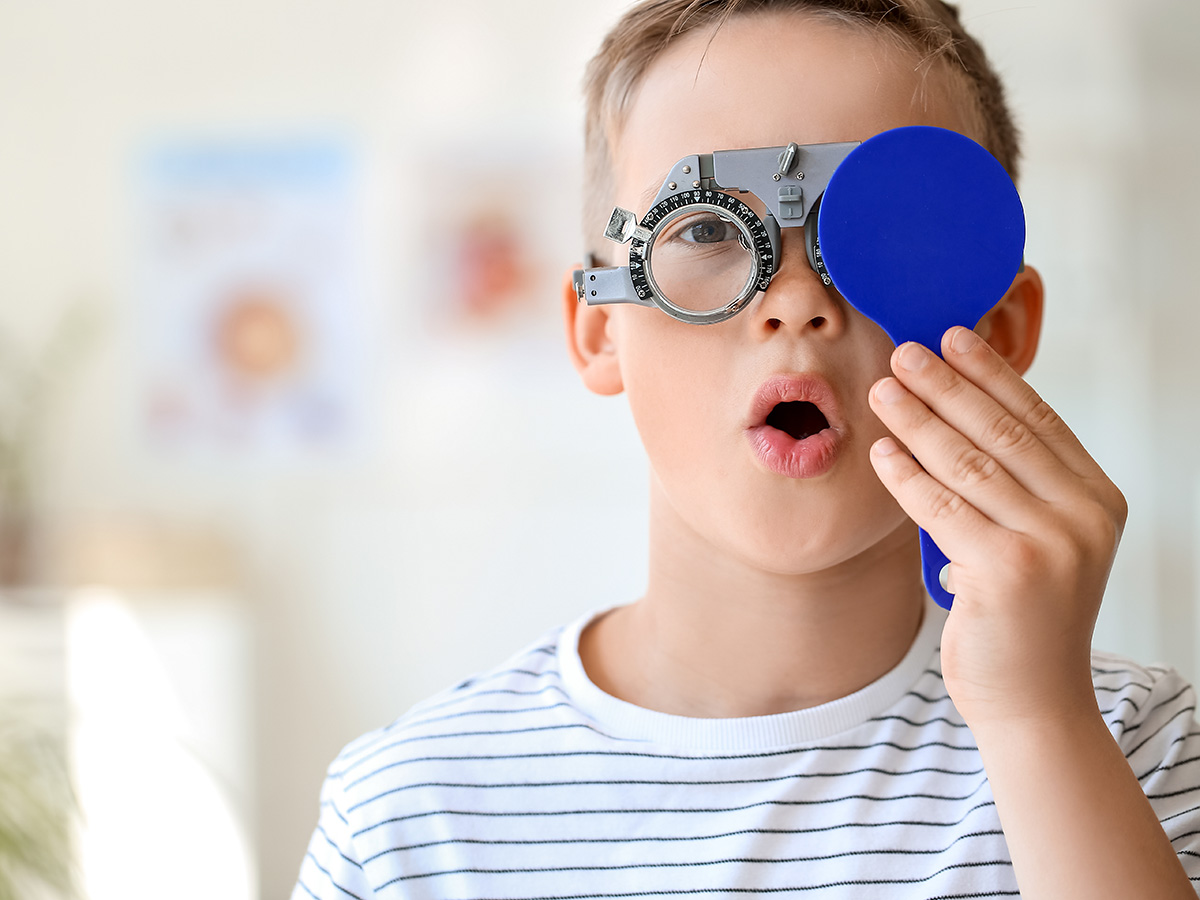
 Researchers at UAB and Cincinnati Children’s Hospital Medical Center have uncovered that supplemental indigo light may effectively reduce the progression of myopia. As technology use increases and children spend less time outdoors, researchers have noticed an epidemic increase in myopia over the past six decades also known as the “myopia boom.” Myopia, or nearsightedness, has become a major health problem across the world, largely impacting children and adolescents.
“It is projected that nearly half of the world’s population could be myopic by 2050,” said Rafael Grytz, Ph.D., Dennis Endowed Professor of Glaucoma Research in the University of Alabama at Birmingham Department of Ophthalmology and Visual Sciences. “Myopia results in higher risk to develop glaucoma, retinal detachments and other blinding disease later in life.”
However, a new study published in Cell Reports Medicine suggests that controlled exposure to the indigo light, wavelengths that are abundant in sunlight but mostly absent indoors, could be an effective treatment for myopia. Partnering with researchers from Cincinnati Children’s Hospital Medical Center, this study poses a new treatment and prevention strategy that could impact current ophthalmologic practices and environment lighting standards.
The right wavelengths for developing clear vision
Myopia develops in children and can be defined as the condition when the eye is deemed too long. This extended length causes the light that enters the eye to focus in front of the retina. This results in distant objects’ appearing blurry and out of focus. While standard glasses and contact lenses may improve sight and mitigate myopia symptoms, they do not slow the development of the condition.
Grytz, lead author of the paper, says indigo light can likely be used to slow the progression of myopia in children because it has proved to be composed of just the right wavelengths to completely suppress myopia development in juvenile animal models.
“If we can implement indigo light into our indoor environment or provide it directly to the eye, we may slow the progression of myopia and even work to prevent it from developing at all,” Grytz said.
While the sun is abundant in indigo wavelengths, the modern age of increased indoor time and exposure to white LED light via technology use and modern lighting design present a clear correlation to the myopia boom.
 Rafael Grytz, Ph.D., Dennis Endowed Professor of Glaucoma Research in the University of Alabama at Birmingham Department of Ophthalmology and Visual SciencesThe indigo wavelengths were found by optimizing opsin 5 activation while accounting for light that is filtered out by the ocular lens. OPN5 is a protein that exists in the retina that serves as a light sensing receptor.
Earlier work in animal models that rely on night vision suggested that violet light could suppress myopia by activating OPN5. But violet wavelengths did not work in different animal models that rely on daytime vision with an eye very similar to that of humans, because the ocular lens blocks most violet light below about 400 nanometers.
Corresponding author Richard Lang, Ph.D., director of research in the Division of Ophthalmology at Cincinnati Children’s, says that “human lenses don’t transmit a lot of light in the ultra-violet spectrum.”
Based on this finding, Grytz predicted the optimal wavelength that could stimulate OPN5 in the animal model eye. This prediction led the team to explore slightly longer wavelengths, including indigo wavelengths. Ultimately, the team established a new metric, called the μ-opic, that can quantify how effectively different light wavelengths may protect against myopia.
“We found that indigo light from 419 to 446 nanometers were the most effective wavelengths,” Lang said. “So, if indigo light can suppress myopia in these tests, then it should also be quite effective in humans.”
The future of myopia treatment
Grytz founded Electric Indigo, a UAB startup that focuses on developing ways to practically manage myopia. This startup was founded with the support of UAB’s Bill L. Harbert Institute for Innovation and Entrepreneurship. HIIE offers the infrastructure necessary to help UAB faculty, staff, and students bring new ideas and technologies to market across the region and beyond.
“At Electric Indigo, we have developed eyewear with LEDs in the frame that emit indigo light at controlled conditions to the eye to effectively treat and slow myopia progression in children,” Grytz said.
Grytz says this approach offers a simpler and new strategy that could surpass current treatment options, which may have difficult side effects and limited efficacy levels.
Compared to the increasingly popular red-light therapy, Indigo Eyewear presents an easier approach to treatment by offering a practical method of exposure.
“If our hypothesis is confirmed that absence of indigo light indoors caused the myopia boom, our eyewear will be the first treatment that attacks the root cause of this epidemic,” Grytz said.
This study was carried out as a collaboration between the research teams of Richard Lang at Cincinnati Children’s and Rafael Grytz at UAB with important contributions from Takahiro Yamashita at Kyoto University and Mehlika Inanici at The University of Washington.
Several organizations provided grants to fund this research, including the National Eye Institute of the National Institutes of Health (EY026588, EY036560, EY032633, EY003039, EY038143, EY028666, EY032029, EY032752, EY032566 and EY034456); the National Institute of General Medical Science (GM152641); the Japan Agency for Medical Research and Development (22gm1510007); the EyeSight Foundation of Alabama, Research to Prevent Blindness; the Henry M. Hollis Fund; the Emma and Irving Goldman Scholar Endowed Chair; and the Cincinnati Children’s Hospital Research Foundation.
Grytz and Lang declare they are inventors listed on pending patents for lighting devices related to this work. Grytz is the founder and CSO of Electric Indigo, a UAB startup in which UAB holds an ownership interest.