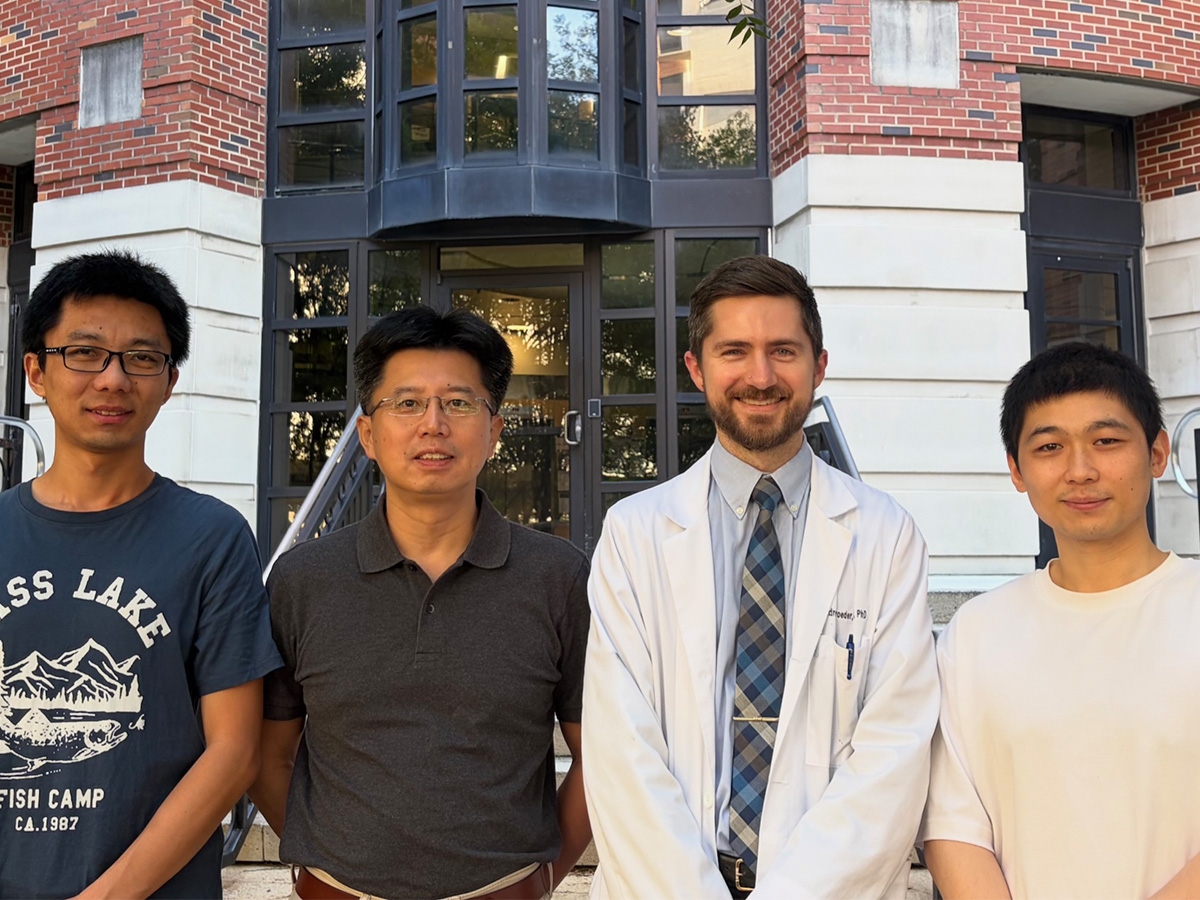
 From L-R Fangming Zhu, M.S., Hui Hu, Ph.D., Andrew Schroeder, M.D., Ph.D., Xianyou Xia, M.S.Researchers at the University of Alabama at Birmingham have uncovered a fundamental mechanism that helps the immune system decide how to respond to infection, a discovery that could inform the development of more effective vaccines and improve understanding of immune-related diseases.
Published in the Journal of Experimental Medicine, the study introduces a new framework for understanding how CD4+ T cells, key coordinators of the immune response, choose between supporting antibody production or directing cellular immune attacks.
“The balance between humoral versus cellular response has always been one of the most fundamental questions in the immunology field,” said Hui Hu, Ph.D., professor in the UAB Department of Microbiology, senior scientist in the UAB Immunology Institute and corresponding author of the study.
The research focused on a protein called BACH2, which helps regulate immune responses. Previous studies suggested BACH2 suppresses a subset of immune cells known as T follicular helper cells, or Tfh cells. However, when the UAB team examined immune responses under different conditions, they discovered that BACH2 can either promote or suppress Tfh cell development depending on factors such as where the immune response occurs and the strength of the immune stimulus.
The finding emerged after researchers observed an unexpected result during an immunization study.
“Immediately we knew we had found something important, because based on the existing knowledge, we had no idea how this could be happening,” Schroeder said.
Further investigation revealed that BACH2 helps coordinate immune responses throughout the body. Near the site of an infection, BACH2 promotes antibody-producing responses. In other areas of the body, it helps prevent unnecessary responses, allowing the immune system to focus its resources where they are needed most.
“These findings help us understand how the immune system will respond across the body, and they show us that BACH2 integrates various signaling pathways of the response to balance the humoral and cellular arms,” said Fangming Zhu, a co-author on the study.
“We were surprised and amazed that millions of years of evolution has managed to pull off such an elegant mechanism to regulate and balance the humoral and cellular arms of the immune response at a systemic level,” Hu said.
The study resolves a long-standing question in immunology involving how immune cells receive STAT5 signals that help them grow and expand while still developing into the appropriate type of response. To put it in a simple way, “the IL-2/CD25/STAT5 signaling is being ‘filtered,’ transiently by BACH2,” Hu said.
Beyond advancing scientific understanding of the immune system, the findings may have practical applications. Researchers say the work could help guide the design of future vaccines by improving scientists’ ability to predict and shape immune responses.
“We want to understand the networks behind it so that later on, for any kind of new vaccine, we will be able to predict, or even better, we can design it in that way,” Hu said.
The findings may help explain BACH2-Related Autoimmunity and Immunodeficiency, or BRIDA, a rare condition in which patients experience both weakened immune defenses and autoimmune symptoms.
As researchers continue investigating BACH2 and other factors that shape immune responses, they hope their findings will improve treatments for immune-related diseases and deepen understanding of how the body decides where and how to respond to infection.
“We believe we’ve revealed a very fundamental principle,” Hu said.