GLP-1 weight loss drugs have quickly moved from medical journals to household conversations, reshaping how Americans think about obesity, diabetes and weight loss. Headlines often describe them as “miracle drugs,” pointing to dramatic weight loss and improvements in blood sugar, heart health and liver disease.
Behind the public buzz is a deeper scientific story, one that researchers at the University of Alabama at Birmingham are helping to tell.
At UAB, scientists are working to understand not just that these medications work, but how they work: how they act in the brain, how they affect multiple organs at once, why some patients respond better than others and what next-generation versions of these drugs might look like.
“These drugs didn’t come out of nowhere,” said Andrew Hardaway, Ph.D., a neuroscientist in the UAB Department of Psychiatry and Behavioral Neurobiology, who studies how hormones influence brain circuits that regulate appetite and reward. “They’re the result of decades of basic science, studying how the body regulates hunger, metabolism and energy balance.”
Beyond the gut: How the brain reacts to GLP-1
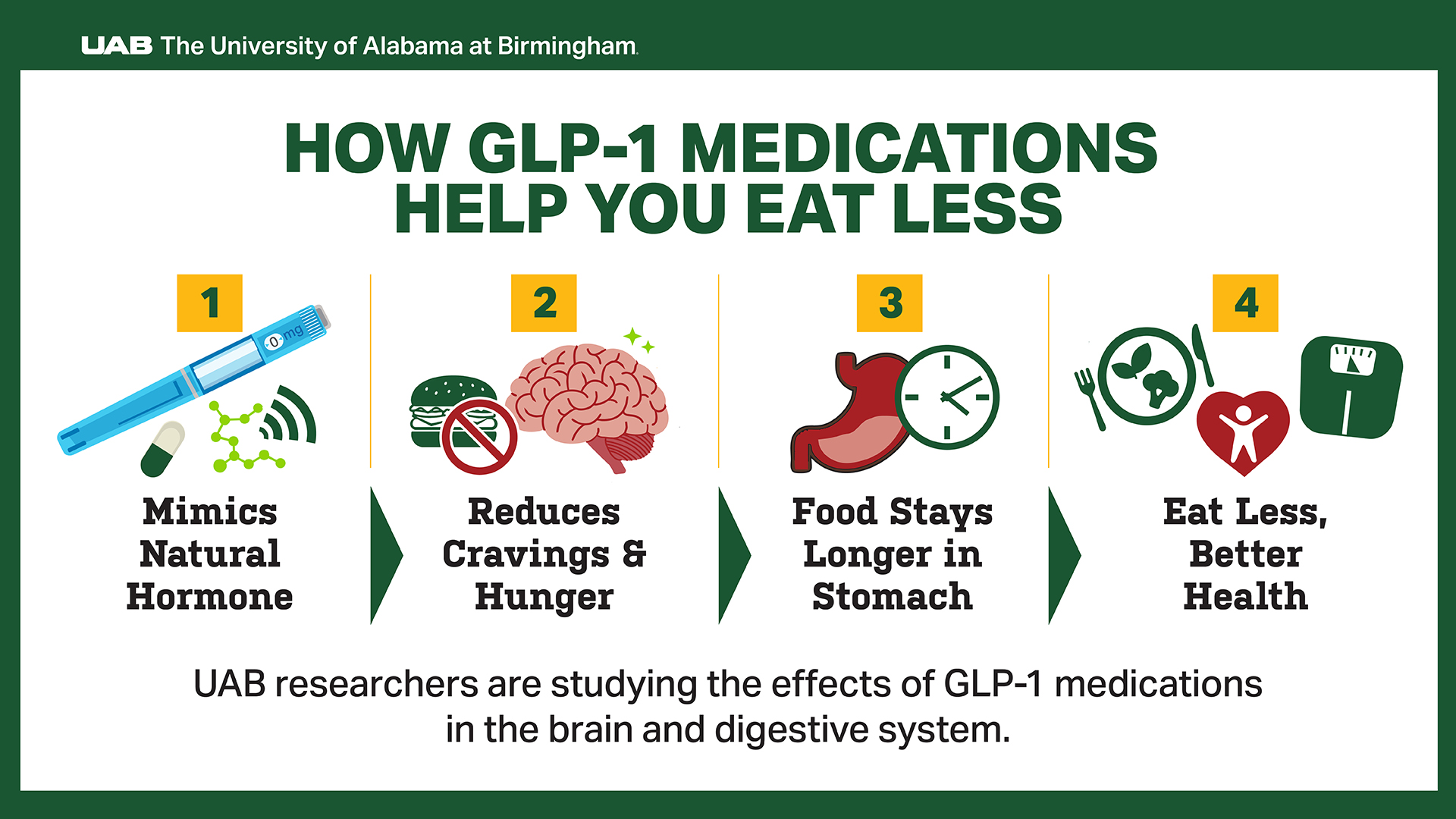
GLP-1 drugs are often described as gut hormones, and for good reason. GLP-1, short for glucagon-like peptide-1, is a hormone released in the gut after eating. It helps regulate blood sugar, slows stomach emptying and contributes to feelings of fullness.
But research over the past several years has made one thing clear: The brain plays a central role in how these drugs suppress appetite.
“Preclinical studies show that, if you restrict the action of GLP-1 drugs to the brain alone, you still see reduced food intake,” Hardaway said. “That tells us appetite suppression is fundamentally a brain-mediated effect.”
The brain contains multiple, overlapping circuits that regulate feeding. Some promote food seeking and consumption, and others act as brakes, signaling when it is time to stop eating. GLP-1 drugs strengthen those natural “stop” signals.
“They essentially amplify the body’s own satiety cues,” Hardaway explained. “You’re not just choosing to eat less. The signals that tell you you’re full become stronger and more effective.”
These drugs work at more than one point in the eating process. They reduce cravings and food-seeking behavior before a meal even begins and then increase feelings of fullness once eating starts.
Reward, dopamine and why food feels different
Hardaway says many patients report that foods they once craved no longer hold the same appeal while taking GLP-1 drugs. That effect, he says, may be tied to changes in the brain’s reward system.
Normally, eating, especially calorie-dense or highly palatable food, triggers the release of dopamine, a neurotransmitter associated with reward and motivation. GLP-1 drugs blunt that dopamine response.
“Food simply becomes less rewarding,” Hardaway said. “You still enjoy eating, but it doesn’t drive behavior in the same way.”
That mechanism has sparked interest far beyond obesity research. Scientists are now investigating whether GLP-1 drugs could help treat substance use disorders, which also involve dopamine-driven reward pathways.
“It’s an active area of research,” Hardaway said. “There are very few effective medications for substance use disorders, so there’s a lot of excitement about whether these drugs could play a role.”
 Kirk Habegger, Ph.D.
Why newer drugs are more powerful
While early GLP-1 drugs focused on a single receptor, newer medications like tirzepatide activate more than one hormonal pathway. Tirzepatide targets both the GLP-1 receptor and the GIP receptor — another hormone involved in metabolism.
That multi-receptor approach is a major reason these drugs are more effective, said Kirk Habegger, Ph.D., professor in the Division of Endocrinology, Diabetes and Metabolism.
“A drug or hormone can only act where its receptor is expressed,” Habegger said. “When you activate multiple receptors that are expressed in different tissues — or even on the same cells — you don’t just add effects. You get synergy.”
In other words, one plus one does not equal two. It can equal much more.
GLP-1 and GIP receptors are found in the brain, alongside fat cells, pancreatic beta cells and other tissues involved in metabolism. Activating both receptors can improve insulin secretion, enhance fat metabolism and amplify appetite suppression.
“Much of the benefit appears to come from the central nervous system,” Habegger said. “But GIP receptors are also expressed on adipocytes, which gives these drugs additional metabolic effects.”
UAB at the forefront of GLP-1 research
In December 2025, the FDA approved an oral version of GLP-1 semaglutide. Multisite research, including research at UAB, shows that oral semaglutide is nearly as effective as the widely used injectable version for treating obesity, delivering about 13.7 percent average weight loss over 64 weeks.
The next wave: Triple and even five-receptor drugs
The pace of innovation in this field is accelerating. Researchers are already testing triple-agonist drugs, such as retatrutide, which target GLP-1, GIP and glucagon receptors. Early data suggest even greater weight loss and metabolic benefits.
Even more ambitious approaches are on the horizon.
“We just had a presentation from a group working on a five-receptor agonist,” Habegger said.
That experimental therapy combines GLP-1 and GIP with activation of nuclear hormone receptors known as PPARs — targets once used by diabetes drugs like rosiglitazone and pioglitazone. Those older drugs were effective but carried side effects that limited their use.
The hope now is that peptide-based therapies could deliver those benefits more precisely.
“If you can target those receptors to specific cell types, you might bypass some of the side effects that previously prevented broader use,” Habegger said.
Why the heart and liver benefit, even without direct targets
Habegger says one of the most striking findings from large clinical trials is that GLP-1 drugs reduce the risk of heart attacks, strokes and cardiovascular death. They also improve metabolic liver disease.
Yet cardiomyocytes, the main muscle cells of the heart, and hepatocytes in the liver do not appear to express GLP-1 or GIP receptors in significant amounts.
So how do these benefits occur?
“The answer is probably both direct and indirect,” Habegger said.
GLP-1 receptors are expressed on certain immune cells, including T-cells. Chronic inflammation plays a key role in fibrosis and organ damage in the heart and liver. Reducing inflammatory signaling may protect tissues even without acting directly on muscle or liver cells.
Weight loss also plays a major role. As patients lose fat mass, they become more metabolically healthy, reducing strain on multiple organs. But researchers are increasingly seeing signs that some benefits may be weight-independent.
“That’s one of the big questions moving forward,” Habegger said. “If we can identify and target those pathways directly, future therapies could be even more effective.”
Not everyone responds the same way
Despite their effectiveness, GLP-1 drugs do not work equally well for everyone. Some patients experience dramatic weight loss, while others see more modest changes.
Now that millions of people are taking these medications — far beyond the scope of clinical trials — researchers are beginning to understand why.
“We’re learning things we couldn’t have learned before,” Hardaway said. “That variation is driving a lot of interest in understanding the underlying biology.”
Researchers hope that, over time, they will be able to predict who will benefit most based on genetics, environment and other biological factors.
“The goal isn’t just weight loss,” Hardaway said. “It’s understanding who will see improvements in blood sugar, heart health, liver disease and kidney function.”
Long-term questions still remain
Hardaway says GLP-1 drugs are essentially supercharged versions of a naturally occurring hormone, and decades of neuroscience research show that receptors can adapt to prolonged stimulation.
One unanswered question is whether long-term use could lead to reduced responsiveness over time.
“Receptors can internalize or downregulate,” Hardaway said. “We don’t yet know the long-term consequences of sustained GLP-1 receptor activation in the brain.”
So far, tolerance has not clearly emerged; but widespread use of these drugs is still relatively recent. Semaglutide was approved for weight management in 2021, while tirzepatide followed in 2023.
“Long-term, prospective studies are still needed,” Hardaway said.
Changing the conversation about obesity
For both researchers, one of the most important impacts of GLP-1 drugs may be how they reshape public understanding of obesity itself.
“These drugs reinforce that obesity is not about willpower,” Hardaway said. “They highlight how powerful biology and genetics are in regulating body weight.”
Habegger agrees.
“When you see how many systems are involved — brain, hormones, immune cells, metabolism — it becomes clear this is a complex disease,” he said.
Rather than a quick fix, researchers emphasize that GLP-1 drugs are powerful tools that work best alongside broader approaches to health.
“These medications are remarkable,” Hardaway said. “But they’re also a reminder of what sustained investment in basic science can achieve.”
As UAB researchers continue to study how these drugs work and what comes next, their findings are helping move the conversation beyond hype, while working toward a clearer understanding of one of the most significant medical breakthroughs of the past decade.