A new tool in understanding and improving nutrition for all now resides at the University of Alabama at Birmingham. The Department of Nutrition Sciences is now home to a brand-new metabolic kitchen and a teaching kitchen, which will significantly enhance the department’s research, education, clinical and community outreach capabilities.
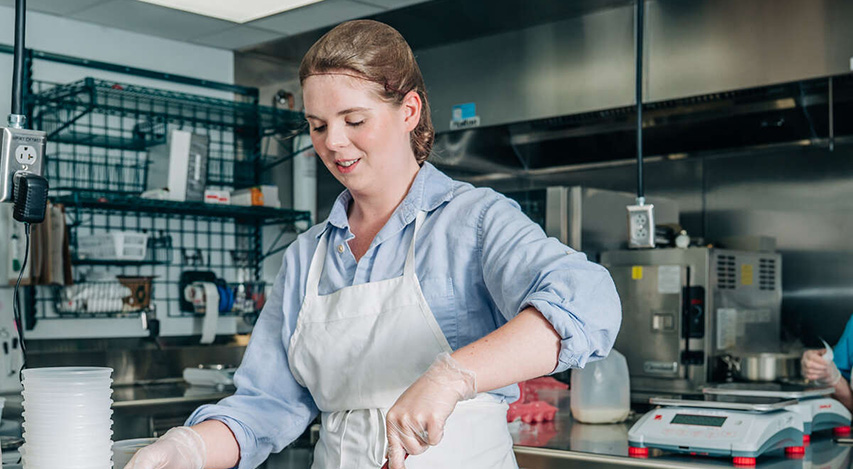 Housed in the newly renovated Susan Mott Webb Nutrition Sciences Building, the kitchen is equipped with professional-grade tools and staffed by registered dietitians. The renovation also included updates to the building’s lobby and atrium, creating a bright and modern environment, as well as the installation of a state-of-the-art calorimeter suite to support advanced metabolic research.
“These renovations set the tone for the future and are a reflection of our Department of Nutrition Sciences itself: a place of excellence,” said Andrew Butler, Ph.D., dean of the School of Health Professions. “All who enter will recognize this as a place of purpose where students, faculty and staff conduct essential work, and our clients receive advanced nutritional services.”
Completed in spring 2025, the metabolic kitchen allows researchers to develop precise dietary interventions for people with diabetes, obesity and heart disease — using real food, not just data.
The kitchen is designed to mass-produce menus and meals for large research studies, ensuring precise control over nutrient content and ingredient interactions.
“I see this new facility as a game-changer for advancing research, education and community health both at UAB and throughout Birmingham,” said Kelly Berg, RDN, assistant professor and director of the metabolic kitchen. “It strengthens our position as a national leader in delivering clinically controlled meals and driving translational nutrition science forward.”
Key features of the metabolic kitchen include precision measurement tools for accurate ingredient quantification, specialized software for creating clinically controlled menus, and temperature-controlled storage including a walk-in freezer, commercial-sized cold storage and blast chiller for ingredient stability experiments.