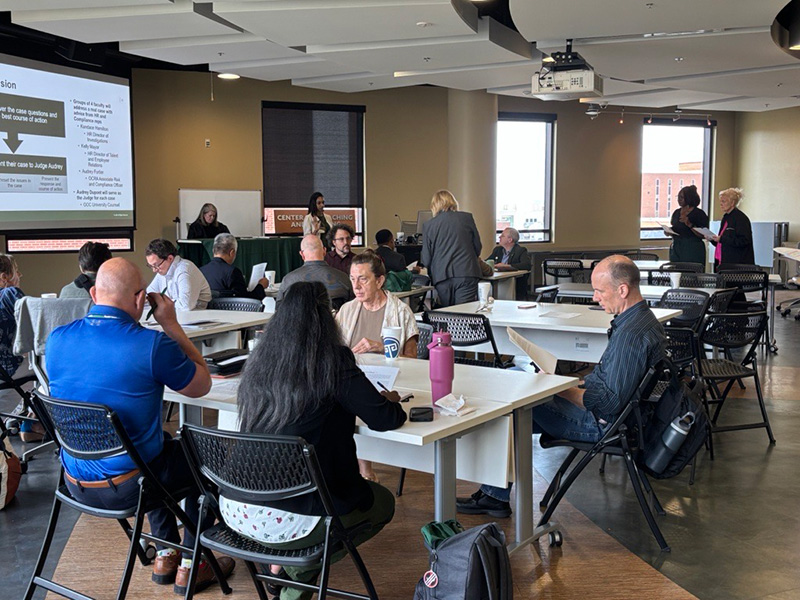
 The UAB Chairs Leadership Academy, a signature initiative from the Office of the Provost, continues to build momentum as participants completed another successful onsite session, marking the second session of the year.
This year, the academy accepted 17 participants who are current department chairs, associate deans, and assistant deans who have been in their roles (including interim) for at least one year.
Designed to support department chairs in their leadership journey, the academy offers a dynamic blend of professional development, peer collaboration, and strategic insight.
The second session, which was held in August, featured a standout activity titled “Judge Audrey,” which challenged participants to engage in critical thinking and collaborative decision-making.
Working in groups of four, participants were presented with a fictional university case and tasked with reviewing its details, analyzing the context, and reaching a consensus on a resolution. HR and Compliance leaders Kelly Mayer, Kandace Hamilton, and Audrey Fortier served as consultants for the exercise. Each groups’ analysis was then judged by Audrey Dupont, senior university council.
The exercise sparked lively discussion and highlighted the complexities of leadership in academic settings—where ethical judgment, policy knowledge, and interpersonal dynamics often intersect.
By navigating these challenges together, participants gained valuable perspectives from their peers and refine their own approaches to decision-making. The academy’s emphasis on experiential learning continues to resonate with attendees, many of whom have praised the sessions for their relevance and impact.
“Our goal is to create a space where chairs can learn from one another, reflect on their leadership styles, and grow in confidence and capability,” said Senior Vice Provost for Faculty and Academic Affairs Michelle Robinson, DMD, MA. “The case-based sessions, like ‘Judge Audrey,’ allow us to explore real-world dilemmas in a safe and collaborative environment.”