 The Putting AI First initiative in the Department of Computer Science includes the renamed M.S. in Artificial Intelligence program and introductory AI classes for non-majors, both launching this fall. Photo by Jennifer Alsabrook-Turner
Computer scientists built the AI-infused world we live in today. But what is the best way to train the computer scientists of tomorrow? UAB’s Department of Computer Science has articulated its approach in three words: Putting AI First.
The line was born at a meeting of the department’s Industry Advisory Board last year. The board members lead digital startups and technology teams at Fortune 500 companies. “They are at the forefront of using these tools today,” said Yuliang Zheng, Ph.D., chair of the Department of Computer Science. “They wanted us to have an easy way to share what we have already done and the even bigger changes that we are planning.”
Putting AI First represents how “we have transformed our curriculum in the past few years,” including changes across undergraduate and graduate programs, Zheng said. It encompasses the renamed M.S. in Artificial Intelligence program and introductory AI courses for non-majors, both launching this fall. And it captures the scope of Zheng’s vision for a suite of combination degrees, College of Arts and Sciences-wide AI minors and industry-focused microcredential programs.
AI is infused across the curriculum
“Today, all of our students are graduating AI-ready,” Zheng said. Students in the department’s undergraduate and graduate programs learn to use AI models for software development and to build new AI tools. The B.S. in Computer Science program now includes required courses in the mathematical foundations of AI (CS 380) and the fundamentals of AI (CS 460). And content in nearly every course is evolving from semester to semester to give students hands-on experience with AI tools, Zheng says. For instance, students in the popular Penetration Testing course, part of the joint degree program in Digital Forensics, now learn to use AI-generated frameworks to counteract the AI-powered attacks employed by today’s cybercriminals.
Learn more about undergraduate and graduate programs in the Department of Computer Science and explore all AI degrees offered at UAB.
Starting with the fall 2026 semester, any UAB undergraduate will be able to take two new introductory courses launched by the Department of Computer Science: the one-credit CS 113: AI in a Nutshell and the three-credit CS115: AI for All. “We want to give all Blazers the chance to get a basic foundation in AI knowledge,” Zheng said.
Also in fall 2026, the renamed M.S. in Artificial Intelligence replaces the department’s former M.S. in Data Science degree. This reflects a shift in the focus of the program that has been underway for some time, Zheng explains. “When this program was started in 2018, data science was the most practical application of artificial intelligence,” he said. “It has graduated hundreds of successful students with cutting-edge skills. This new name represents how it has evolved in the past few years.”
Future-proofing students for lifelong learning
As Zheng’s Industry Advisory Board has emphasized, “businesses are still trying to work out the exact mix of skills they will want to see in graduates,” he said. And he thinks this process has another few years to run. This is one reason hiring of computer science graduates nationwide has slowed recently, he explains. The other is a pandemic-fueled hiring spree.
Academic programs will have to change to get in sync with these shifts, Zheng adds. That is why he and his faculty, encouraged by the Industry Advisory Board, have accelerated their plans for new educational pathways, a process that typically takes years. “Our faculty have been working very hard at this,” he said.
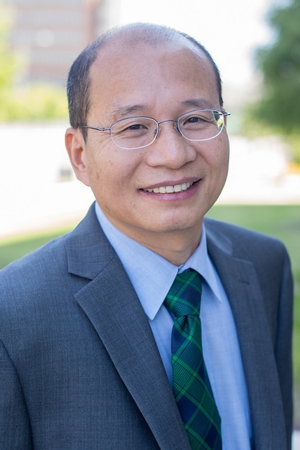 Yuliang Zheng, Ph.D.Technical training in the fundamentals of AI, and the mindset of adaptability needed to evolve with the changes that are ahead, will give UAB students the foundation to build successful careers. “One of the key skill sets of computer science students has always been lifelong learning,” Zheng said. “We teach students the fundamental technical knowledge, so that when they become professionals, they are ready to adapt to a field that is always rapidly changing. Going forward, every UAB graduate will need to have that same skill set.”
Is Zheng concerned that, eventually, “AI will just build AI”? “I get that question all the time,” he said. “The answer is no. AI still needs people.” He points to the 1990s fixation on cloning and Dolly the sheep. “Within a few generations of clones, everything had degraded. It was a dead end. We see the same thing with AI left to itself.”
That said, in the future AI will be everywhere, used in every industry, Zheng predicts. “AI is a fabulous accelerator,” he said. It can take on routine tasks, help with idea generation and synthesize large amounts of information quickly, allowing people to focus on higher-level thinking and problem-solving. “But the quality of a product is not just determined by how fast you solve a problem,” he said. “We have to produce graduates who can build better AI, more secure AI, and AI that is more fair, trustworthy and ethical.” (UAB’s Department of Philosophy recently introduced an Ethical Dimensions of AI Graduate Certificate program.)
Exploring new interdisciplinary degrees
Putting AI First aims to help position UAB as a leader in AI across the curriculum, not just in computer science. “We feel a responsibility to share our expertise in this area with all of campus,” Zheng said. “We can provide the technical training, but we are also eager to collaborate with other departments.”
Zheng has had discussions with departments across the College of Arts and Sciences about the potential to create new interdisciplinary degrees that leverage the college’s broad expertise in technology, science, ethics, sociology, communication and more. One idea is a new major that could give students rigorous training in AI and another discipline simultaneously. Zheng and his faculty are also envisioning two CAS-wide minors that would be focused on AI for the humanities and AI for the sciences. And a potential new AI minor in the Department of Computer Science would act as a bridge for students from other disciplines who want to complete the prerequisites for admission to the M.S. in Artificial Intelligence program. The minor would be modeled on the existing, successful cybersecurity bridge program that the department has created with federal funding. “We know how to build bridge programs that prepare students for graduate work,” Zheng said.
What sets UAB apart in AI education
Universities around the country are promoting their AI programs and credentials. So what sets UAB apart? When he gets this question from students and parents, Zheng offers three factors:
1. No AI siloes. “At UAB, we are not doing AI in a vacuum,” Zheng said. “We are teaching cutting-edge skills, but our faculty have other expertise as well. Students who come to UAB can also learn about applying AI to cybersecurity and other critical topics.”
2. Real-world research. “UAB is an R1 research-intensive university with a heavy emphasis on medical science, so students who want to contribute to major, real-world problems have plentiful opportunities to get an internship at one of our research labs and centers across campus,” Zheng said.
3. Unbeatable location. “UAB is a city campus, with a wide range of industries, including Fortune 500 companies, next door,” Zheng said. The department also has a close relationship with Birmingham’s Innovation Depot, a renowned business incubator, which is “filled with high-tech companies that are always asking for talent.”
Expanding AI research
Students, especially graduate students, benefit from working with faculty who are expanding the boundaries of their fields through research. Last year, the Department of Computer Science launched its AI Research and Collaboration Hub, which brings together AI-focused research faculty, supports new grant applications and acts as a gateway to collaborations with faculty working in adjacent areas. Zheng’s goal is for the hub to eventually become a college-wide center, modeled on the success of the UAB Center for Cyber Security.
In May, the Department of Computer Science joined with the UAB Center for Clinical and Translational Science to host its first AI Summit. The event attracted more than 130 participants from UAB and other state universities. In fact, organizers had to close registrations early because they had reached the maximum capacity for the venue.
Also in early May, UAB announced the launch of its AI Strategic Initiative. The initiative is establishing a unified, enterprise-wide approach to AI across the university’s academic, research, clinical and operational missions.
The AI Summit included extensive networking time to give faculty, students and staff an opportunity to meet potential collaborators. “That was our primary goal,” Zheng said, “and I do think there will be joint proposals coming from people who met each other at the summit.”
Zheng says this will be an annual event, and he expects it to grow. “As soon as it ended, we had people asking us when the next one would be,” he said.
Collaboration is key in a time of change
Although the current moment of change and uncertainty can be unsettling, Zheng emphasizes that UAB is positioned to lead.
Joint programs between departments will not only create new educational pathways but “open new avenues for faculty to partner on research as well,” he said. “There is so much potential here for collaborations that build on our strengths and allow us to explore new areas.”