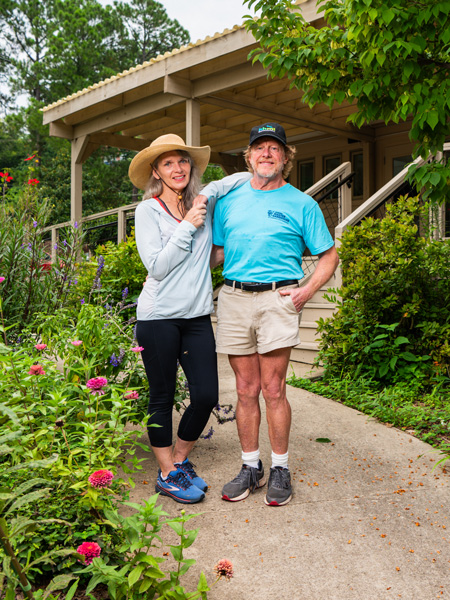
 Mary Williams and Fred Wagner at the UAB Solar HouseLast year, Fred Wagner retired from UAB after more than 38 years working as a research scientist in five different labs. But Wagner, who lives a short distance from campus in Crestwood South, has lately been making a familiar commute. As part of his required volunteer service for the Alabama Master Gardener program, he has been lending his horticultural expertise to the gardens at the UAB Solar House.
Therapeutic gardening
Wagner has been gardening for most of his life. “I like growing plants,” he said. “I find that it’s therapeutic.” It’s also an interest he shares with his wife, Mary Williams, Ph.D., a UAB alumna and former UAB employee who now teaches at the Alabama School of Fine Arts in the Math/Science Specialty Program. Wagner and Williams have built several greenhouses on their properties; they are filled with orchids, cacti and succulents. “I grow a lot of different plants here,” Wagner said. One of his favorite things to do is “find something I’ve never grown and order seeds.”
Wagner says he had been interested in getting his Alabama Master Gardener certification for a long time. “As I was starting to think about retirement, Mary and I saw a sign advertising the classes during a walk at the Birmingham Botanical Garden,” he said.
At first, Wagner’s main motivation for pursuing the certification was “learning more about different types of plants.” But while the classes and labs are interesting, Wagner says, he has found that the required volunteer hours have been most rewarding.
In addition to the Solar House, he is working with the Lovelady Center, helping with a rooftop garden on the center’s parking deck. “The ability to help other people is one of the most rewarding parts of the training,” Wagner said. “It’s a nice way to feel useful and to be useful.”
A new role in the Solar House garden
As a research scientist, Wagner spent the longest time — 17 years — in the lab of Olaf Kutsch, Ph.D., professor in the Division of Infectious Diseases, where he used “a vast amount of different molecular biology techniques” as part of the lab’s work studying how HIV hides in the body and then reactivates itself. “I really enjoyed my time at UAB,” Wagner said.
Now he is back, working with undergraduate and graduate students once a week in the gardens at the Solar House. The tasks vary: incorporating new plants, mapping the gardens’ variety of species, and inevitably, weeding and other garden chores. “Any type of garden has to be weeded,” Wagner said. “With all the mechanical devices that have been invented, usually you just have to do it by hand.”
Tour the UAB Solar House and gardens at the free, community-wide National Solar Tour event from 10 a.m.-1 p.m. at 1637 11th Ave. South on UAB's campus (find the Solar House on the Campus Map here). Learn more online.
Still, he does not mind getting his hands dirty. “It’s been a neat way to connect with new people after being retired,” Wagner said. “I really enjoy doing that. And it’s a way to be part of campus again.”
Rekindling a connection in retirement
Wagner was already familiar with the Solar House gardens through his wife. In 2020, Williams helped UAB Sustainability Manager Bambi Ingram create the Monarch Waystation plantings at UAB’s Honors Hall. “I had created a Monarch Waystation at Altamont School when I was teaching there, and Bambi found me through that,” Williams said.
A Monarch Waystation is one that is certified by the nonprofit organization Monarch Watch to provide a refuge for some of the hundreds of millions of monarch butterflies that travel between Canada, the United States and Mexico each year. “It must be a minimum size of at least 100 square feet, it must use native milkweed, and you cannot use pesticides on the garden,” Williams explained.
The plantings at UAB’s Solar House gardens are primarily swamp milkweed and common milkweed. Milkweed is named for the white liquid that is released from the plant when its leaves are eaten or broken. This liquid is filled with bitter alkaloids that are poisonous to most wildlife, Wagner says, but over time caterpillars have evolved resistance. “If a bird eats a monarch or caterpillar, they usually don’t finish the meal, because it is so bad tasting,” Wagner said.
Wagner has brought several different species of native milkweed plants and nectar plants from his greenhouse to help attract caterpillars and butterflies to the Solar House gardens. He also has supplied asters, a plant in the same family as the sunflower, and fennel and dill, which draw swallowtail butterflies. Passionflower, which was already growing in the Solar House gardens, attracts another type of butterfly called the Gulf fritillary.
“You have these specific plants that fulfill a niche for specific pollinators,” Wagner said. “If you want to see these different types of butterflies, you have to find what plants they feed on. Plant those and you are almost guaranteed to see butterflies.”
“The greatest gift that Fred and Mary have given to this project is expertise,” Ingram said. “We rely on student interns, volunteers and AmeriCorps VISTA volunteers to manage the gardens, and we can’t expect them to have the deep plant knowledge that Fred has. That, and they have given us the gift of butterflies!”