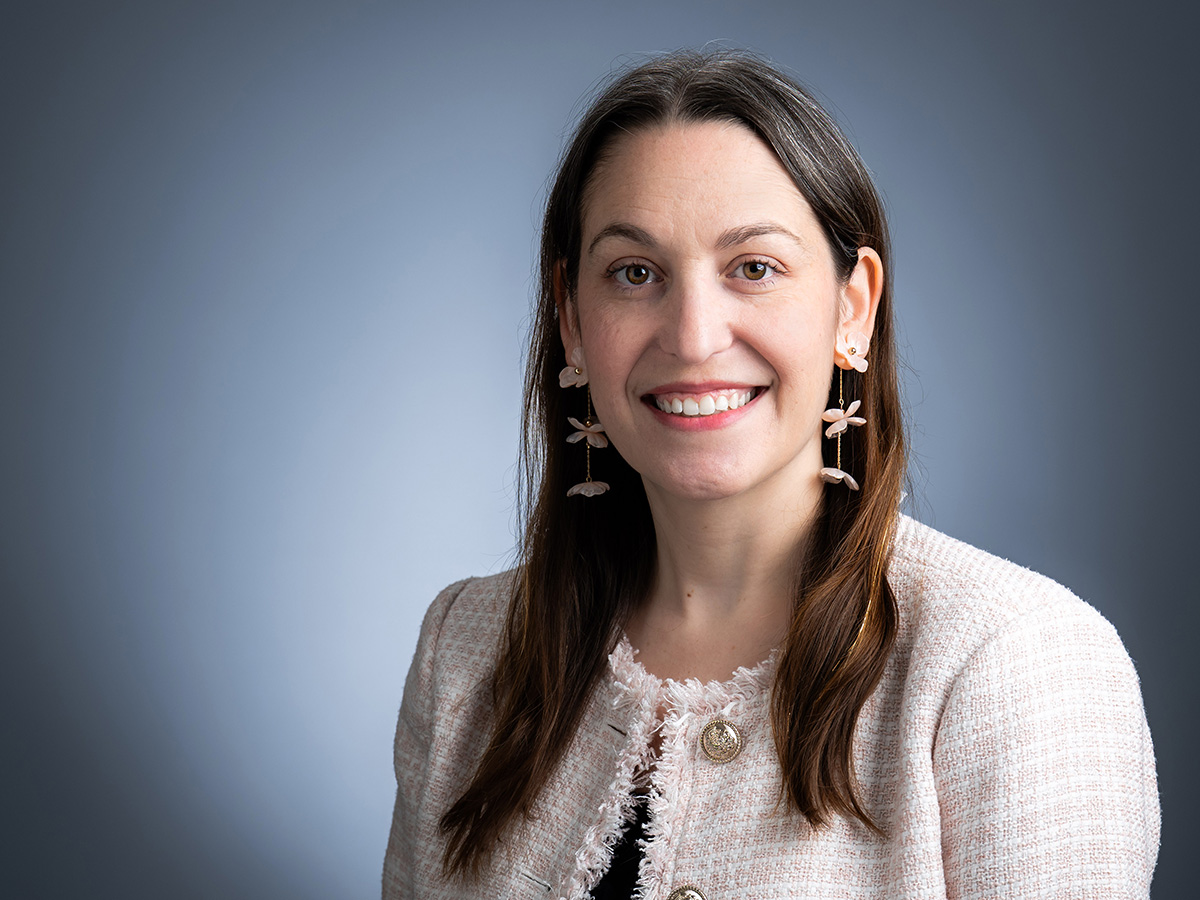
 Laura Stafman, M.D., Ph.D.How can you make a difference in the world around you?
It all begins with a willingness to get involved — and a commitment to the day-to-day work of moving things forward. That may be something as weighty as developing new treatments for childhood cancer or as seemingly simple as delivering meals to people in need.
Laura Stafman, M.D., Ph.D., an assistant professor in the Division of Pediatric Surgery in the UAB Heersink School of Medicine, does both. She also serves on a long list of institutional committees and national organizations, travels around the city and the state to provide surgical coverage, and maintains a research lab. After hours, she paints with watercolors and practices embroidery, including making tea towels with anatomically correct brains and hearts. (Her mother is a calligrapher and book artist.)
“I like to stay involved,” Stafman said during a recent interview. A pink neon sign in her office carries a message that seems equal parts motto and commentary on her busy schedule: “Evidence-based chaos.”
In recognition of Stafman’s efforts, she has received the 2026 President’s Award for Excellence in Support of UAB and Shared Governance. The award is given to a faculty member, staff member or student who exemplifies and embodies the UAB core value of unity of purpose through shared governance that propels the institution to achieve excellence in all parts of its mission.
From the OR to basic science and back
Stafman specializes in surgical oncology and hepatobiliary surgery (focused on the liver, pancreas, gallbladder and bile ducts) in pediatric patients. She also has a basic science lab where “I study pediatric solid tumors on a cellular level with the goal of trying to understand them better and develop therapies that can target them,” she said.
She is particularly interested in sialylation, a process that adds sugar molecules to proteins in tumor cells and “changes how the tumor cells behave,” Stafman said. Sialylation plays a role in neuroblastoma, tumors of the nervous system that almost exclusively affect children age 5 and under. “If we can understand that better, maybe we can develop therapies that target sialylation to help treat neuroblastoma,” she said.
Stafman first came to Birmingham in 2013, when she began her residency in general surgery. She also earned her doctorate in cancer biology at UAB in 2018, studying cell signaling in liver cancer in the lab of Distinguished Professor Elizabeth Beierle, M.D., Charles D. McCrary Endowed Chair in Pediatric Surgery in the Department of Surgery. After completing a three-year fellowship at Vanderbilt University Medical Center in 2023, Stafman returned to join the faculty at UAB.
Curiosity, resilience and collaboration
In nominating Stafman for the President’s Award, her colleagues noted her active roles in institutional and national committees, her extensive scholarship and participation in collaborative research projects, her efforts to mentor trainees, and her contributions to formal teaching and curriculum development.
She is a member of the Pediatric Surgical Oncology Research Collaborative, an international group that meets regularly to discuss and evaluate research questions of interest to practitioners in the field. “We vote on which ones we want to study and then we do the studies,” Stafman said. “That is helpful because pediatric tumors are, fortunately, very rare. But that makes them hard to study. Even somewhere like UAB, where we see patients from across the entire state, we still don’t see that many each year.” The research collaborative allows more than 50 institutions “to pool our data and look together, which is really helpful,” she said. Stafman also is a member of a research group that focuses on Wilms tumors, which are the most common childhood kidney cancer but still quite rare.
“As a principal investigator and collaborator on multiple funded projects, including NIH- supported programs, she advances our understanding of pediatric solid tumors and develops pathways toward improved therapies,” a colleague wrote in nominating Stafman for the President’s Award. “Her extensive scholarship and participation in multi-institutional collaborations reflect both intellectual rigor and a strong commitment to team science that advances the field as a whole.” In addition, the colleague wrote, Stafman “fosters a culture of curiosity, resilience and collaboration, empowering the next generation to contribute meaningfully to academic medicine.”
Another colleague praised Stafman for “always aligning her efforts with broader organizational goals” in clinical care, research and educational programming. “Her participation in leadership roles reflects a collaborative mindset and a clear dedication to advancing both departmental and institutional missions in a cohesive and inclusive manner,” they wrote. “She is particularly adept at bridging gaps between disciplines and aligning stakeholders toward shared goals.”
Getting involved and saying no — productively
Committee work may not be as exciting as a lifesaving surgery or offer the immediate gratification of delivering a warm meal to an elder, but it is how clinical care and medical research progress spread from a handful of institutions to standard practice. Stafman is a member of committees within the Children’s Oncology Group and the Association for Academic Surgery. She also is the vice chair of the Early Career/Trainees Committee within the American Academy of Pediatrics Section on Surgery.
At UAB, Stafman helps lead CME course development and resident education initiatives, including training in robotic surgery techniques. “I am currently the only general pediatric surgeon here who is robotic-trained,” Stafman said. “I am working to expand that.”
During her first stint in Birmingham, Stafman joined the Junior League, continued with the organization in the Nashville Junior League during her fellowship at Vanderbilt and has rejoined the Birmingham group now that she is back at UAB. “Each year, we have a project,” Stafman said. “This year, through Collat Jewish Family Services, I am delivering groceries to people in the area.”
Does Stafman have any advice on getting involved, moving into leadership and making a difference? She offers five suggestions.
1. Be visible:
“On Zoom, the first thing I would say is turn your camera on,” Stafman said. “People will see you, and then at a meeting that is in person, they will recognize you. If your camera is off, they won’t have any idea who you are. All the senior people know each other, but they probably do not know you. So, putting your camera on is really helpful.”
2. Raise your voice.
“When it seems like you could contribute, you should speak up,” Stafman said. “Many people are nervous, especially if it is a bigger meeting with senior colleagues you really look up to. But it’s important to speak up.”
3. Take your opportunities.
“Especially in the beginning, when you are new in a group or job or committee, if there is an opportunity to do something, take it,” Stafman said.
4. But do not agree if you cannot commit.
“If you feel like you don’t have the time to do something, don’t take it on if you are not going to be able to do it well,” Stafman said.
5. “No, but …”
“If someone asks you individually to do something, don’t just say no,” Stafman advised. “Say, ‘I don’t think I have the bandwidth for it right now, but this person would be really great.’ And have a suggestion — a peer or a trainee or someone else you can lift up to try to get them more visibility. You can help someone else out, even if you don’t have the time yourself.”