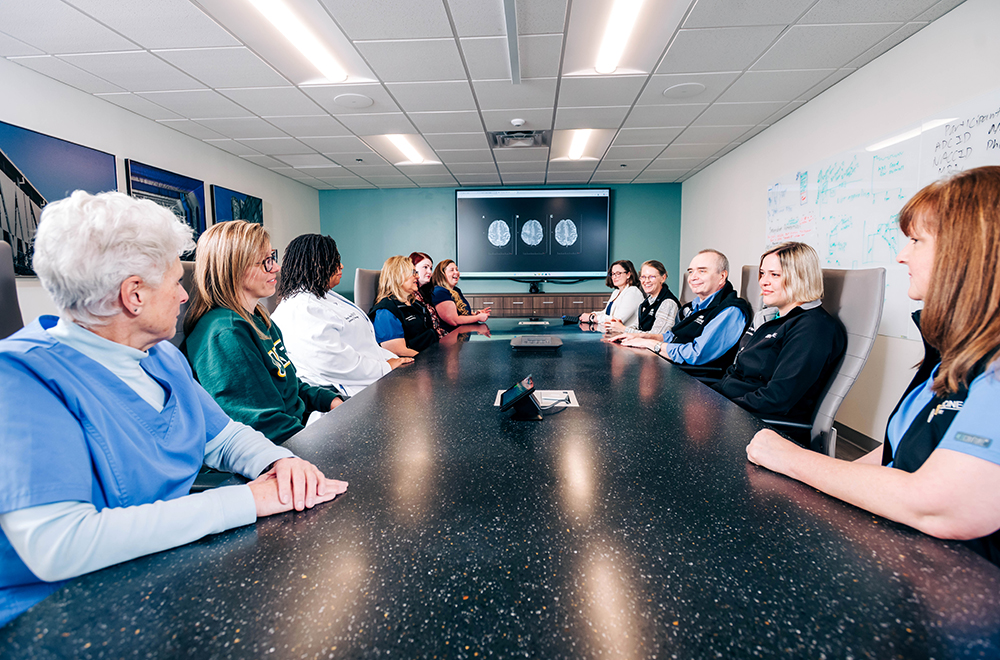
 Doctors, nurse practitioners, nurse case managers, and social workers gather in UAB's Brain Aging and Memory Clinic to discuss patient cases. “We have everyone involved in the process in the same place, and we are able to collaborate and have those conversations face to face that we need to have to care for our patients and track their progress,” said David Geldmacher, M.D. (third from right), who leads one of the country's largest anti-amyloid therapy programs, with more than 300 patients enrolled in treatment. "And we are doing it with many fewer neurologists," he said.
Can anything slow down Alzheimer’s?
For 35 years, as David Geldmacher, M.D., entered the field and became an internationally known expert in Alzheimer’s disease and memory disorders, he encountered that question from nearly every patient and family he treated. The answer, always, was no, not yet.
Today, that answer has changed. After decades of research and clinical trials, new treatments are available that can clear out the amyloid plaques in the brains of Alzheimer’s patients. Better yet, the pivotal trials showed that they slowed progression of the disease by as much as 30 percent.
 The availability of anti-amyloid therapies is "incredibly fulfilling," said Geldmacher, who directs UAB's Division of Cognitive and Behavioral Neurology. "For the first time, we are seeing patients who have amyloid levels that are undetectable on PET scans — as if they never had the disease."These anti-amyloid therapies — lecanemab (Leqembi), approved by the FDA in July 2023, and donanemab (Kisunla), approved in July 2024 — are not appropriate for all patients. They also come with a possibility of serious side effects from brain swelling and brain bleeding for some patients. Nevertheless, they have made UAB’s busy Alzheimer’s clinics even busier. And they are a source of pride for Geldmacher, who has been involved in studying this class of medicines for more than 20 years.
“For the first time, we are seeing patients who have amyloid levels that are undetectable on PET scans — as if they never had the disease,” said Geldmacher, who is University Professor, Warren Family Endowed Chair in the UAB Department of Neurology and director of its Division of Cognitive and Behavioral Neurology. “That is incredibly fulfilling, to say to a patient, ‘I took one of the pathogens causing your disease out of your body.’ After 35 years in the field, I know that I am actually altering the course of Alzheimer’s.”
In a lecture celebrating the 50th anniversary of the Department of Neurology this spring, David Standaert, M.D., Ph.D., professor and chair, John N. Whitaker Endowed Chair, called this “just an extraordinary moment in the world of Alzheimer’s disease.”
UAB now has one of the largest anti-amyloid therapy programs in the country, with more than 300 patients enrolled in treatment and an average of 10 new patients beginning therapy each month. This is remarkable success, even as an ongoing shortage of neurologists in Alabama has constrained UAB’s ability to meet the state’s desperate needs for brain care. “We are one of the larger programs in the country, and we are doing it with many fewer neurologists,” Geldmacher said.
This success is the result of proactive planning, a new space specifically designed for memory care, UAB’s long involvement in Alzheimer’s therapy trials and its experience in administering these new drugs. It also is due to a willingness to try new approaches to bring the benefits of these disease-modifying treatments to the maximum number of Alabama patients, Geldmacher says.
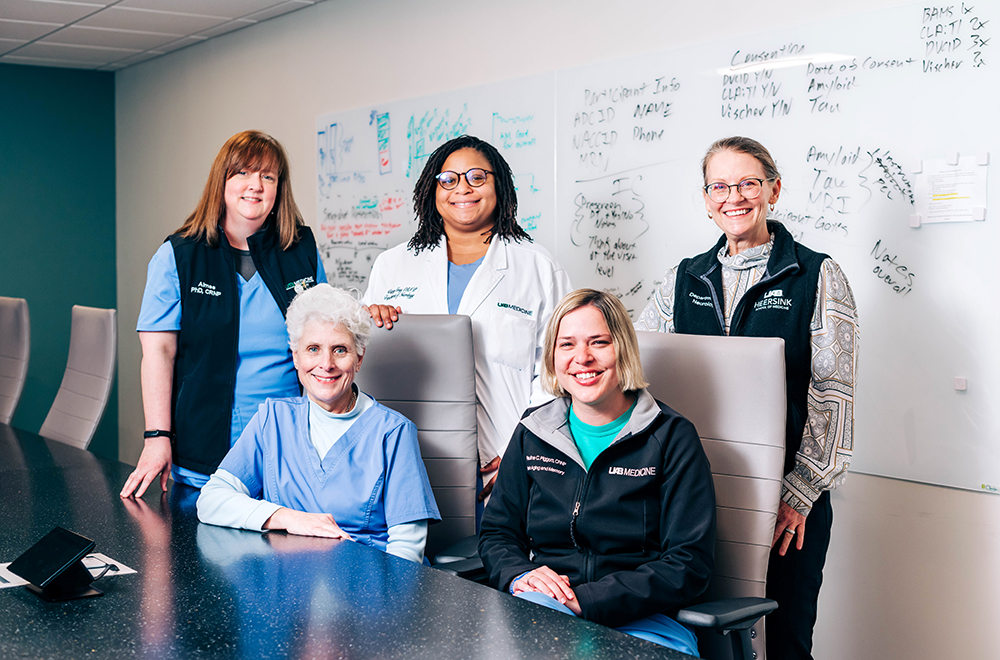 Specialized nurse practitioners are extending UAB’s limited supply of neurologists. Standing, left to right: Aimee Morrison, Ph.D., CRNP; Whitney Gray, CRNP; Catherine Brown, DNP, CRNP. Sitting, left to right: Rita Jablonski, Ph.D., CRNP, FGSA, FAAN; Pauline Piggott, CRNP Advanced.
“We could see this was coming”
“We created our care system in anticipation of the drugs — that is what makes our program different,” Geldmacher said. “We were ready to start an anti-amyloid therapy program before the first drug even came out. We could see this was coming.” In fact, Geldmacher says, UAB began testing lecanemab in 2014.
A few years ago, Standaert told Geldmacher, “We can’t keep doing what we’ve been doing.” Like all neurologists, Geldmacher and Standaert understood the statistics: By 2060, Alzheimer’s diagnoses in the United States are predicted to nearly double. Diagnoses in Alabama were on their way to rising by more than 20 percent between 2016 and 2025. Meanwhile, the training pipeline produces about 30 new cognitive neurology specialists each year. And so the UAB Memory Clinic, the only dementia-specialty clinic in Alabama and the Florida Panhandle region, was “becoming overwhelmed with patients,” Geldmacher said.
At the same time, UAB experts were part of the ongoing anti-amyloid therapy trials. They could see that the new drugs were successful at removing amyloid buildup in the brain — and likely slowing the progression of Alzheimer’s disease. “I’ve been involved in those studies going back all the way to the early 2000s,” Geldmacher said. “The trend was clear that the agents were becoming more effective.”
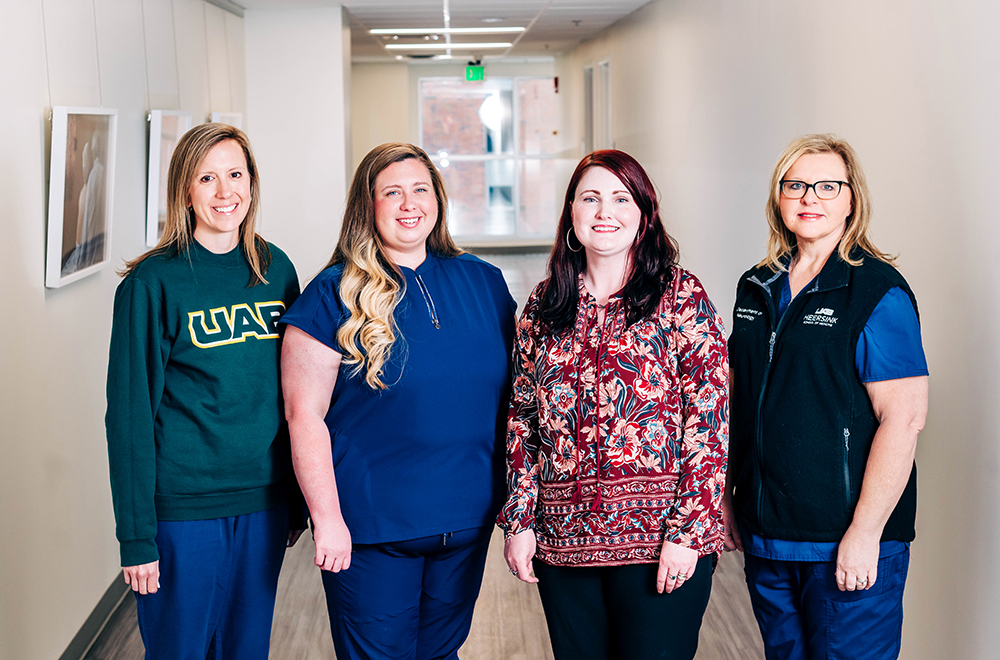 Dedicated nurse case managers coordinate the complex logistics of test and treatment scheduling needed to administer anti-amyloid therapies. Left to right: Laurie Morrison, R.N.; Danielle Wills, R.N.; Christina Mamaeva, R.N.; and Karen Fahnestock, R.N.
Reimagining Alzheimer’s care
In 2020, Standaert asked Geldmacher to lead an effort to reimagine how Alzheimer’s and memory care was provided at UAB. “We brought together a massive planning group — everyone involved in Alzheimer’s care, including social workers, case managers, nurse practitioners, doctors and more,” Geldmacher said.
 The UAB Brain Aging and Memory Hub, a 20,000-square-foot space on the fifth floor of the UAB Callahan Eye Hospital, opened in 2024, consolidating clinics and clinicians formerly spread around the UAB medical center.They consolidated clinics and clinicians that were spread around the UAB Medical Center into a single space, the nearly 20,000-square-foot UAB Brain Aging and Memory Hub, which opened in 2024. “It facilitates care and allows us to interact,” Geldmacher said. “We have everyone involved in the process in the same place, and we are able to collaborate and have those conversations face to face that we need to have to care for our patients and track their progress.”
They also established a new paradigm for Alzheimer’s care, with specially trained nurse practitioners extending UAB’s limited supply of neurologists. Dedicated nurse case managers, meanwhile, coordinate the complex logistics of test and treatment scheduling needed to administer anti-amyloid therapies.
“There is a tremendous shortage of neurologists as a whole in Alabama,” Geldmacher said. This also is a national problem, he emphasized: “There are more players under contract in the NBA than behavioral neurologists in the United States,” Geldmacher said. “But Birmingham is a net producer of nurse practitioners, and 80 percent of the care needs in Alzheimer’s disease are in the domain of nursing more than medicine. Nurse practitioners can also be trained in much larger numbers and shorter time frames than neurologists.”
Geldmacher’s team in the Division of Cognitive and Behavioral Neurology collaborated with leaders at the UAB School of Nursing to develop an Alzheimer’s-focused curriculum for nurse practitioners. They are now working to create a certificate program as well. “Other neurology practices could adopt this nurse practitioner model,” Geldmacher said. “It is a force multiplier that allows you to do more.”
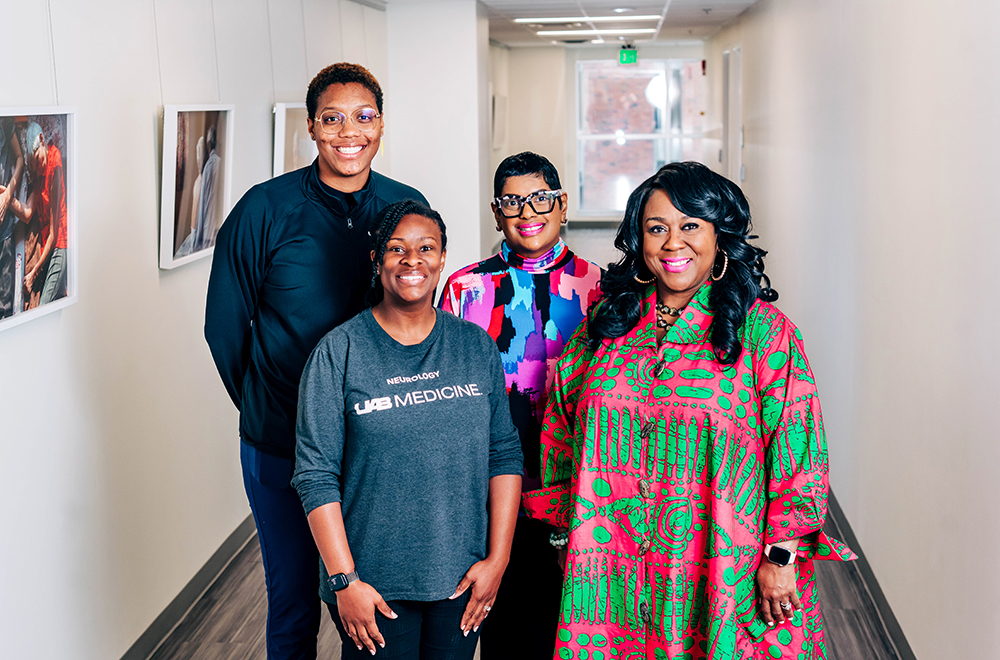 The planning process for UAB's reimagined approach to Alzheimer's care involved everyone involved in providing care. Members of the social work team shown here are, left to right: Medical Social Worker Chelsea Robinson; Medical Social Worker Phylicia Jackson; Care Transitions Assistant Trijah Jordan; and Care Transitions Assistant Andrea Kemp.
Another proposal Geldmacher is exploring is a “hub and spoke”-style system, along the lines of the Georgia Memory Network, which has a hub at Emory University and seven satellite programs around the state. “Emory provides the training, supervision and data management; but the care is provided at those locations, with support from the state,” Geldmacher said.
These efforts could greatly expand access for patients in Alabama. “And we are committed to doing everything we can to accelerate the process,” Geldmacher said. UAB is now piloting a new, nurse practitioner-centered intake plan, called the Amyloid Treatment Program, “for patients whose primary care doctor or neurologist has already done the workup, and they just need us to organize the medication plan and safety monitoring,” Geldmacher said.
Still, “we have a substantial queue” overall for treatment initialization, Geldmacher said. “There has been a very clear rising trend in people coming to specialty memory care” over the past several years. “Now that there are medications out there, people are much more likely to ask their doctor, ‘Do I need to go to a memory clinic?’ And now, instead of saying, ‘That’s just a part of growing old,’ more doctors are saying, ‘Yes, we should get that checked out.’”
“Now that there are medications out there, people are much more likely to ask their doctor, ‘Do I need to go to a memory clinic?’ And now, instead of saying, ‘That’s just a part of growing old,’ more doctors are saying, ‘Yes, we should get that checked out.’”
The main bottleneck in seeing more patients is the reality that “you still need to diagnose,” Geldmacher said. “Alzheimer’s disease is frequently the cause of memory problems and dementia symptoms, but there are other causes that can masquerade as Alzheimer’s. There is still a need for biomarker-based diagnosis and interpretation of symptoms.”
The future of anti-amyloid therapy
Anti-amyloid therapy continues to evolve. “There is interesting new technology being developed by Roche to try to get more drug in the brain” by carrying it more efficiently across the blood-brain barrier, Geldmacher said. That could result in “fewer infusions and higher concentrations” of the drug in the brain. It also could reduce the vascular exposure, including the brain swelling and amyloid-related imaging abnormalities, or ARIA, that are seen in some patients and require particular caution for patients with APOE4 genetic mutations.
The new technology “offers great promise for enhanced safety and patient convenience, but we don’t know if it offers greater benefit,” Geldmacher said. UAB was selected as study site for Phase 3 clinical trials of the new drug candidate, trontinemab, he notes (enrollment has already closed).
“The anti-amyloid therapies we have today are expensive, potentially toxic and very time-consuming,” Geldmacher said, “but they put us on the path to where we need to be.” And it is always important to remember that Alzheimer’s itself is an implacable enemy, he says. “This is a uniformly progressive, usually terminal disease that had no prior treatments available,” Geldmacher said. “Most patients and families, in listening to the potential risks and benefits — and knowing the other option is doing nothing — choose to accept the risks.”
Geldmacher began his career in memory specialty practice in 1993, the same year that Cognex, the first symptom-modifying treatment for Alzheimer’s, was approved to improve memory and thinking. “And now we have these anti-amyloid therapies,” Geldmacher said. “So my career spans the first symptomatic drugs to the first disease-modifying drugs. That is really fulfilling as a drug-based researcher, to know that that arc over time has really paid off.”
Learn more and contact the UAB Brain Aging and Memory Clinic.