 Julia Schroeder, M.D., an instructor and fellow (left), presents the details of a case to Jeremey Walker, M.D., medical director of the Immunocompromised Infectious Diseases program (center), Edwina Rao, M.D., second-year infectious diseases fellow (right) and other members of the team.
Jeremey Walker, M.D., medical director for UAB’s newly expanded Immunocompromised Infectious Diseases program, regularly finds himself on the outer reaches of medical experience.
“A lot of what we do doesn’t have a formal guideline or book chapter that you can look up,” said Walker, an associate professor in the Division of Infectious Diseases in the UAB Heersink School of Medicine. The specialty is regularly referred to as “transplant infectious diseases,” named for the unique challenges that occur when patients are given immunosuppressive drugs to keep their bodies from rejecting donor organs. But today, the boundaries of the specialty keep expanding. Immune-modifying therapies are multiplying for treatment of cancer and autoimmune diseases. These new drugs are remarkably effective, but they increase patients’ risk for infections as well.
UAB is the only medical center in Alabama offering specialty care for infections in immunocompromised patients.
The specialists who staff UAB’s growing IC-ID program — including seven physicians, a nurse practitioner and a dedicated pharmacist — pool their experience to solve the diagnostic challenges they face regularly. In their field, the microbes causing patient illness are often ones rarely seen by most physicians, even infectious diseases specialists. The team also taps into advanced diagnostic testing from UAB’s microbiology and pathology departments and access to the latest anti-microbial drugs thanks to the leadership of UAB Professor Pete Pappas, M.D., in the international Mycoses Study Group.
UAB is the only medical center in Alabama offering specialty care for infections in immunocompromised patients. The IC-ID team fights the infections that attack Alabamians after solid organ transplants or stem cell transplants for blood cancers; while receiving chemotherapy and CAR-T treatments for cancer or TNF inhibitors and monoclonal antibody-based drugs for autoimmune disorders; or while using advanced cardiovascular support devices, such as LVADs for heart failure or the ECMO heart and lung bypass machine.
 The multidisciplinary IC-ID team includes: front row, left to right: Antimicrobial Stewardship Pharmacist Seth Edwards, PharmD, BCIDP; Assistant Professor Emily Wong, M.D.; Assistant Professor Aditi Jani, M.D., MSPH; middle row, left to right: Professor Peter Pappas, M.D.; Professor Craig Hoesley, M.D.; Instructor-Fellow Julia Schroeder, M.D.; Associate Professor Jeremey Walker, M.D.; Fellow Kenneth Long, M.D.; back row, left to right: Professor and Division Director Martin Rodriguez, M.D.; ID Transitions of Care Pharmacist J.D. Olivet, PharmD, BCIDP, AAHIVP; Associate Professor Todd McCarty, M.D.; Assistant Professor Cesar Berto Moreano, M.D.; Fellow Robert Johnson, M.D.; and Associate Professor Nathan Erdmann, M.D., Ph.D. Edwards and Olivet are members of the UAB Hospital pharmacy department; all others pictured are members of the UAB Division of Infectious Diseases.
More transplants, new therapies and longer lives
According to a national health survey, the number of immunocompromised patients in the United States more than doubled between 2013 and 2021, to an estimated 23 million Americans. The number of solid organ transplants performed each year rose sharply over that time frame, but new therapies for cancer and autoimmune diseases are also driving that growth.
“People are living longer with advanced conditions. I see patients all the time in clinic who are 20 years out from a kidney transplant.”
Those same trends have stretched UAB’s IC-ID program, which works closely with the UAB Comprehensive Transplant Institute, one of the nation’s busiest transplant centers, and the UAB O’Neal Cancer Center. In addition to the growth in transplant volume and new immune-modifying treatments, “people are living longer with advanced conditions,” Walker said. “I see patients all the time in clinic who are 20 years out from a kidney transplant.”
A recent investment from the UAB Health System has expanded the IC-ID program’s outpatient clinics to five days a week, added space and allowed the recruitment of two additional physicians: Julia Schroeder, M.D., and Kenneth Long, M.D., who just completed third-year fellowships with concentration in transplant infectious diseases at UAB. (Robert Johnson, M.D., currently a second-year fellow, will also focus on transplant infectious diseases in the upcoming year.) The funding also allowed for increased support for multidisciplinary care meetings, infection prevention, antibiotic stewardship and quality initiatives. “We are very appreciative of this support,” Walker said.
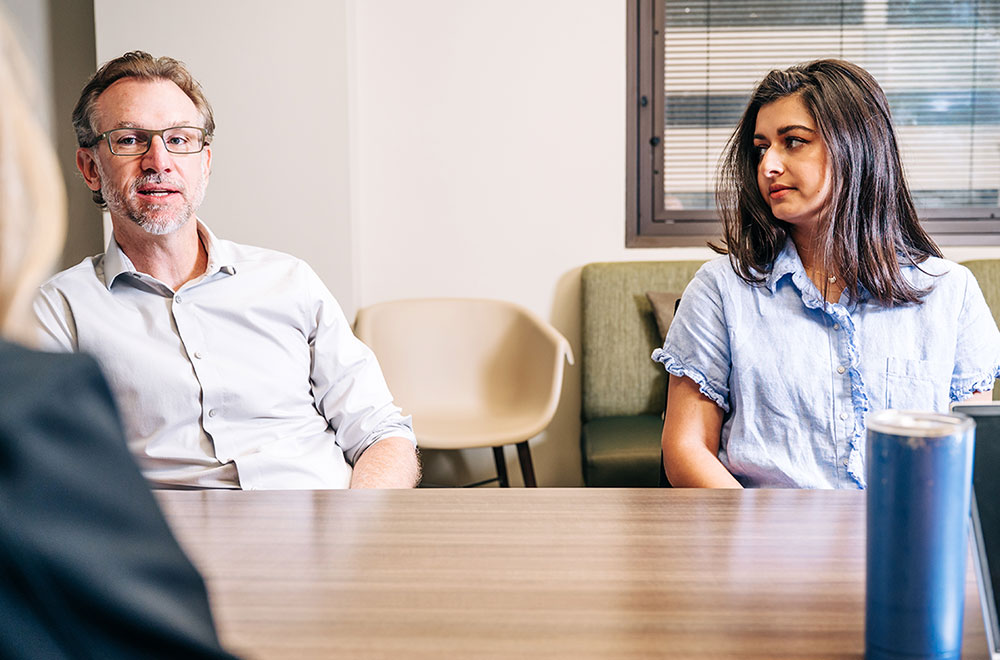 Nathan Erdmann, M.D., Ph.D., and Aditi Jani, M.D., MSPH (left and right), weigh in on the details of a case. Because the microbes involved are often so rare, and the treatments so new, pooling the knowledge of a network of specialists helps the UAB team solve diagnostic dilemmas.
Where the threats are
Microbes that threaten immunocompromised patients fall into three main categories, Walker says. There are community-acquired pathogens, such as E. coli and strep; hospital-acquired pathogens, such as Candida auris and other drug-resistant microbes; and opportunistic pathogens, such as molds and fungal infections, that typically do not infect healthy individuals. “Any immunocompromised person is at higher risk for community-acquired illness and more likely to have a healthcare exposure,” Walker said. But it is the opportunistic pathogens that can be the most puzzling, because the infectious agent could be so many different things, many of which do not grow on typical lab cultures.
“That is where you really see the value in subspecialized knowledge like we have here at UAB, because we are seeing all these cases and getting broader exposure to the effects of different agents.”
Certain therapies have clear immune implications. Patients with leukemia have lower neutrophil counts after a stem cell transplant, which makes them particularly vulnerable to mold and fungal infections. With solid organ transplants, T cells are more impacted, and physicians encountering an infection may suspect pneumocystitis or CMV. “With the new monoclonal antibodies used for many conditions, including autoimmune diseases, there are some known associations — this is related to certain viruses, this is related to fungi — but it’s not nearly as well understood,” Walker said. “That is where you really see the value in subspecialized knowledge like we have here at UAB, because we are seeing all these cases and getting broader exposure to the effects of different agents.”
The treatments are often so new, and the infections that immunosuppressed patients acquire are so rare, that much of the work falls in the category of what Walker calls “diagnostic dilemmas.” They “really challenge you to think about the immunology and underlying deficits” caused by the patient’s disease and the treatments they are receiving, Walker said. “You use all aspects of your memory and medicine mind. And then we have a network to go and say, ‘I’m seeing something atypical; has anyone seen something like this before?’”
 Specialized pharmacists such as Seth Edwards, PharmD (left), work closely with IC-ID physicians such as Julia Schroeder, M.D. (right), to identify potential drug–drug interactions between an antimicrobial treatment and a patient’s immunosuppressive therapy, and to work through the prior authorizations needed for insurance to cover expensive or rarely used medications.
Multidisciplinary care
The specialty is highly collaborative. “Multidisciplinary care is a hallmark of our program here,” Walker said. On any given day, IC-ID physicians may work with:
- pharmacists to think through potential drug–drug interactions between an antimicrobial treatment and a patient’s immunosuppressive therapy — and to get the prior authorizations necessary for the patient’s insurance to cover expensive or rarely used medications;
- microbiologists and pathologists to get speedy access to the advanced PCR and genetic testing available from UAB’s world-renowned Fungal Reference Laboratory and other diagnostic facilities to pinpoint the bacterium or virus causing a patient’s illness;
- interventional specialties such as pulmonologists, radiologists, dermatologists or surgeons to obtain a testable sample from wherever infections localize;
- oncologists, rheumatologists and transplant physicians to discuss whether a patient’s symptoms could be related to their cancer or autoimmune disease — or effects of their treatment — and, if necessary, consider how best to adjust immunosuppressants moving forward.
Often, an IC-ID physician must balance the need to knock out an acute infection while interfering as little as possible with care for the patient’s chronic condition. “Sometimes, we will have to call after a transplant, for instance, and say, ‘This is a bad infection; is there anything we can do to reduce immunosuppression while not prompting organ rejection?’” Walker said.
“The opportunity for reassurance”
One of the joys of the specialty is “the opportunity for reassurance,” Walker added. “Just the other day, I had a patient in my clinic who had driven several hours to see one of our oncologists, and it turned out she had a routine infection,” he said. “The oncologist wanted to know, ‘Is this under control?’ Being able to provide that reassurance and tell the oncologist, ‘It’s OK to move forward and do what you need to do to treat the main issue,’ and tell the patient, ‘You can start your cancer treatment today’ — that is a wonderful feeling.”
"People have a transplant or get treatment for a chronic disease so they can live their lives, not live in a bubble. Being able to give them parameters about what is higher risk and what is lower risk allows them to reenter their old routines as much as possible.”
Helping patients and family members learn how to reduce their risk of infection is rewarding as well. “People have a transplant or get treatment for a chronic disease so they can live their lives, not live in a bubble,” Walker said. “Understandably, especially if they have already experienced a bad infection, they may be hesitant to step out. Being able to give them parameters about what is higher risk and what is lower risk allows them to reenter their old routines as much as possible.” The IC-ID program now offers five half-day outpatient clinics where these issues can be addressed with patients — and serious infections can be followed until resolution.
UAB offers a specialized one-year fellowship program in transplant infectious diseases, but all infectious diseases fellows care for this population during their fellowships, Walker notes. Education is central to the specialty; Walker and his colleagues regularly teach medical students, residents and community physicians about the growing impact of transplant surgeries and immune-modifying drugs on their patient populations, no matter what type of medicine they practice.
“I always like to share this stat,” Walker said: “More than 16,000 organ transplants have occurred at UAB, and they live throughout our region. In any hospital, any service, any time, you may get someone with a kidney transplant walking in your door. Knowing what that means if they are having a fever is important to any doctor.”