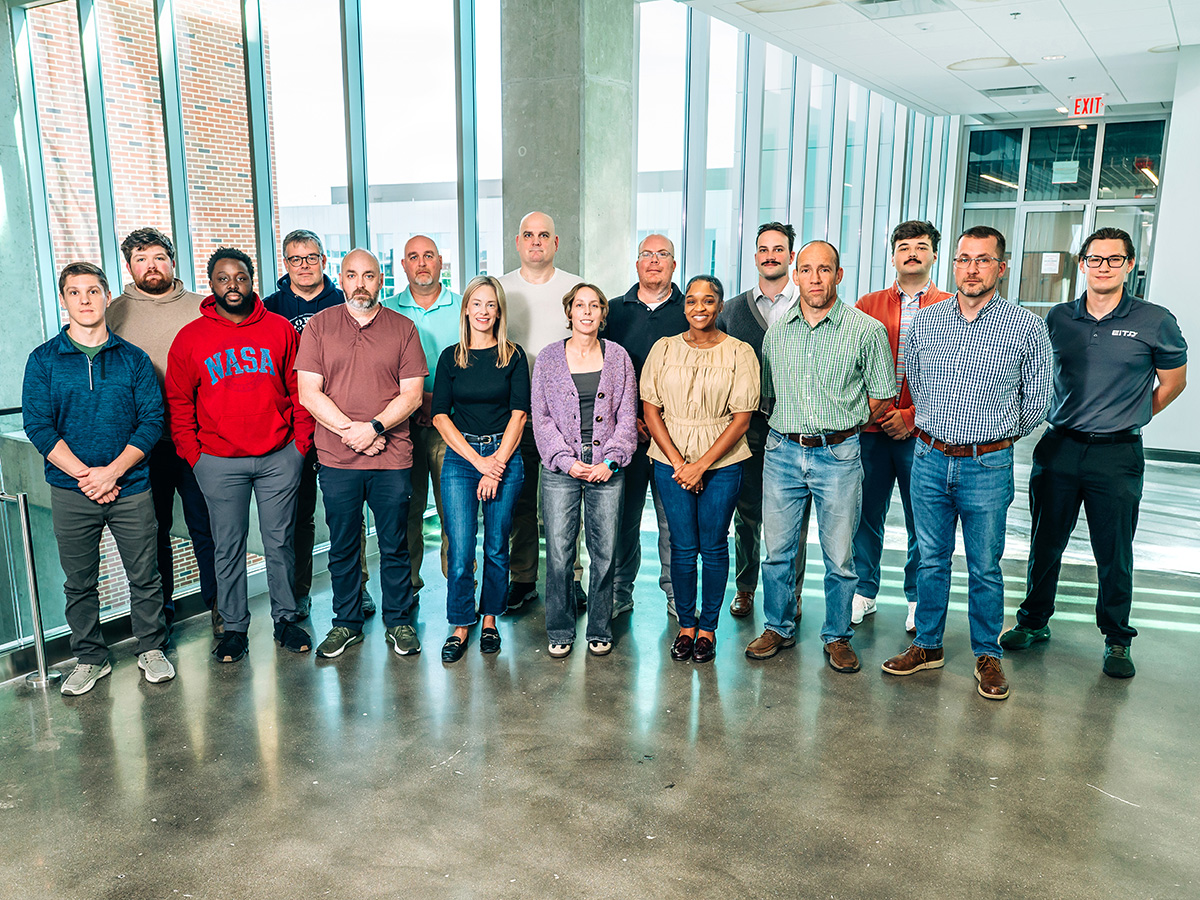
 Members of the EITD group in the School of Engineering outside their labs on the fourth floor of Gorrie Hall.These days, any ambitious project may call itself a “moonshot.” Chad Duke and his team in UAB’s Engineering and Innovative Technology Development (EITD) group are prepping for a real one.
In the fourth-floor labs of the School of Engineering’s new Gorrie Hall, EITD is developing the Lunar Freezer System for NASA’s Artemis moon missions. Their machines, tentatively scheduled to launch in 2030, build on a long tradition of EITD cold stowage work with NASA that dates back more than two decades.
The original Microgravity Experiment Research Locker Incubator (MERLIN) cooling system was designed for the Space Shuttle. EITD adapted it for the International Space Station, then followed with Glacier, Polar, Glovebox Freezer, Cryo Chiller and Iceberg. All of these units are still in active operation supporting science on the ISS, while MERLIN and Polar are used to ferry science samples and other specimens from space to Earth and vice versa. EITD monitors and troubleshoots the units from a live link in its Remote Operations Control Center — they call it the ROCC — in Gorrie Hall.
The Lunar Freezer System, being developed through a $37 million NASA contract, has some requirements similar to those of the ISS units, Duke says. “It must be able to maintain a constant temperature of -85 degrees Celsius while also consuming very little power,” he said.
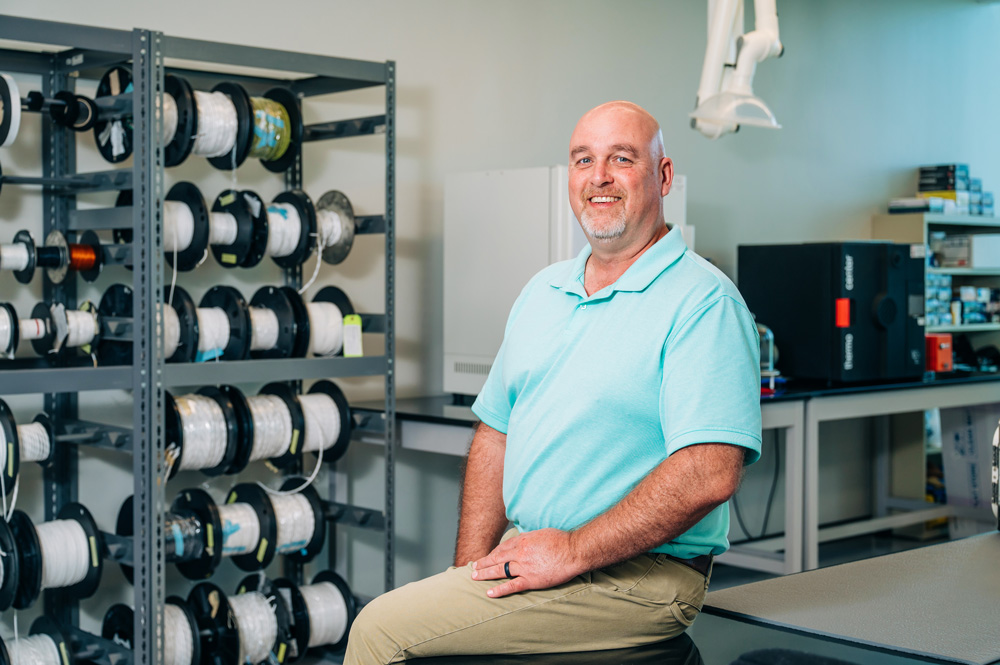 EITD Director Chad Duke said the Lunar Freezer System that his team is developing for NASA's Artemis missions requires unique engineering design choices to cope with the harsh environment of the planned moon landings.Those competing demands, along with zero tolerance for maintenance issues, means EITD plans to adapt the same Stirling engine cryocooler concept it uses in all its cold stowage hardware. These cryocoolers have a long track record of reliability and efficiency, requiring minimal power to reach tremendously low temperatures.
The Lunar Freezer System will travel to the moon’s surface, where astronauts will fill it with soil and dust samples, known as lunar regolith, that will be carried back to Earth for research. “Volatile gasses can be released from the lunar regolith samples if they are not kept at the right temperature,” Duke said. “In addition to the low-temperature requirements, the Artemis missions will present a harsher environment than the ISS’, causing radiation hardening to be a major consideration in our design. We are also designing unique ways to transfer the heat and protect the samples.”
EITD is now in the System Requirements Review phase with NASA, which will be followed by Preliminary Design Review and Critical Design Review and finish with System Acceptance Review. The team will build a technology demonstrator unit and then an engineering design unit to prove their design, before beginning construction on the actual flight units, which are due to NASA in 2029.
The first flight unit will be designated the qualification unit. EITD and NASA will put it through a series of torture tests designed to verify its ability to handle the rigors of spaceflight. “We’ll test its performance to the limits and prove that our design works,” Duke said.
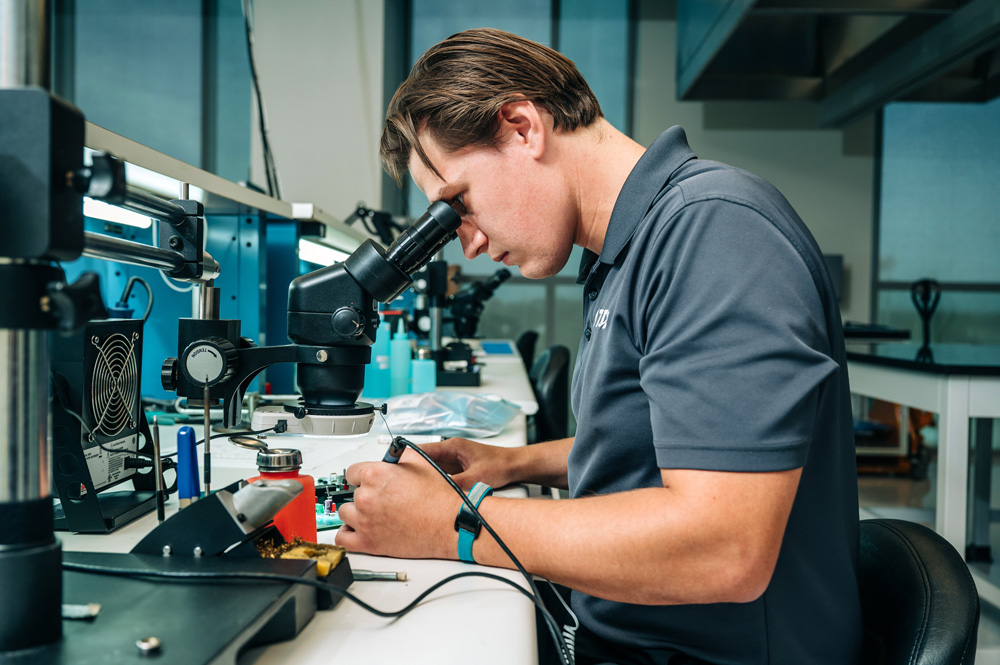 EITD's Nicholas Collins works on a component of the Lunar Freezer System prototype.
Glacier was originally designed, fabricated and assembled all in-house at UAB, Duke explains. But the need for more cold stowage units over the years means that fabrication is now trusted to outside manufacturers, working to detailed specifications and drawings from EITD. “We do the design and drawing, we put the drawings out for manufacturing, and then everything comes back here for assembly,” Duke said. “Our technicians are certified to stringent NASA standards for soldering, crimping and harnessing skills.”
Even as work progresses on the Lunar Freezer System, EITD’s Cold Stowage contract continues. “We have had to staff up,” Duke said.
Put elite minds to work on your UAB projects
This year, EITD added a new service for the UAB campus community, Blazer Launchpad for Advanced Design & Engineering, known as BLADE. This “university-wide rapid innovation engine” was designed to leverage EITD’s expertise to help UAB clinicians, researchers, faculty, staff and their collaborators “de-risk high-potential concepts,” Duke said. “We can work with them to translate promising ideas, unmet clinical or research needs, and early-stage concepts into engineered solutions.” Selected projects receive focused engineering and product-development support, ranging from feasibility assessment to proof-of-concept or functional prototype development, Duke says.
Learn more about eligibility requirements and see examples of support areas on the BLADE site.