 Results from a small randomized controlled clinical trial show promising findings about a new type of therapy for patients experiencing brain fog as part of long COVID. Brain fog affects more than 1 in 5 people with long COVID, according to a review of multiple studies published in 2024, while long COVID itself affects 45% of COVID survivors.
Known as Constraint-Induced Cognitive Therapy, or CICT, this is the first treatment to show improvements in everyday function in a randomized controlled clinical trial for this often-disabling condition, said Gitendra Uswatte, Ph.D., professor in the departments of Psychology and Physical Therapy at UAB and director of its CI Therapy Research Group. Uswatte was the study’s principal investigator and senior author of a paper describing the trial in the February 2026 edition of the journal Rehabilitation Psychology.
In the 14-person study, participants randomized to receive CICT had very large improvements in their ability to perform everyday tasks compared to participants who received treatment as usual. Four of the five non-retired participants who received CICT treatment were able to return to work; the fifth was working on a limited duty set before treatment and went back to work full-time after CICT therapy. None of the five treatment-as-usual participants returned to work. (In each group, two participants were retired.) “Those were really striking findings,” Uswatte said. A larger clinical trial of the treatment is now underway and still enrolling participants. (Learn more about that trial online or by calling (205) 934-9768 or emailing
“These are still early days,” Uswatte said. “The findings from the pilot need to be confirmed in a larger trial, but there is certainly considerable interest from patients and from the community that is studying long COVID. There are really no cognitive rehabilitation interventions for long COVID brain fog with evidence of efficacy from a randomized controlled trial, and there are a lot of patients whose functioning is impaired substantially by brain fog.”
How CICT works
CICT combines two research-based therapies: a software-based training to improve cognitive processing speed and intensive lab training on everyday tasks, followed by a “transfer package” to help participants translate this training into their regular lives.
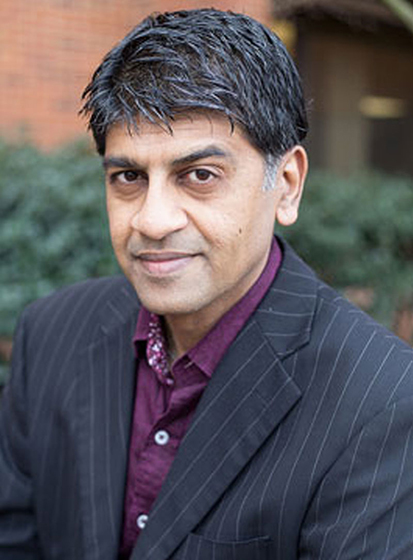 Gitendra Uswatte, Ph.D.“A common feature of people with long COVID who have brain fog symptoms is slowed cognitive processing,” said Uswatte. This also is a common complaint affecting patients after stroke. Before the pandemic, Uswatte and Edward Taub, Ph.D., retired University Professor in the Department of Psychology and founding director of the CI Therapy Research Team, had been working on adapting Constraint-Induced Movement Therapy, or CI Therapy, originally developed by Taub, to help with cognitive issues.
In several single- and multi-site randomized controlled trials, CI Therapy has demonstrated effectiveness at helping participants regain use of their limbs after stroke. It is used around the world to help patients regain limb function and language abilities after stroke. Some 97% of the thousands of stroke patients who have taken part in CI Therapy at UAB have seen meaningful improvement, Uswatte says, and the average patient uses his or her affected limb five times more post-therapy than pre-therapy. Brain scans showing significant rewiring after CI Therapy had long since convinced the UAB researchers that the technique could restore cognitive function in the same way it restored a person’s ability to move their arms or legs. “We found in the motor rehabilitation work that the therapy is effective for a number of different types of brain damage,” Uswatte said.
Where CI Therapy particularly stands out is its ability to translate gains out of the lab into real-world settings. A main component of the therapy, in addition to intensive training on everyday tasks and constraint of compensatory behavior, is called the transfer package. The transfer package includes negotiating a behavioral contract at the beginning of treatment, specifying activities that participants will do at home and the responsibilities of caregivers, and problem-solving with participants to help them overcome perceived and actual barriers.
“A thread that runs through all our CI Therapy work, motor and cognitive, is an emphasis on measuring and making meaningful changes in people’s everyday lives,” Uswatte said. “We use specific strategies to manifest changes in the treatment setting, but also beyond that.”
Taub and Uswatte had already adapted the therapy for other conditions, including cerebral palsy, and for stroke patients with aphasia, or trouble speaking. Because strokes often leave patients with slowed cognition as well as motor difficulties, the researchers had been exploring ways to rehabilitate damaged minds by combining their CI Therapy with speed of processing training, another research-proven treatment that was developed by University Professor Karlene Ball, Ph.D., also a member of UAB’s Department of Psychology.
“Karlene developed what looks like a video game to speed up how quickly the brain processes information,” Uswatte said. “There are many different tasks, but typically they involve identifying a central target and then identifying a target in the periphery. The stimuli are presented quickly, and as the participant gains mastery, the progression of stimuli gets increasingly fast.”
Processing speed is “a basic cognitive capacity that underlies our other, more specialized cognitive functions,” Uswatte explained. “So many of our everyday activities depend on that basic process of our brain.”
Participants complete speed-of-processing training during 10 sessions in the lab at UAB; after each session, they are assigned 10 tasks to carry out as homework. “These are tasks that are important to the person or their quality of life and are going to challenge their cognitive skills.” Examples include cooking a meal with more than three ingredients, starting a conversation, remembering medication, doing the laundry or making out a shopping list.
Uswatte notes that the Alabama Department of Rehabilitation Services is a partner in the ongoing randomized controlled trial of CICT in his lab. “They are very interested in anything that helps people return to work,” Uswatte said.