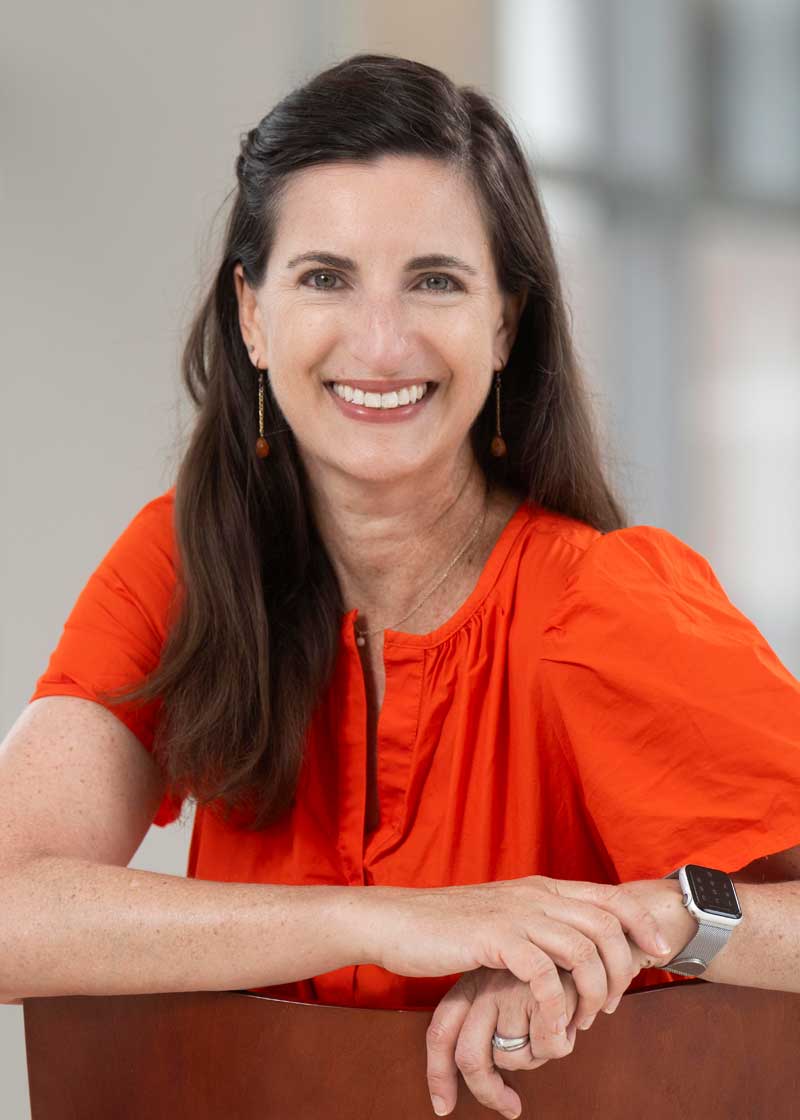
Monica Gramatges, M.D., Ph.D., is a physician-scientist whose research has focused on understanding and improving outcomes for children with cancer and childhood cancer survivors. Her work explores the genetic and molecular factors underlying cancer treatment outcomes and disparities, as well as strategies to improve access to cancer survivorship care and education. She joins the Department of Pediatrics at the University of Alabama at Birmingham (UAB) Heersink School of Medicine as a Professor in the Division of Pediatric Hematology/Oncology. She will serve as Deputy Director of the Institute for Cancer Outcomes and Survivorship.
Dr. Gramatges earned her B.S. from the College of William and Mary and her medical degree from the University of Texas Medical School at Houston. She completed her residency in general pediatrics at Oregon Health and Science University and her fellowship in pediatric hematology/oncology at Stanford University. She later earned her Ph.D. in Clinical Investigation from the Baylor College of Medicine Graduate School of Biomedical Sciences. She joined Baylor College of Medicine in 2009 as an Assistant Professor of Pediatrics, supported by an NIH K12 Paul Calabresi Career Development Award. She was promoted to Associate Professor with tenure in 2017 and to Professor with tenure in 2023.
Dr. Gramatges investigates factors that influence and underlie cancer treatment outcomes and the long-term health of survivors of childhood cancer. Her research examines how genetic and molecular differences contribute to variation in treatment outcomes and to disparities in cancer outcomes. She also investigates approaches to improving access to survivorship care and education to promote lifelong health for survivors. Supported by a K23 Mentored Patient-Oriented Research Career Development Award to Promote Diversity, her early basic science/translational research examined evidence for genetic predisposition to acute myeloid leukemia and treatment-related toxicities, with a specific focus on defects in telomere biology.
Over time, Dr. Gramatges developed a growing interest in cancer survivorship research, recognizing that most survivors develop significant late effects that impact their quality of life, while simultaneously lacking access to quality, guidelines-informed survivorship care. Very early in her career, she submitted a proposal to study the effects of telomere length on the risk of second cancers using the Childhood Cancer Survivor Study. Dr. Smita Bhatia was assigned as her mentor, beginning their longstanding mentor-mentee relationship and leading to Dr. Gramatges’s first funded R01 award. Her independent research career has subsequently focused on understanding the role of telomere genetic variation and dysfunction on risk for second cancers, characterizing clinical outcomes and related molecular characteristics in understudied, vulnerable survivor populations such as Latino survivors and survivors of Down Syndrome-associated acute leukemia, and developing pragmatic strategies to improve delivery of cancer education and survivorship care in low-resource settings.
Gramatges’ research has been supported by awards from the National Institutes of Health (NIH) and the leading cancer research foundations. Her work has appeared in peer-reviewed publications including Blood, Clinical Cancer Research, Journal of Clinical Oncology, Journal of the National Cancer Institute, PLOS ONE, Annals of Oncology, Lancet Oncology, and JAMA Network Open. She is a member of the American Pediatric Society and the American Society of Clinical Investigation honorary societies, and in 2021 was recognized by the American Society of Pediatric Hematology/Oncology with a Childhood Cancer Survivorship Award for Excellence. She holds several national leadership roles in pediatric oncology and cancer survivorship: she is the current Chair of the Children’s Oncology Group Outcomes/Survivorship Committee, Co-Chair of the Genetics Working Group for the Childhood Cancer Survivor Study, and Chair of the Advocacy Committee for the International Society of Pediatric Oncology-North America.
Transitioning to her new role at the University of Alabama at Birmingham offers a wealth of opportunities for scientific collaboration as she shifts current funded projects from observational studies to interventions and expands foundational survivor cohorts into prospective, longitudinal follow-up studies. UAB also offers exciting prospects to build from existing infrastructure and expand access to survivorship services across the state. The long-term goals of her research program are to expand healthcare access for underserved, vulnerable populations, identify modifiable factors contributing to disparities in cancer outcomes, and develop pragmatic strategies for screening and intervention to support equitable outcomes for all survivors.
Having benefited from extraordinary mentorship throughout her career, Dr. Gramatges considers mentoring early- and mid-career investigators a top priority. She is strongly committed to promoting diversity and inclusion within her academic community. She is a life-long learner who has participated in the American Society of Hematology Clinical Research Training Institute (including as faculty), the American Society of Clinical Oncology Leadership Development Program, the NIH-supported Advanced Course for Cancer-Related Health Disparities, Mentoring, and Leadership, and the ASH Advocacy Leadership Institute. Her scientific service contributions include regular participation in NIH study sections for both R and K awards, membership on the Advisory Board for the Children’s Cause and the St. Baldrick’s Foundation, and participation in various national committees and think tanks. She is delighted to bring her experience, expertise, and training to her new role as Deputy Director of the Institute for Cancer Outcomes and Survivorship, where she hopes to support the next generation of cancer outcomes researchers.