Your application to the PhD in Nutrition Sciences is completed through the UAB Graduate School admissions process. The PhD program in Nutrition Sciences accepts admission for the fall term only. Applications are handled through UAB Graduate School, and your application must be complete by December 1. A complete application includes a CV, essay, and all materials including transcripts and three letters of recommendation. The application fee must be paid to complete your application by the deadline in order to be considered by the admissions committee. International applicants should check with UAB International Student and Scholar Services (email
Students who are competitive for the PhD program have an overall undergraduate GPA of 3.5 with a degree in a recognized field of biological, physical, chemical, agricultural, or engineering science from an accredited university . While the GRE is not required, you may submit your scores if your application is strengthened with the score. The admissions committee considers a GRE score (verbal + quantitative) of 310 to be competetive. The GRE must have been taken within the past five years to be considered.
Please note: We do not offer conditional admission.
UAB Graduate School Application Process
Official transcripts from each institution where college credit was received can be submitted electronically at
UAB Graduate School
LHL G03, 1720 2nd Avenue South
Birmingham, AL 35294-0013
Applications are submitted online through the UAB Graduate School. All admissions documents (test scores, transcripts, immigration documents, WES, etc.) must be sent to the UAB Graduate School. Use code 1856.
To apply you must submit the following:
- Complete the on-line UAB Graduate School application. The fee for domestic applicants is $50, the fee for international applicants is $60.
Note: When asked to select a concentration you will elect “Not Applicable – Selected Program does not offer concentrations”. - Please address the following topics in your letter of application:
- Short-term and long-term professional goals
- Research and other training experiences that make you well suited for this program
- Reasons for applying to this program
- Submit official transcripts from all universities and colleges attended directly to the UAB Graduate School – note that proof of degree is required. Applicants with coursework earned from institutions outside the United States must provide a course-by-course foreign college transcript evaluation of all attended non-U.S. institutions.* We will accept a transcript evaluation from any NACES accredited evaluation company. A list of approved current members can be found here.
- Current Resume or Curriculum Vitae. As a part of your application to the UAB Graduate School, you will be asked to provide a current Resume or Curriculum Vitae.
- Letters of Recommendation (3) are required. Also as part of your application to UAB Graduate School, you will provide reference contact information, including email addresses. UAB Graduate School will contact each of your references who will submit their letters online directly to UAB Graduate School.
- Graduate Record Examination (GRE) Scores are no longer required to be considered for the program. If have taken the GRE and you want your scores considered as part of your application, submit official scores of the GRE directly from the testing service to UAB Graduate School. Scores may not be more than five years prior to the desired term of admission.
- For international students, there is an expected cumulative TOEFL (Test of English as a Foreign Language) score of 80, IELTS (International English Language Testing System) score of 6.5, PTEA (Pearson Test of English Academics) score of 65, Duolingo score of 120, or a IELA (International English Language Assessment) test score of 176. Please contact the Office of International Admissions with questions specific to the English proficiency test requirements. If you are an international student with questions regarding English Proficiency scores, please contact the UAB International Affairs office.
Please note that your application is sent from UAB Graduate School to our department for review only after completion with official transcripts, letters of recommendation and official testing scores.
Request More Info
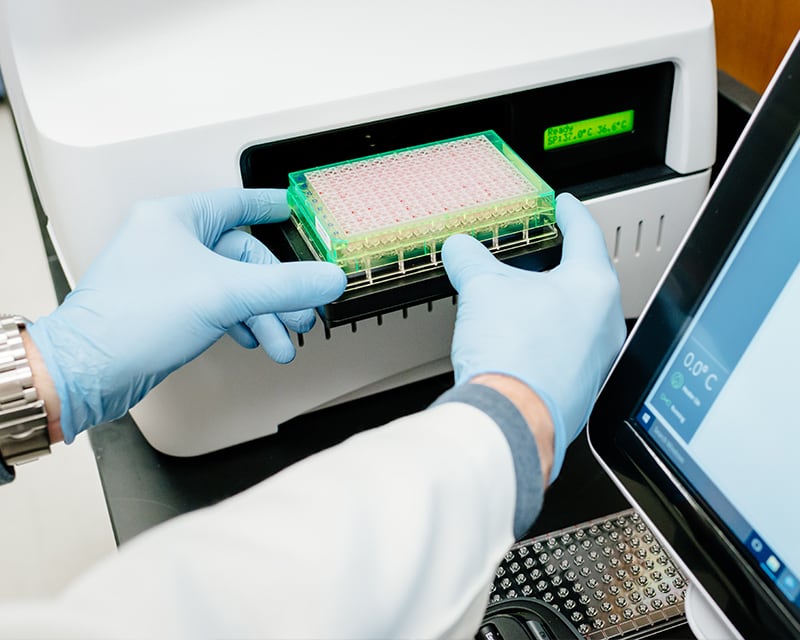
The PhD in Nutrition Sciences program provides training and research experiences in basic and translational nutrition science. Students learn the science of nutrition as it relates to maintaining the health of individuals and populations, as well as the biochemical basis and application of nutrition to promote health and prevent disease.
Students who are enrolled in the PhD in Nutrition Sciences program complete coursework through a planned, structured, yet flexible curriculum that is tailored to meet each individual’s needs. We create an environment that fosters novel learning and the use of cutting-edge technology to facilitate both scholarly proficiency and an in-depth understanding of nutrition sciences. Our coordinated and interdisciplinary courses will help you transcend boundaries and allow you to succeed in professional and academic arenas.
Possible areas of study are:
- experimental design
- nutritional biochemistry
- energy requirements
- body composition
- geriatric nutrition
- community nutrition
- disease prevention
Program Timeline
Most students complete the PhD in Nutrition Sciences program within 4 to 5 years of full-time study. The following is a general overview of the program timeline:
Years 1 and 2: Complete core and elective coursework, as well as non-dissertation research hours.
- End of Year 1: Identify research mentor
- End of Year 2*: Produce first research publication
Year 3: Candidacy examination occurs.
Years 4 and 5: Committed to dissertation research. Including completion of original research project, writing of related publications, and dissertation defense.
*Students without a thesis masters degree will complete their thesis requirements during Year 2.
Core Completion Requirements
The following is an overview of the PhD in Nutrition Sciences' Core Course Requirements, listed in chronological order. This outline reflects the first two years of study, subsequent years include additional research hours and elective coursework.
-
Fall (Year 1)
- NTR 621: Applied Statistics to Nutrition Sciences I (3 credits)*
- NTR 690: Seminar (2 credits)*
- NTR 733: Laboratory Instruments and Methods in Nutrition Research (1 credit)
- NTR 788: Advanced Nutrition Seminar (1 credit)**
- GRD 717: Principles of Scientific Integrity (3 credits)
-
Spring (Year 1)
- NTR 637: Applied Research in Nutrition Sciences (3 credits)*
- NTR 733: Laboratory Instruments and Methods in Nutrition Research (2 credits)
- NTR 747: Molecular Biology and Nutrition Sciences (3 credits), Spring EVEN years
- NTR 788: Advanced Nutrition Seminar (1 credit)**
-
Summer (Year 1)
- NTR 618: Nutritional Biochemistry (6 credits)*
-
Fall (Year 2)
- NTR 623: Applied Statistics II (3 credits)
- NTR 736: Scientific Methods (3 credits)*, Fall EVEN Years
- NTR 788: Advanced Nutrition Seminar (1 credit)**
- Non-Dissertation Research Hours
-
Spring (Year 2)
- NTR 779: Obesity in the 21st Century (3 credits)*, Spring ODD Years
- NTR 788: Advanced Nutrition Seminar (1 credit)**
- Elective (3 credit hours)***
- Non-Dissertation Research Hours
*Denotes courses offered online only
**NTR 788 needs to be taken for a minimum of 5 semesters but should be taken in every Fall and Spring while enrolled in the program. Additional credits of NTR 788 beyond 5 credits may be applied as electives.
***Students should register for electives in odd years.
All students complete a minimum of 12 non-dissertation research hours (NTR 798) and 12-dissertation research hours (NTR 799) in addition to 24 hours of elective coursework.
Approved Electives
The following is an overview of the approved electives for students in the PhD in Nutrition Sciences program. Other electives may be approved by the PhD Program Director in the Department of Nutrition Sciences.
-
Fall Elective Offerings
- NTR 609: Applied Nutrition for Physical Activity and Disease Prevention (3 credits)*
- NTR 632: Nutrition Counseling and Education (4 credits)*
- NTR 704: Principles and Practice of Nutrition Support (3 credits)*
- NTR 761: Enhanced Research Production Thru Intensive Writing (3 credits)
-
Spring Elective Offerings
- NTR 631: Community Interventions for Healthy Lifestyles (3 credits)*
- NTR 701: Advanced Medical Nutrition (3 credits)*
-
Summer Elective Offerings
- NTR 500: Communication in Nutrition (1 credit hour)
- NTR 750: Body Composition and Energy Metabolism (3 credits), Summer EVEN Years
-
Other Elective Offerings
- NTR 755: Teaching Practicum in Nutrition Sciences (3 credits)**
*Denotes courses offered online only
** NTR 755 may only be taken with permission of the program director.
Request More Info
Have an immediate question about the PhD in Nutrition Sciences program? You might find it in our “Frequently Asked Questions” section below.
-
How much does the PhD program in Nutrition Sciences cost?
Visit the School of Health Professions' Tuition and Fees page for the most up-to-date information available.
-
What types of research opportunities are available at UAB?
UAB offers a wide variety of research opportunities! The Department of Nutrition Sciences has two NIH-funded Centers, the Nutrition Obesity Research Center and the Diabetes Research Center, plus the NIH-funded Comprehensive Cancer Center. The premier medical facilities at UAB offer the unique opportunity to pursue a wide range of research interests in a variety of settings. Research opportunities extend beyond the traditional lab, including clinical and human studies in a wide variety of areas and community settings. From pediatrics to geriatrics, obesity to oncology and beyond, the research happening at UAB is exciting, innovative, and new research ideas are always welcome.
For more information on the types of research being conducted in the Department of Nutrition Sciences, visit our research page.
-
Do you offer a waiver of the application fee?
Currently our department is unable to offer a waiver of the UAB Graduate School application fee.
-
Are scholarships available?
Tuition scholarships and stipend support may be available and are generally awarded on a yearly basis.
For more information regarding scholarships, see the School of Health Professions Scholarships page.
-
Can I learn how to teach as part of my PhD experience?
Yes! There are many opportunities to learn how to teach while at UAB. Visit the UAB Center for the Integration of Research, Teaching and Learning (CIRTL) for more information.
-
How long does it take to earn a PhD?
It usually takes four to five years of full-time study. However, you are allowed seven years to complete the PhD program.
-
Still have a question?
Contact us, and we’ll be happy to help you!
Request More Info