Grant Purpose:
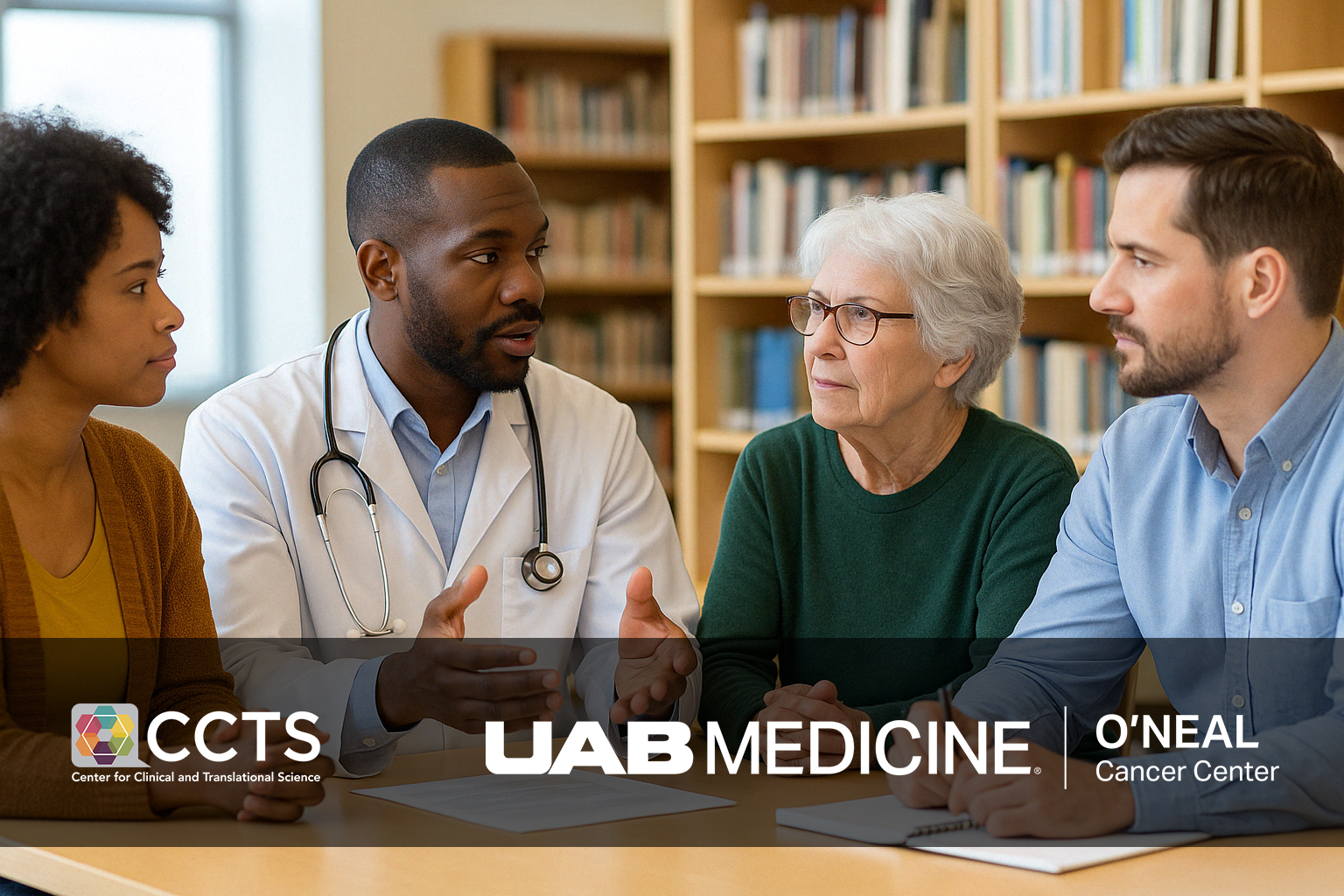 The University of Alabama at Birmingham (UAB), through the Center for Clinical and Translational Science (CCTS) and the O'Neal Comprehensive Cancer Center, is pleased to offer a $20,000 funding opportunity for collaborative teams of UAB faculty members and community members/organizations.
Through this collaborative effort between the CCTS, the O'Neal Comprehensive Cancer Center, and local communities, the funded grants will aim to provide preliminary data that may:
- Foster research that addresses major health challenges in Alabama, with an emphasis on diseases (e.g., cardiovascular disease, diabetes, obesity, and cancer) and lifestyle behaviors (e.g., diet, physical activity, and sleep), environmental exposures (e.g. indoor and outdoor air pollution, soil or water contamination, sanitation infrastructure, or other toxic or harmful exposures), and social determinants (e.g. education, economic opportunity, housing, living conditions, food access, transportation, crime and safety, service and built environment, or other social drivers) linked to higher risk of cancer morbidity and mortality.
- Strengthen partnerships with communities, ensuring that research is both community-driven and scientifically rigorous.
- Provide seed funding to initiate impactful, collaborative research that can be expanded upon through additional funding sources in the future.
Funding Details:
- Download RFA here (PDF).
- Amount: Up to $20,000 per project. Up to two projects will be funded.
- Application Deadline: Submit all components compiled as a single PDF to CCTS@uab.edu by the deadline of June 1, 2026, at 11:59pm
- Duration: One year (July 1, 2026 –June 30, 2027).
- Allowable Expenses: Funds can be used for community partner, graduate, undergraduate, and administrative effort; materials and supplies; research related expenses (analysis costs, participant stipends, lab expenses, etc.); and project-related local and scientific travel.
- Disallowed Expenses: Funds cannot be used for faculty effort or fringe.
Grant Information Session:
Click here to view the latest pre-application information session.
This session was originally presented on April 24, 2026.
Contact LaToyaRBishop@uabmc.edu with any additional questions.
Application Process:
- Eligibility: Applications must include both an academic and a community investigator. This collaboration ensures that the research is not only academically rigorous but also grounded in the needs and priorities of the community.
- Academic Investigator: Must serve as Principal investigator (PI) or lead Multiple Principal Investigator (MPI) and must hold UAB faculty status.
- Community Investigator: Must serve as MPI or co-investigator. Must be part of an organization with 501c3 status.
- Proposals must focus on a cancer-related health challenge that is pertinent to Alabama, especially challenges related to diseases with high mortality rates and modifiable lifestyle behaviors.
- Proposal Components & Instructions and Formatting Guidelines: Applications must conform to formatting instructions and include all required components, or they will not be reviewed. There will not be an opportunity to edit submitted applications after the submission deadline.
- General Application formatting:
- All four margins ≥ 0.5”. Arial 11 pt. or Times New Roman 12 pt. with > 8 pt. font for tables and figure legends.
- Submit your application as a single document in PDF format with the sections compiled in the order below.
- Cover sheet: Please use the cover sheet provided and obtain the signature of your Division Director. Download the cover sheet here: https://www.uab.edu/ccts/images/cappaa/2026-CAPPAA_CoverSheet.pdf
- Proposal Sections (Assembly order):
- Lay abstract: (30 lines) Please provide a brief description of your project’s significance, hypothesis, and innovation in lay terms. This is to inform non-scientists at potential funding sources of the importance of the proposed work. Do not include figures or diagrams.
- Significance/relevance to catchment area: (30 lines) Please identify how your project will address specific needs of our catchment area (within the State of Alabama). For example, provide information on specific cancer burdens and outcomes in the catchment area that your work may impact.
- Approach and preliminary data (3 pages) Provide specific aims, study design and any key data needed to support your hypothesis. Describe the approach you will use to carry out the specific aims. Discuss your expected results and at least one alternate result, and how you may alter your approach if this result is achieved. Discuss at least one potential technical challenge and how you would approach it.
- Complementary expertise and readiness of the Co-investigative team: (30 lines) Provide a description of the unique strengths, complementary expertise, and prior collaboration of the research team that makes it clear why the investigators are best suited to complete the proposed research. List key elements (equipment, staff, approaches, animal models etc.) for the proposed work that are already in place that will allow you to initiate the proposed studies without delay.
- Next steps: (30 lines) Explain what you plan to do after completing this seed grant, including aims and potential funding mechanisms for next grant application.
- Bibliography: (No page limit) Use a format that includes article titles and all authors.
- Biosketch: Include NIH biosketches for PIs and Multi-PIs only (community MPIs may substitute a resume or CV for the NIH Biosketch).
- Other and Pending Support: For PI and Multi-PIs only. Include all (extramural and intramural) current active other support with name of PI, your role on project, project title, funding agency, grant number, total amount of funding, funding duration. Also list any pending extramural support.
- Budget with Budget Justification: Please indicate a budget and justify how funds will be allocated. List all personnel with % effort. List budgets for supplies, animal costs, etc. that are needed to complete the project. Not allowed: PI or other faculty salaries; travel costs to meetings; publication charges; costs for work done at other institutions or private companies (Southern Research excluded) unless approved prior to submitting the proposal.
- General Application formatting:
- Submission Details
- Submit all components compiled as a single PDF to CCTS@uab.edu by the deadline June 1, 2026, 11:59 pm.
- Deadlines:
- Application Open: April 15, 2026
- Application Deadline: June 1, 2026, at 11:59pm
- Notification to Applicants: June 30, 2026
- Grant Period: July 1, 2026 – June 30, 2027
Evaluation Criteria
Factor 1: Importance of the Research (significance and innovation):
- Should the research be done?
- Why does it matter?
Factor 2: Rigor and Feasibility:
- Can the research be done well?
- Is the approach rigorous, feasible, and appropriate?
Factor 3: Expertise and Resource
- Are the right people and environment in place to do the work?
Post-Award Expectations:
- Deliverable: Awardees must submit a final report summarizing their findings and the outcomes of their projects. The report is due 30 days after the project end date or by August 31, 2027, whichever occurs first.
- Dissemination: Awardees are expected to submit a proposal to present their findings at (1) an upcoming CCTS Community Engagement Institute or a similar internal event with prior approval, and (2) a regional or national scientific meeting.