

The Comprehensive Examination Questions are in essay format. The exam is held from 8:30 a.m. – 12:30 p.m. on:
- the ninth Friday of the Fall/Summer semesters (for the 14-week Summer Semester)
- the seventh or eigth Friday of the Spring Semester
It may be taken no earlier than the semester prior to graduation. You must submit their completed registration form (see below) for approval to Kathy Lowe Tubbs no later than the Friday of the week before the last day of classes for the semester before your Comprehensive Exam Semester.
You must pass three out of the four Comprehensive questions. If you fail to pass three questions you must retake the exam the following semester. The questions will come from four classes that are pre-approved by the Graduate Program Coordinator. You will receive notification of your results within four-six weeks after taking the exam.
You will be tested on coursework from the following classes:
- EPR 594
- KIN 637 or KIN 638
- Two additional classes approved by the Graduate Program Coordinator
Registration Process
- Download and complete the
 registration form. The course instructor is the Examiner.
 - Email completed form. The form is a fillable PDF, so you can fill it out on your computer rather than printing it out. Once you have filled it out, save a copy to your computer. Please add your name to the filename so that when you send it as an attachment, your name will be part of the filename of the PDF. You should keep a copy of the completed PDF file. Send that copy as an attachment in an email to Kathy Lowe Tubbs opens a new website.
- Set up an appointment with the Graduate Program Coordinator at least one week after you have completed your registration form. During this meeting, we will review the registration form and sign it.
- After meeting with the Graduate Program Coordinator, the signed registration form is given to Kathy Lowe Tubbs. After receiving your registration form, she will email you to confirm your registration and send you the details with the time and location of the exam.
Tentative Schedule
| Semester Comps Will Be Given | Deadline to Register | Date of Exam |
|---|---|---|
| Fall 2025 | August 1, 2025 | October 17, 2025 |
| Spring 2026 | November 21, 2025 | March 6, 2026 |
| Summer 2025 | May 1, 2025 | July 11, 2025 |
Questions?
Please contact program director Gordon Fisher at grdnfs@uab.edu if you have any questions or concerns about the Comps procedure.

The purpose of the internship experience is to expand student knowledge, skills, experiences, opportunities, and exposure to real-world applications of their degree. If a student receives an opportunity for financial assistance and can fulfill this purpose, the Department of Human Studies views this as a positive opportunity that should be considered. Forms of financial assistance that would be considered acceptable and approved are:
- Official paid internship positions
- Internship stipends
- Positions where the student is offered employment after securing the internship
- Positions where the student is employed and offered to do additional hours/responsibilities outside of the regular paid position and separate from the job description of the current employment. (These responsibilities will be determined in collaboration with the site supervisor and student.)
- If the above situation for remuneration is applicable, the student must provide the Employment/Internship Approval Letter from the facility supervisor documenting how the internships responsibilities will differ from current employment duties. These duties will be determined in collaboration with the student and the facility. The duties must be approved by the internship supervisor before site approval is granted.
The site must have a Memorandum of Agreement (MOA) with UAB.
Download Employment/Internship Approval Form Opens a PDF.
Policy: Remuneration for Community Health and Human Services Internships/Advanced Field Experience, Exercise Science, Exercise Bioenergetics, and Sports Physiology and Performance
Application Information
All application information is available on the Apply page under Community Health and Human Services in the Individual Degree Requirements section.
Accreditation
Certified Health Education Specialists (CHES®) are individuals who have met the standards of competence established by the National Commission for Health Education Credentialing Inc. opens a new website (NCHEC) and have successfully passed the CHES® examination. NCHEC serves to enhance the professional practice of Health Education by promoting and sustaining a credentialed body of Health Education Specialists.
The CHES® credential establishes a national and international standard for members of the profession and ensures prospective employers that an individual has taken the initiative to pursue additional certification, and is proficient in evidence-based planning, implementing, evaluating, and advocating for the health of communities.
NCHEC developed a rigorous set of professional standards known as the Responsibilities and Competencies for Certified Health Education Specialists. These standards serve as a framework for the profession, illustrating the knowledge, required skills, and expertise needed for a position in the field of health education and promotion.
CHHS Faculty utilized these standards as a framework for the development of the PhD in Community Health Promotion, including coursework in the health promotion core. This curriculum meets the academic qualifications for eligibility and adequately prepares students to sit for the CHES® examination. Although not a requirement, many students sit for and pass this important exam. This is in part due to the increasing demand to have credentialed health education specialists on the job; particularly, if part of the job responsibilities include training health educators in post-secondary settings.
Comprehensive Examination
All PhD candidates must sit for a comprehensive examination, which is offered on the third Thursday of January and June of each year. This exam should be prepared for by individual study expanding on the content covered in the health promotion core courses. The exam must be passed unconditionally before students can defend their dissertation proposal and be advanced to candidacy. Students must be registered for at least three semester hours of graduate work during the semester(s) in which the comprehensive exam is taken.
The comprehensive exam is a criterion-referenced assessment — students do not compete with other students. Students should NOT assume that “A” level performance in their coursework as adequate preparation for passing the comprehensive exam. To prepare, students should review all materials from the HP core courses as well as other supplementary material. Students should review health education theory and program planning, implementation, and evaluation materials not only from their prior coursework but also from a range of self-selected documents, websites, and texts.
The core courses provide background information and a blueprint for their own regimen of self-study — students must demonstrate broad mastery of the subject matter and intellectual growth. Each student must be able to synthesize and apply what has been learned in order to design an appropriate, theory-based intervention to address the chosen health issue/population. Students must be able to specify why a program is necessary, how it can be achieved, who will be involved during implementation, and how results might best be used. It is recommended that students preparing for their comps work with other students, share materials, discuss key concepts with faculty members, and confer with students who have already passed the exam.
Eligibility
To qualify to sit for comprehensive exams, students must have successfully completed the health promotion core courses:
- CHHS 731: Advanced Theoretical Approaches in Health Promotion
- CHHS 732: Advanced Planning and Implementation in Health Promotion
- CHHS 740: Evaluation and Research Methods in Health Promotion
- CHHS 742: Health Disparities in Diverse Populations
Dissertation and Final Defense
The dissertation represents the culmination of a significant research experience. Students begin work on their dissertation only after they have completed all coursework, passed the comprehensive examination, organized their dissertation committee, defended their dissertation proposal, and gained admission to candidacy.
The dissertation committee consists of a minimum of five faculty members and typically includes a chair, methodologist, content expert(s), and other interested faculty. The chair must be faculty from the CHHS program in the School of Education and Human Sciences. While the chair may assist with the formation of the committee, it is the student's responsibility to invite committee members. Students finalize their committee selections by completing and submitting the Graduate Student Committee Letter to the Graduate School and work closely with their committee to develop a dissertation proposal. Before beginning dissertation research, students must have successfully defended their dissertation proposal, be admitted to candidacy, and submit the proper paperwork to the Graduate School. Students cannot collect or analyze data ahead of committee or IRB approval.
PhD candidates should set the date and time of their final defenses well in advance, making certain that all committee members can attend. Candidates are also responsible for furnishing committee members with complete copies of their manuscripts by a date of the committee’s choosing. They must make all requested changes or corrections to the manuscript as soon as possible after the defense and obtain signatures of all committee members and the Program Director on the appropriate approval form. Each candidate must submit a completed dissertation for online review to the Graduate School no later than two weeks (10 business days) after the final defense.
Additional information about graduation requirements may be found in the Graduate Catalog, Graduate Student Handbook or by contacting the Graduate School opens a new website staff via email (gradschool@uab.edu) or phone (205-934-8227).
Financial Support
For highly qualified first-year PhD students, the UAB Graduate School supports a small number of Blazer Graduate Research Fellowships. The position requires full-time enrollment (9 hrs/semester Fall/Sp/Su) to be considered for funding. Full-time UAB employees are not eligible for these funds. These funds vary from year to year and are awarded on a competitive basis.
Other resources:
Finally, PhD students who have a background in health promotion may be hired as adjunct faculty to teach undergraduate health education courses. For more information, contact the Graduate Program Director.

What are the career opportunities upon graduation? The competencies and skills you learn during your program can enable you to work with individuals and communities to promote health and improve quality of life through health coaching and education, social service programming, and health advocacy.
In the recent past, emphasis has been placed on professionals in non-profit, governmental, and agency settings to have the skills and training needed to communicate a variety of health-seeking behaviors to diverse populations effectively. Skills such as adapting to diverse community groups, providing effective programming in various settings, assessing the service population's needs, and using a client-centered lens to develop meaningful interventions are only a few of the needed competencies in today's job market
Employment and Job Outlook
Health Education/Promotion
An emphasis on promoting healthy behaviors, mainly based on experiences from the COVID-19 pandemic, is expected to increase demand for these workers over the decade. The job outlook for the field is projected to grow 17% from 2020 to 2030, much faster than the average for all occupations. (Source: US Bureau of Labor Statistics opens a new website)
Further, government, healthcare, and social services providers want to improve the quality of care and health outcomes while reducing costs. Health education specialists are uniquely trained to serve in this capacity. Job titles may include community outreach coordinator, patient educator, health policy coordinator, clinical diabetes educator, public health educator, community health worker, community nutrition educator, and HIV counseling specialist.
Opportunities are broadening in community and public health as more sectors recognize the critical role of communities and the environment in health. As the idea of "Health in All Policies opens a new website" continues to gain prominence, leaders in diverse fields are seeking workers who can bring public health awareness about the role of the environment in health and the connection between behavior and health outcomes.
Human Services
The job outlook for human services professionals is expected to grow by 13.9% over the next decade. Specifically, jobs for social and human service assistants and substance abuse counselors are projected to increase by 9% and 18%, respectively, from 2022 to 2032 (Source: US Bureau of Labor Statistics). A contributing factor to the demand is the growing population of elderly, increased awareness of mental health needs and governmental policies aimed at expanding social services to vulnerable populations.
Graduates of this program are trained to prevent and remediate a range of problems in multiple service populations (i.e., children, adolescents, adults, and the elderly), to improve service delivery systems, accessibility, and accountability, and to facilitate coordination among agencies and professionals. They can develop treatment plans, research available and appropriate services, assist in the completion of paperwork, and monitor the quality of services rendered to their clients. Graduates with these skills become rehabilitation caseworkers, advocates, community coordinators, mental health workers, child welfare workers, social service assistants and liaisons, substance abuse counselors, probation officers, home health aides, and employment counselors.
Six Major Career Sectors in Health Education
-
Community Health Education
Projected to grow 17 percent from 2020 to 2030, much faster than the average for all occupations.
- Community Health Educator
- Education Program Manager
- Case Manager
- Alcohol Educator
- Family Services Specialist
- Community Outreach Coordinator
- Program Resource Coordinator
- Community Organizer
- Health Education Programmer
- Diabetes Educator
-
School Health Education
- District Wellness Coordinator
- School Health Educator
- Youth Program Specialist
- Director of Health Promotion
- Head Start Health Specialist
- Health Counselor
- Youth Outreach Coordinator
-
Business and Non-profit Health Education
- Health Literacy Program Coordinator
- Clinical Research Specialist or Coordinator
- Wellness Consultant
- Health Coach
- Integrative Health Practitioner
- Corporate Trainer
- Employee Wellness Coordinator
- Worksite Safety Coordinator
- Health Education Director
- Cultural Competency Trainer
- Health Media Director
- Grant Writer
- Health Journalist
-
Academia and University Health Education
- Adjunct Faculty
- Assistant Professor
- Curriculum Development Specialist
- Health Programs Management Director
- Education Outreach Liaison
- Education Director
- Health Promotion Programmer
- Health and Wellness Coordinator
-
Government and Health Departments
- Accreditation Coordinator
- Health Officer or Department Planner
- Prevention Specialist
- Health Program Analyst and Advocate
- Program Resource Coordinator
- Public Health Inspector
- Infection Preventionist
- Health Information Specialist
- Epidemiology
- Environmental Health Educator
- Violence Prevention Program Coordinator
-
Health Care
- Community Outreach Coordinator
- Health and Wellness Coordinator
- Medical Resource Manager
- Patient Education Director
- Patient Care Coordinator
- Biometric Health Screener
- Nutrition Services Coordinator
- Community Benefits Manager
- Prevention Program Director
- Lactation Consultant
- Cancer Information Specialist

What can you do with a MAEd in Community Health? It's an important question. The competencies and skills you learn during this program will enable you to work with individuals and communities to promote health and improve quality of life through health coaching and education, social service programming, and health advocacy.
In elementary, middle, and high schools, health educators teach health as a subject, promote and implement Coordinated School Health programs, foster related school-community partnerships, and encourage a healthy school environment.
In colleges and universities, health educators work to create caring communities and environments in which students feel empowered to make healthy choices, identifying needs and developing programs to address those needs, teaching courses, developing mass media campaigns, and training peer educators, counselors, and advocates.
In corporations, health educators coordinate employee education services, employee health risk appraisals, and health screenings. They design, promote, lead, and evaluate programs to address weight control, hypertension, nutrition, substance abuse prevention, physical fitness, stress management, and smoking cessation. And they write grants and develop educational materials in support of such projects.
In clinical settings, health educators teach patients about medical procedures, services, and therapeutic regimens; create activities and incentives to encourage patient compliance; train staff; consult with other health care providers about behavioral, cultural and social barriers to health; and address ways to maintain health and reduce risky behaviors.
In community organizations and government agencies, health educators identify needs and mobilize resources to improve health. They organize community and outreach efforts, write grants, build coalitions, advocate on behalf of their constituency, and develop, produce, and evaluate mass media health campaigns.
 High-achieving undergraduate students may pursue the Accelerated Bachelor's/Master's Program (ABM) in Kinesiology with a concentration in Exercise Physiology (ABM-EPH). This program allows undergraduate students to take courses that count toward their undergraduate and graduate degrees at the same time.
How it Works
Students may apply after completing 60 or more undergraduate course hours (36 of which must be completed at UAB).
Once admitted, students may take up to 12 approved credit hours of approved 500/600-level graduate courses during their undergraduate degree.
Program Requirements
Students must arrange a meeting with their undergraduate and graduate advisors at the beginning of each semester to review their course selections and progress toward the degrees. To maintain a good status, the student must:
- Maintain a 3.0 GPA average in undergraduate exercise science courses.
- Receive a B (or better) in graduate courses while still an undergraduate student.
- Remain at full-time-student status at UAB (with exceptions for medical emergencies)
The student will be withdrawn from the EPH-ABM program if any requirements are violated. Students who withdraw will retain credit for the courses already taken in the program. No credit sharing will be allowed if students enroll later in a graduate program in the Department of Human Studies.
Application Process for the ABM Program
- UAB Transcript
- ABM Form opens a new website
- Application Fee
- Essay
- Resume
Contact Program Director Gordon Fisher opens a new website for more information.
The Department of Human Studies Physical Education Honors Program provides high achieving students in the Physical Education Teacher Certification program with the opportunity to participate in honors (HON) sections of KIN 409 and KIN 489. You will collaborate with faculty mentors in pursuit of your intellectual interests and complete an honors project. You will have an opportunity to conduct an in-depth literature review plus a research project designed to meet some particular need related to physical education.
Coursework
By the time you complete KIN 489 HON (6 credits), you should have devoted at least 90 hours to your honors project. Faculty mentors submit either a satisfactory or unsatisfactory progress report and a copy of your written report. You submit a journal (hourly log) of your activities signed by your faculty mentor.
Project
In order to complete the honors project successfully, you must produce a written report and a public presentation that meets stated criteria in the syllabus.
Requirements
- Junior standing
- Completion of 9 hours pre-professional education courses
- 3.5 GPA in Education courses
- 3.0 GPA overall
- Faculty recommendation from Mentor
Graduating with Honors
Honors students must earn a grade of ‘A’ in HON sections of both KIN 409 and KIN 489 in order to graduate with "Honors in Education.” You must also maintain an overall GPA of 3.5 or higher throughout your degree.
Honors graduates will wear a white cord at the Commencement ceremony (picked up from the Honors table), and ‘Honors in Education’ will be printed by your name in the program.
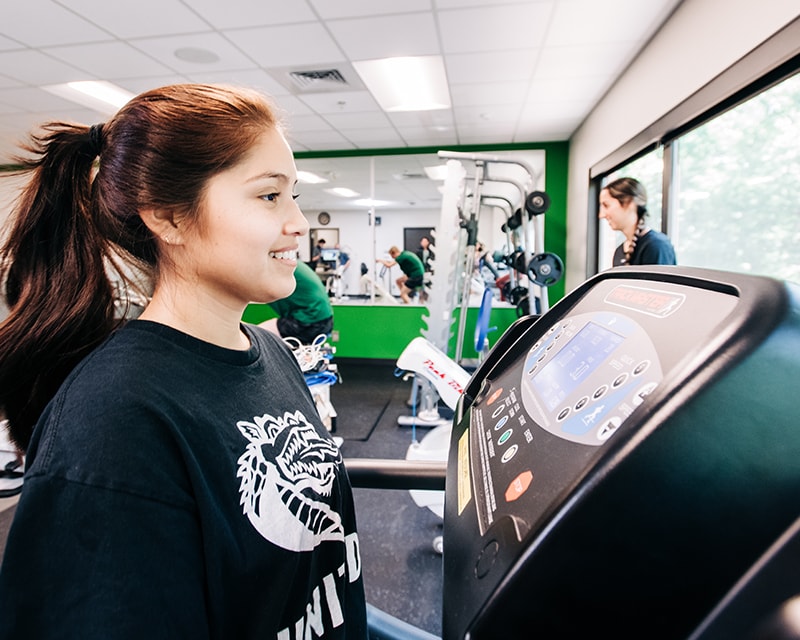
The Department of Human Studies Honors Program provides high-achieving students studying Exercise Bioenergetics, Exercise Science, and Sports Physiology and Performance the opportunity to participate in honors (HON) sections of KIN 485 and 499. You will collaborate with faculty mentors in pursuit of your intellectual interests and complete an honors project.
Supervision of your work will be conducted by a faculty mentor who is responsible for guiding your progress and setting deadlines. The honors project consists of an inquiry or investigation that makes an original intellectual or creative contribution to the discipline of kinesiology and meets global and societal needs. The Honors Program director must pre-approve all projects.
Benefits
Each student has the opportunity to work one-on-one with a mentor in an area of mutual interest. You will conduct an in-depth literature review and either a research project or a civic engagement project designed to meet some particular need related to pertinent areas of fitness, exercise, or physical activity. The experience is designed to encourage critical thinking and presentation skills.
Eligibility
Students majoring in kinesiology with concentrations in either Exercise Science or Sports Physiology and Performance who have an overall GPA of 3.5 or higher are eligible to apply for this program.
How to Apply
Students should secure a faculty mentor and identify an honors project during their junior year while taking or after taking KIN 307 and 400. You should apply to the honors program during the semester prior to taking KIN 485 so you have sufficient time to complete your honors projects (which will entail at least 90 hours of coursework) in your senior year while enrolled in KIN 485 and KIN 499.
Deadlines
The deadline to submit an application for students taking KIN 485 in:
- Fall: July 20
- Spring: November 10
- Summer: March 20
Each student is required to submit
- a student application,
- an essay,
- a letter of support from his or her faculty mentor, and
- a second letter of recommendation.
All of these materials may be submitted as attachments in one email to the honors program director, or else as hard copies in one envelope to the director. Please be sure to submit ALL four documents together and at the same time; incomplete packets will NOT be reviewed.
NOTE: Please use a PC to complete this form—the form is NOT compatible with Mac computers. If you have difficulty entering information in the template provided, please seek assistance from the student workers in the EB 149 Open Lab.
Coursework
Grades for students enrolled in KIN 485 (HON) are determined in the same manner as they are for students in KIN 485 (non-HON). During the last week of the semester, the faculty mentor will submit a progress report with the designation of satisfactory or unsatisfactory for each of their mentees. Mentees submit a journal (hourly log) of their activities signed by their faculty mentor to the KIN 485 HON course co-instructor. Students are placed in the HON or non-HON section (traditional) of KIN 499 based on the recommendations of their faculty mentors.
The faculty mentor also determines, in consultation with the program director, the final grades for KIN 499 HON coursework. By the completion of KIN 499 HON (3 credits), students should have devoted at least 90 hours to their honors project. Faculty mentors submit either a satisfactory or unsatisfactory progress report and a copy of each student’s written report—while each student submits a journal (hourly log) of his or her activities signed by the faculty mentor—to the program director.
Please refer to the syllabus (provided by your faculty mentor) for specific course prerequisites, grading policies, and guidelines. Your mentor serves as the agency supervisor during the KIN 499 HON Fitness Internship. You may register for an additional section of KIN 499 HON if you need more time to complete your project.
Project
In order to complete the honors project successfully, you must produce a written report that meets stated criteria in the syllabus and also conforms to the format necessary for submission to an approved journal for publication and/or a professional organization for an oral or poster presentation. The written report may consist of the following components: abstract, introduction, statement of the problem, purpose, materials and methods, results, discussion, and conclusion.
For more information and guidance, consult the Office of Undergraduate Research opens a new website, UAB’s one-stop clearinghouse for the promotion and facilitation of undergraduate research, scholarship, and creative activities across all disciplines at the university. You may also wish to seek guidance from Inquiro opens a new website, the official UAB journal for undergraduate scientific research.
Graduating with Honors
Honors students must earn a grade of ‘A’ in HON sections of both KIN 485 and KIN 499 (3—6 hours) in order to graduate with "Honors in Education.” You must also maintain an overall GPA of 3.5 or higher throughout your degree.
Honors graduates will wear a white cord at the Commencement ceremony (picked up from the Honors table), and with ‘Honors in Education’ will be printed by your name in the program.
Advising/Program Director
Please contact Dr. Gordon Fisher opens a new website, Honors Program Director, for additional information and advising. He will help students identify both their project and faculty mentor.