CINL Facilities
The Civitan International Neuroimaging Lab (CINL) is a 5,000 square foot facility located on the first floor of UAB Hospital-Highlands. The facility consists of the Siemens 3T MAGNETOM Prisma MRI suite, the GE 3T Premier suite, two private interview rooms dedicated to pre-/post-scan patient screening and testing, two MRI preparation rooms with lockers, and an equipment room. Space for your equipment can be reserved by contacting us.
The Prisma is a shared resource and workhorse for both UAB Medicine and UAB-affiliated investigators. Refer to our Policies and Procedures page for Siemens Prisma and GE Premier availability.
CINL Equipment
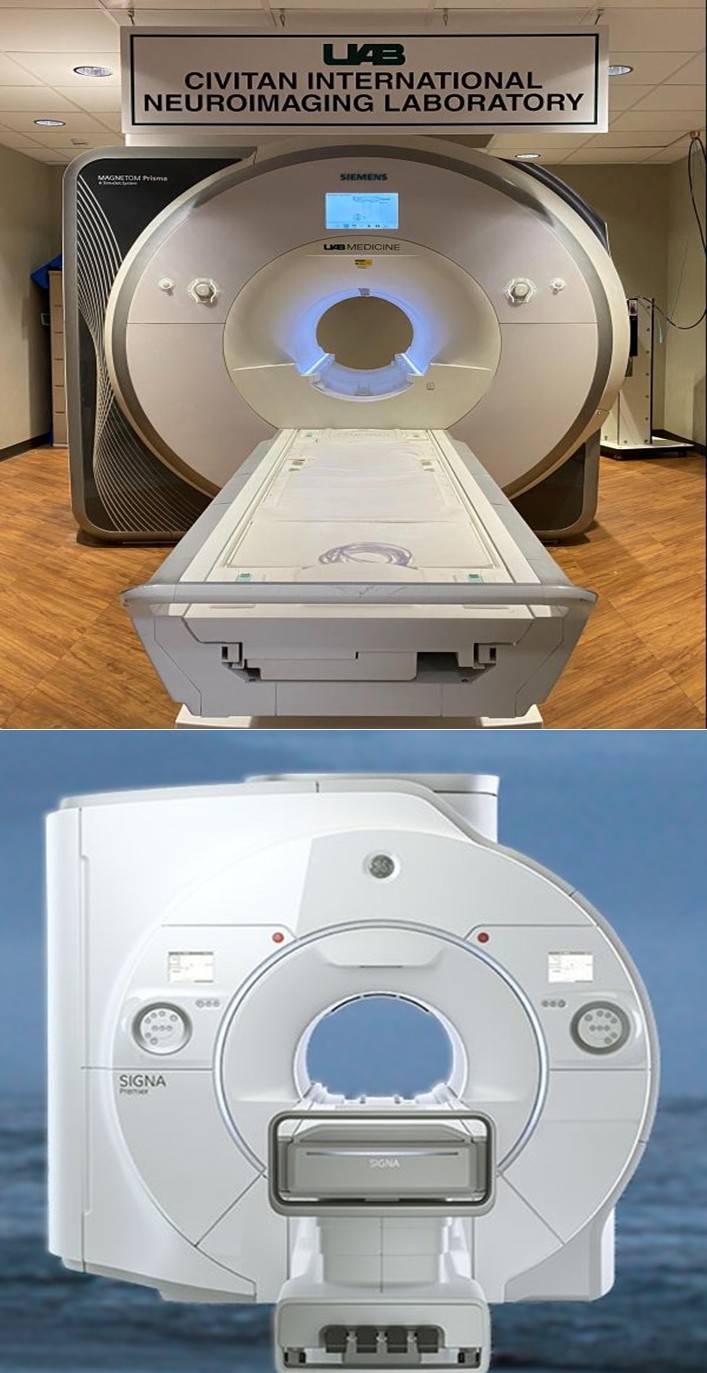
The two primary scanners at UAB Civitan International Neuroimaging Laboratory (CINL) are the Siemens MAGNETOM 3-Tesla Prisma whole body MRI scanner and the GE 3-Tesla Premier MRI scanner.
Siemens MAGNETOM 3-Tesla MRI Scanner:
- Designed to withstand high-duty cycle sequences and to operate at maximum performance during prolonged experiments.
- Based on a super-homogeneous 3T magnet.
- Performance gradients: 80 mT/m, 200 T/m/s.
- 3rd-order shims.
- Advanced parallel transmit technology for 3D localized excitation (ZOOMit).
- Multi-Nuclear capability.
GE Premier 3-Tesla MRI Scanner:
- Designed for cutting-edge research and supports the most demanding applications, such as Connectome-type studies that require Ultra-short TE diffusion imaging and high-resolution resting state fMRI.
- The SuperG 80/200 gradients deliver 60-cm performance in a spacious 70-cm bore, ensuring participant comfort and excellent data quality.
- The 146-channel RF receive chain enables unprecedented acceleration in parallel imaging that can be leveraged for increased resolution, shorter scan times, or both.
The CINL is equipped with a full suite of MR-compatible stimulus delivery and response devices for functional experiments.
For more information about available scanners and other equipment please see the Equipment page on the Research MRI Core Website.