

NIH Publication Policies
We have provided this official statement for acknowledging this T32 in your publications:
“Research reported in this publication was supported by the Eunice Kennedy Shriver National Institute of Child Health and Human Development of the National Institutes of Health under Award Number T32HD071866. The content is solely the responsibility of the authors and does not necessarily represent the official views of the National Institutes of Health.”
From the NIH Office of Extramural Research: https://grants.nih.gov/grants/acknow.htm
Requirements for Acknowledging NIH-Supported Research
The NIH grants policy statement outlines requirements for acknowledging Federal funding in the following products when describing projects or programs funded in whole or in part with NIH funds:
- research publications
- press releases and other public statements
- other publications or documents about research that is funded by NIH
- requests for proposals and bid invitations
- and other documents describing projects or programs funded in whole or in part with Federal money
- A specific acknowledgment of NIH grant support, such as:
(If you have more than one grant, only cite the grant(s) that supported the research described in the article or presentation.)
- An acknowledgement of the level of NIH funding that indicates:
- the percentage and dollar amounts of the total program or project costs financed with Federal money and
b. the percentage and dollar amount of the total costs financed by nongovernmental sources. - A disclaimer that says:
NIH communicates this requirement to its grantees in the NIH notice of award, and the NIH Grants Policy Statement (Sections 4.2 and 8.2.1).
NIH also encourages grantees who have used or generated HeLa cell whole genome sequence data to acknowledge Henrietta Lacks and her family. Please see the FAQ below for more information.
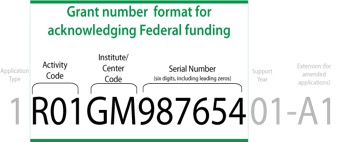
Proper Grant Number Format
Information for Researchers
Citing the grant number in the correct format improves NIH information resources such as PubMed, PubMed Central, and RePORTER.
Please also be aware that, in addition to this requirement to acknowledge Federal funding as described above, NIH also requires scientists to submit final peer-reviewed journal manuscripts that arise from NIH funds to the digital archive PubMed Central upon acceptance for publication. To help advance science and improve human health, the Policy requires that these papers are accessible to the public on PubMed Central no later than 12 months after publication. Please visit the NIH Public Access Policy page for more information about these requirements.
Information for Public Information Officers
NIH wants to work with you in broadly sharing the scientific advances of your researchers—follow these steps when publicizing NIH-supported research.
When writing a press release:
The specific acknowledgement and disclaimer statements mentioned above must be included in your press release text. This can be placed in the footer of the release, but we also encourage mentioning NIH early in the text of your press release. Here are a few examples:
“…. This study performed at the University of X, funded by the National Institutes of Health, reveals that… “
“…. , said University of X professor of medicine Jane Doe, whose research is supported by the National Institutes of Health”
When finalizing your press release:
NIH requests that, prior to issuing a press release, public information officers get in touch with the funding NIH institute or center (IC) in advance, to allow for coordination. Please visit the NIH media contacts directory or email pio@nih.gov for help in identifying the appropriate NIH contact.
Universities using EurekAlert! or Newswise can include the NIH grant number when submitting releases, and this will automatically link your press release to the grant record in RePORTER, a comprehensive searchable public database of NIH grants. Following a project search on REPORTER, users can then access press releases related to their search results in the “News & More” tab.
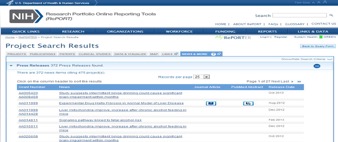
PIOs that do not use EurekAlert! or Newswise can contact NIH for help in linking their press release to grant records on RePORTER.
Don’t forget: Using the proper grant number format is critical for linking to the correct NIH grant record!