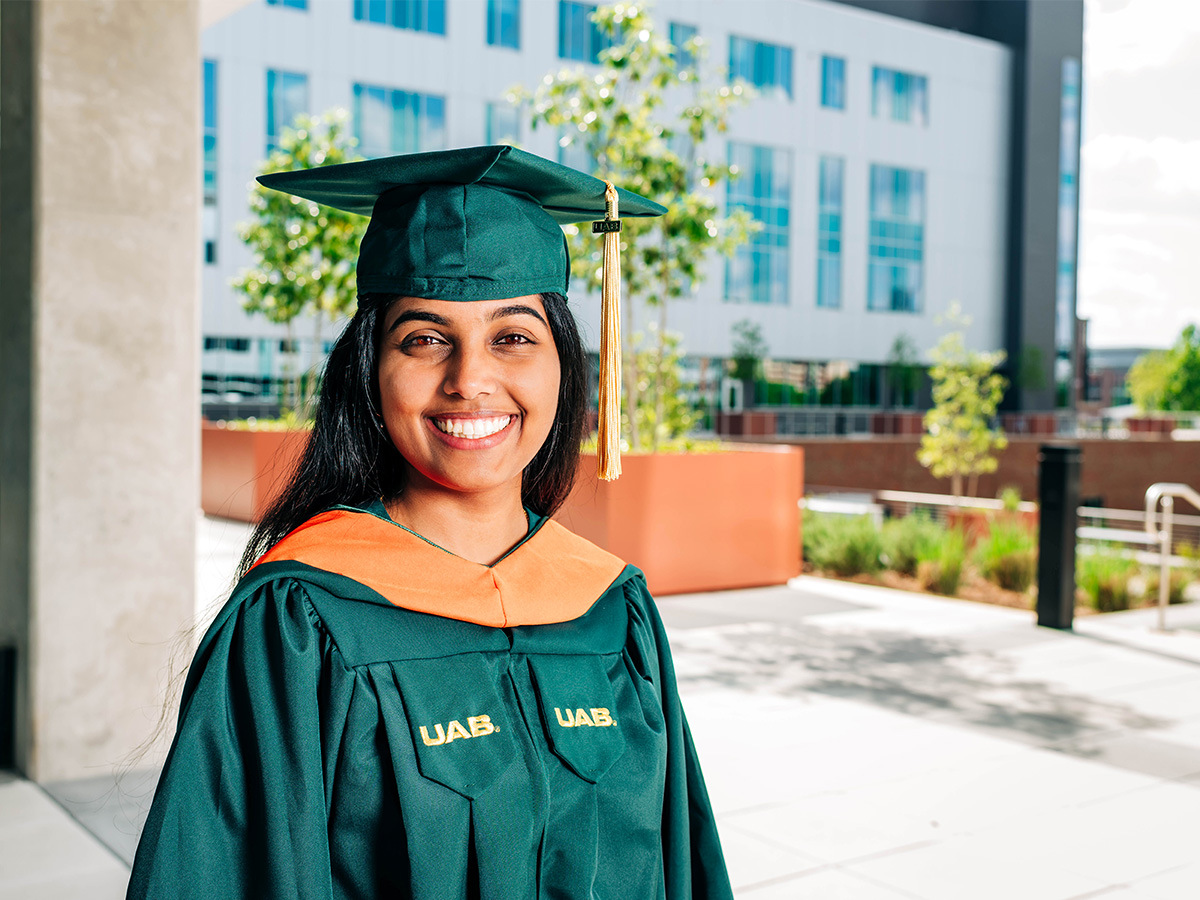
 When she walks across UAB’s commencement stage on May 2, an academic-filled chapter will close for Ann Varghese.For many, college graduation is a once-in-a-lifetime event. For Ann Varghese, it seems to be more of an annual tradition.
On May 2, the Montgomery native will graduate from the University of Alabama at Birmingham for the second time in two years when she receives her Master of Science degree in biomedical engineering, one year after receiving her Bachelor of Science degree. Varghese participated in the department’s Accelerated Bachelor’s to Master’s program, allowing her to pick up graduate school credits as an undergrad, pick up the dual degrees in successive years and finish her college career with a flurry of engineering success after what she describes as a slow start.
“I chose biomedical engineering because I really liked the hands-on portion of the curriculum,” Varghese said. “But an engineering degree requires a lot of prerequisites before you start major classes. So that was a struggle; once I knew where I wanted to go, I felt like I was stuck waiting.”
Not content to wait, Varghese began looking for opportunities to engage with engineering outside of class. She found that through organizations like the Society of Women Engineers and Project Lab.
“Choosing engineering was hard because I felt like I was not very good at math in high school, and taking classes during COVID made me feel like I was worse than I probably was,” she said. “Organizations like SWE gave me access to people who had been through those challenges and who could relate to what I was going through.”
While SWE provided the support she needed, Varghese says Project Lab gave her an outlet to satisfy her engineering interest. “That was my first experience in engineering, and I loved it,” she said. “No matter how bad it seemed like classes were going, Project Lab gave me something tangible to work on. During the time when I was only taking prerequisites, Project Lab was a lifesaver.”
Looking back, Varghese says her experiences during those first two years of prerequisites shaped her college experience in ways she did not realize.
By leaning into the challenges, she developed a network of peers that continued to pay dividends. “When we got together to work through problems our first two years, I don’t think any of us realized that those would be the people we would depend on for help and support over the next four years,” she said. “By the time we took our capstone senior design course, we were very prepared. When we had to divide up into teams to do these projects, we knew each other’s strengths, and we had built up a lot of trust in each other.”
With the completion of her capstone project, Varghese had a decision to make: stick around for another year of school or enter the workforce. “I initially wanted to go into industry after undergrad,” she said. “BME gives you a lot of different avenues you can take, and I decided I wanted to focus on something specific where I could apply the things I’d learned as an undergraduate.”
Varghese chose biomechanics as her specialty, and she spent the past year working in the lab of Christopher Hurt, Ph.D., in the Department of Physical Therapy. She has been conducting research into therapies for stroke and Parkinson’s patients. “Even with the tighter focus on biomechanics, there has been a lot of variety and different avenues to explore,” she said. “I’m glad I stayed to do my master’s because it has given me more experience and time to home in on exactly what I want to do.”
In the near future, Varghese says her plan is to find a job in the biomedical industry. And while she will not go for a three-peat and get another degree in 2027, she says she is not ruling out more graduate school in her future.
“My experience at UAB has been so fulfilling; I know I can succeed and that time spent studying and doing research will be worthwhile,” she said. “My advice for other students is to be ready to say yes to new experiences, and take advantage of the opportunities that are offered.”