By Laura Gasque
The University of Alabama at Birmingham School of Nursing’s Blazer Simulation is an internationally recognized leader in healthcare simulation. Accredited by the Society for Simulation in Healthcare in the areas of teaching and education and endorsed by the International Nursing Association for Clinical Simulation and Learning, the School is setting the standard for revolutionizing nursing education through the power of simulation.
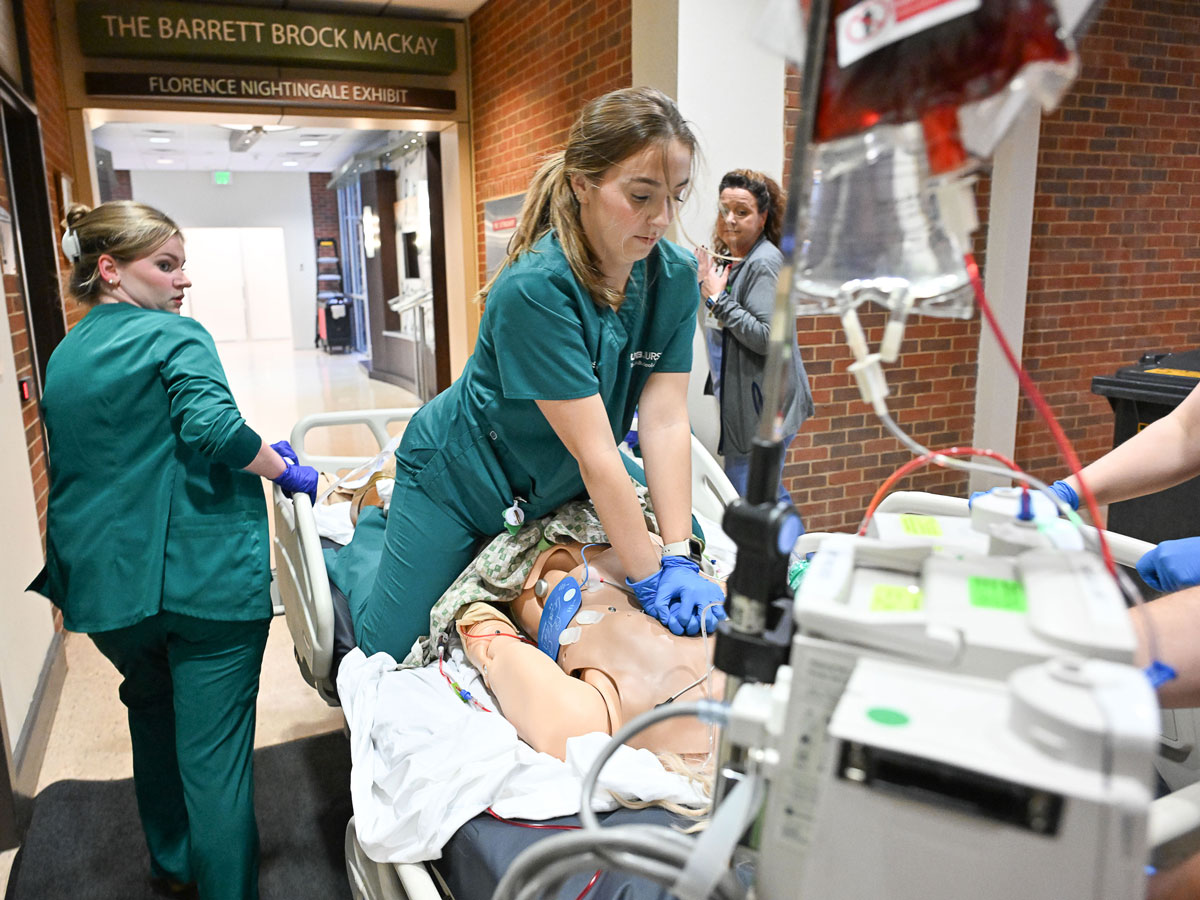
The School is home to nearly a dozen full-time staff and faculty, as well as some part-time staff, dedicated solely to Blazer Simulation to implement experiences in four functioning, multi-purpose hospital rooms; a fully outfitted operating room; completely equipped nurse’s station; home health suite with working kitchen and bathroom; infusion clinic setting and multiple other simulation and practice labs. Learning in one of the only schools in the state with dedicated faculty and staff and a state-of-the-art mini, in-house hospital, UAB School of Nursing students build confidence, knowledge and skills essential to providing quality patient care. Real scenarios—from basic patient care common to most any clinical setting to mass casualty and other emergency events—are developed for students to learn and practice using latest high-tech manikins and live actors as simulated patients.
“Our Blazer Simulation team are experts in designing and implementing well-designed scenarios for student outcomes,” said Professor and Associate Dean for Technology and Innovation Penni Watts, PhD, RN, CHSE-A, FNAP, ANEF, FSSH, FAAN (PhD 2015). “Their expertise allows our faculty to focus on teaching their specialties, and the real-world scenarios and experiences help equip students with not only the critical skills, decision-making and confidence they need to excel in the demanding healthcare environment. Students are provided a space for students to make mistakes, reflect on the experience and create new strategies to improve. Our goal is to create a safe learning environment for all of our learners.”
Unique to Blazer Simulation is its growing integration of distance simulation, which brings immersive, simulation-based learning to students wherever they are located. Through carefully designed, live distance simulation experiences, students engage in realistic patient-care situations that require them to assess information, make clinical decisions, communicate with patients and health care team members, and reflect on their performance, all while participating from locations outside the physical walls of Blazer Simulation.
Distance simulation is being incorporated across multiple programs and levels of study at the School. Adult-Gerontology Acute Care Nurse Practitioner students, for example, participate in a telehealth simulation that challenges them to consider social determinants of health while developing an appropriate plan of care. In another experience, Neonatal Nurse Practitioner students assume the role of providers at a Level IV neonatal center and are consulted via telehealth by a nurse caring for a critically ill newborn at a rural hospital. Working as a team, students assess the infant using real-time vital signs and information from the electronic medical record, communicate with the bedside nurse and provide orders and recommendations for care. Doctor of Nursing Practice students also use distance simulation to practice presenting, defending and responding to questions about their scholarly projects. Together, these experiences allow faculty to address clinical judgment, communication, teamwork, professional role development and other competencies in ways that extend beyond the traditional classroom.
“Distance simulation allows us to provide the same kind of intentional, experiential learning that makes simulation so powerful while reaching students who may be hundreds of miles from campus,” said Assistant Professor and Distance Simulation Coordinator Tracie White, DNP, APRN, ACNP-BC, CRNFA, CNOR, CHSE (MSN 2010, DNP 2017). “It is much more than putting a simulation on Zoom. We intentionally design the prebriefing, the patient scenario and the debriefing so students are actively making decisions and applying what they know in a psychologically safe learning environment. It gives us another way to ensure all of our students have opportunities to apply their knowledge in realistic scenarios before encountering similar situations in clinical practice.”
As part of the School’s strategic plan, a key objective is the expansion of simulation in all programs to align with the competencies required by the American Association of Colleges of Nursing Essentials.
“At its core, simulation is about transforming learning into action,” Watts said. “Blazer Simulation has established itself as a national leader in simulation and immersive learning using various modalities ensuring that education does not end with understanding but culminates in the ability to perform. Through intentional practice, reflection and mastery, we prepare learners to deliver safe, high-quality care making meaningful differences in the lives of patients. And that’s why we do what we do.”