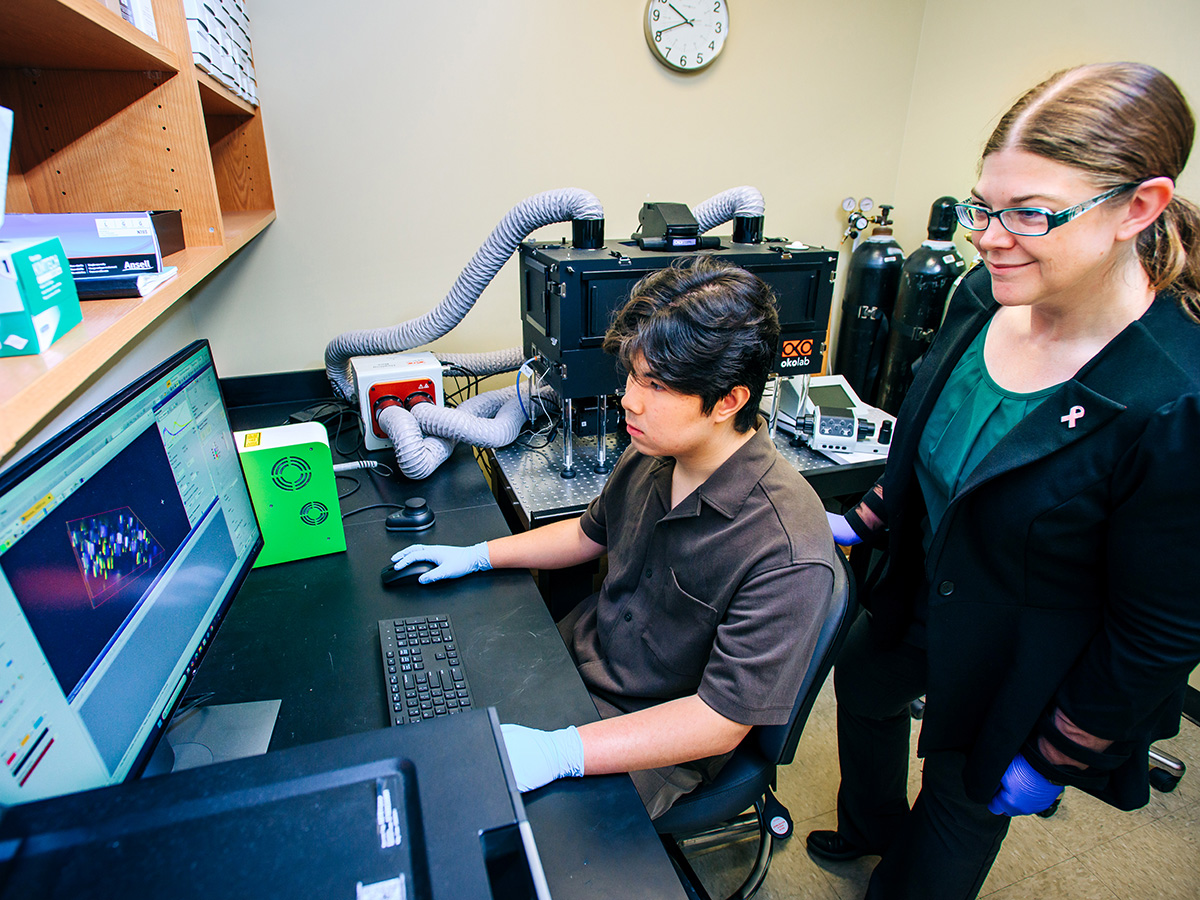
 Undergraduate Connor Nguyen and Mary Kathryn Sewell-Loftin, Ph.D., examine an image from Cheryl, the Sewell-Loftin lab's specialized fluorescence microscope (visible behind them), which she uses to track the movements of cancer cells as they respond to different mechanical forces.The cancer cells are looking to move.
“You can watch them testing handholds, like a rock climber,” said Mary Kathryn Sewell-Loftin, Ph.D., associate professor in the Department of Biomedical Engineering, a joint department of the School of Engineering and Heersink School of Medicine.
Packed into small “tissue-on-a-chip” devices that mimic various environments in the body, these human triple-negative breast cancer cells are doing what they do in humans: seeking to spread. Sewell-Loftin’s lab, located in the UAB O’Neal Cancer Center, studies how changes in mechanical properties affect cancer outcomes, primarily in breast and ovarian cancer.
Cheryl, the lab’s specialized fluorescence microscope, captures a picture every 30 minutes, recording the position of the tiny fluorescent beads that surround each cell. “We put that in a computer program, and it creates arrows showing where everything moved,” Sewell-Loftin said. The goal is to learn more about the conditions that allow cancer cells to escape their primary tumor site and migrate to secondary sites. “Our chips let us create normal tissue, metastatic issue and cancer tissue, and then we can watch the cells migrate and move in real time,” Sewell-Loftin said.
“I just want to be that kind of mentor”
Everything that Sewell-Loftin describes can be and is carried out by the four to eight undergraduate students working in her lab each semester. They learn to make tissues on a chip, operate the microscope, analyze images and create their own research questions. Many of them are still freshmen and sophomores. Sewell-Loftin launched her lab in January 2020; by the following month, she had accepted her first undergraduate student.
Sewell-Loftin’s undergraduates regularly present at conferences and are co-authors on her lab publications. They also credit her with outstanding mentorship as well. In 2025, Sewell-Loftin received the Provost’s Award for Faculty Excellence in Undergraduate Research. “Dr. Sewell-Loftin’s support has had a direct impact on my academic success and, more personally, my confidence in my ability to achieve my professional goals,” one student wrote in a nomination letter. “She is a stellar faculty member at UAB and an incredible mentor. I know from others in my cohort that I am just one of many students who she has positively impacted.”
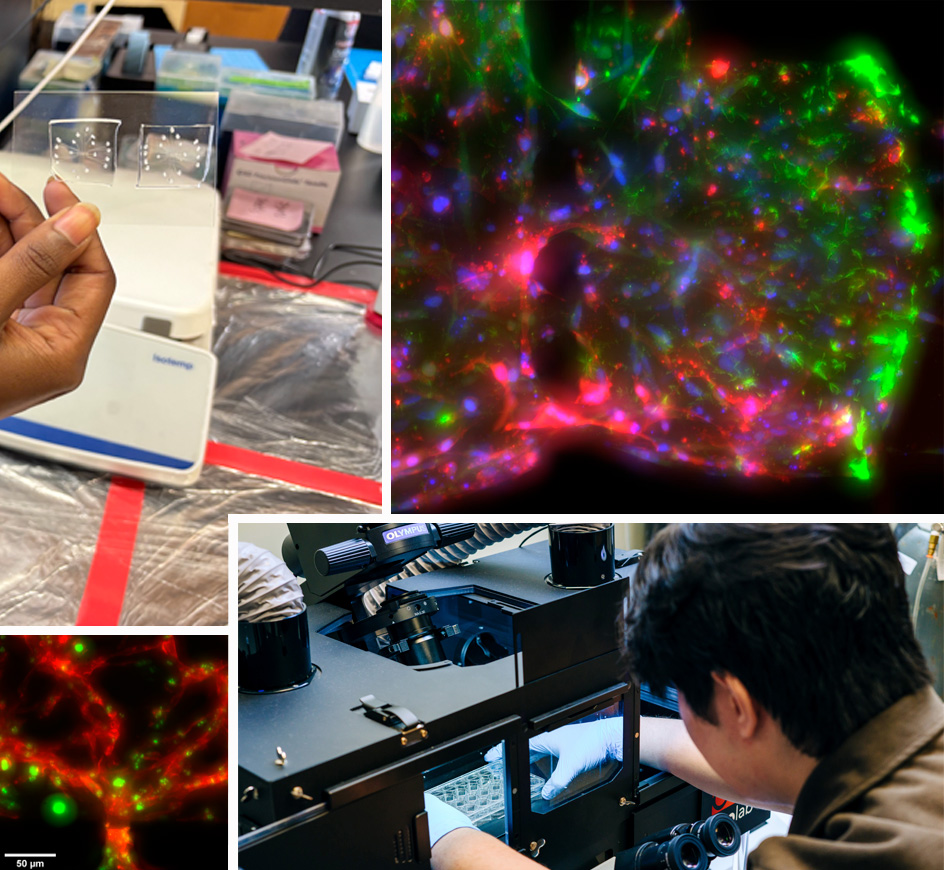 Clockwise from top left: Image 1: Shalarria Cooper, a graduate student in Sewell-Loftin’s lab, holds samples of the “tissues-on-a-chip” created in the lab. Image 2: An image from the lab’s fluorescence microscope, Cheryl, shows blood vessels (red), cell nuclei (blue) and collagen (green); cancer cells secrete collagen “so they can attach and migrate around in the chips,” Sewell-Loftin said. Image 3: Connor Nguyen inserts a sample into the fluorescence microscope. Image 4: Ovarian cancer cells and blood vessels (red) growing in a tissue-on-a-chip (here, a “tumor-on-a-chip”). The green cells are undergoing cell division, which means they are probably tumor cells. Images courtesy Sewell-Loftin Lab
Connor Nguyen, a junior majoring in biomedical engineering and applied mathematics, started working in Sewell-Loftin’s lab during his freshman year. “Aside from all the interesting lab techniques we use day to day, I’ve learned how to become an independent researcher who can review previous work and identify gaps in the knowledge that are worth looking into,” Nguyen said. “I’ve also learned a lot about how science and research operate behind the scenes.” (Read more about Nguyen’s work in this article.)
Sewell-Loftin says her own experience as an undergraduate researcher shaped her readiness to welcome these students into her lab. “I’m pretty sure it was my third meeting with my undergraduate research advisor where I decided I wanted to continue in research,” she said. “He was such a supportive mentor to me. I am where I am because I had mentors who believed in me when I did not know I could do this. I had great mentors and now I just want to be that kind of mentor to the next generation.”
Benefits of hosting undergraduates
But having undergraduates in the lab is not just about giving back: It also brings several benefits, Sewell-Loftin says.
It helps her explain her work to others.
“I enjoy it because it forces me to think about what we are doing, why we are doing it and how to explain it,” Sewell-Loftin said. “It helps me know how to explain things in a way that is relevant and approachable.”
Undergraduates expand her lab’s reach.
“I view our lab as a big umbrella of mechanics and cancer,” Sewell-Loftin said. Underneath are graduate students working on specific projects, and then undergraduates who are working with them and eventually developing their own questions. “Everyone has a piece of the puzzle so we can create a much more complete picture of what’s going on in cancer,” she said.
She sharpens her teaching skills.
“Nobody is born knowing how to do research, or use a pipette or design an experiment,” Sewell-Loftin said. “One of the things I find really rewarding is the actual process of watching them figure it out in real time. The idea is that I can keep myself in good practice by continuing to interact with this population who is just entering their scientific development.”
She learns too.
“I am learning from them as much as they are learning from me, and we are solving problems together,” Sewell-Loftin said. “That’s the goal.”
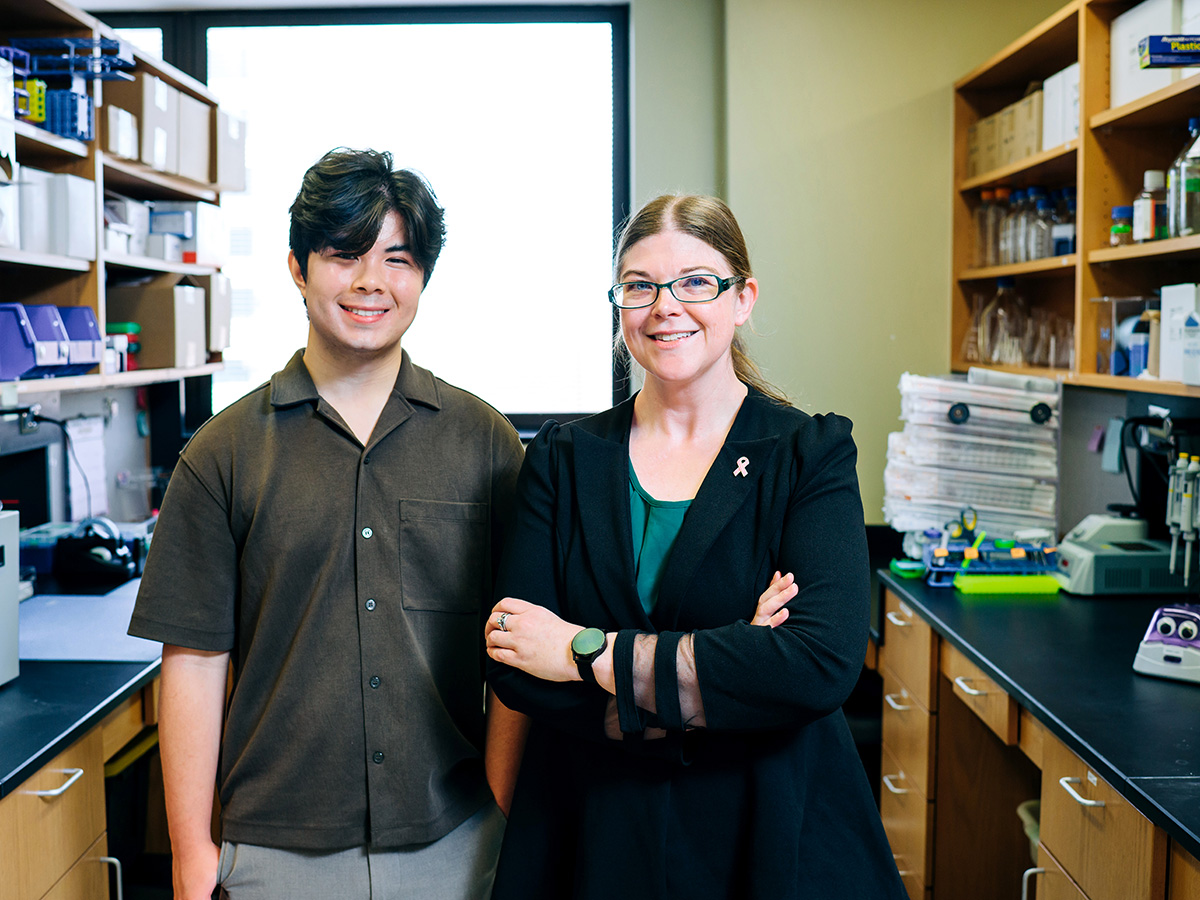 Connor Nguyen and Sewell-Loftin in her lab
Advice on hosting undergraduates
Start with thorough training.
“I’m a firm believer that everybody should learn about everything,” Sewell-Loftin said. “We have a basic list of protocols, and I insist that everybody learns them all.” This “level zero start point” is important, she explained. “The time you invest in training them and mentoring them will make them better scientists and contributors. One of the only benefits of COVID is that I had a lot of time to think about building my program. I have a very specific onboarding protocol we do, including safety training, technical training, and who to contact if it is after hours and something goes sideways. I tell them, ‘read it, read it again, and send questions.’”
Do not overlook younger students.
“Faculty have to be willing to talk to freshmen and sophomores,” Sewell-Loftin said. “We all get excited about senior-level electives; but by that time, students are graduating.”
You set the tone.
“The lab environment you create and you support is one of the things that will make undergrads successful or not,” Sewell-Loftin said. “We never want to make it the breast cancer project vs. the blood vessel project. It is us versus the question. I really appreciate that UAB has had the facilities, resources and mentorship that have helped me thrive, and then in turn I can create an environment where others can thrive.” One example: “We have a little star trophy for people who have had a bad day and things went wrong,” she said. “It means, you’re here, you’re learning, you’re trying. Failure is a large part of that process.”
Prioritize fit, not background.
“Everyone’s first semester is a trial basis,” Sewell-Loftin said. “I’m very honest. They have to fit in, learn, grow and develop skills, and they have to like it. If they hate Western blots, my lab is not a good fit for them; but I want to help them find a place that is. Life is too short for a job you hate.”
The majority of undergrads in her lab are biomedical engineering majors, along with students majoring in cancer biology and biomedical sciences. “But if someone is willing to come in and learn and is responsive to feedback, I will consider all backgrounds,” Sewell-Loftin said. “I’m married to a music educator; if people want to make sure they are good in science, or art, I’m happy to talk to them too.”
Learn more about undergraduate research resources at UAB. One of these is the Faculty Fellows in Undergraduate Research program, which offers one-year fellowships to faculty members and course instructors who want to integrate a course-based undergraduate research component.
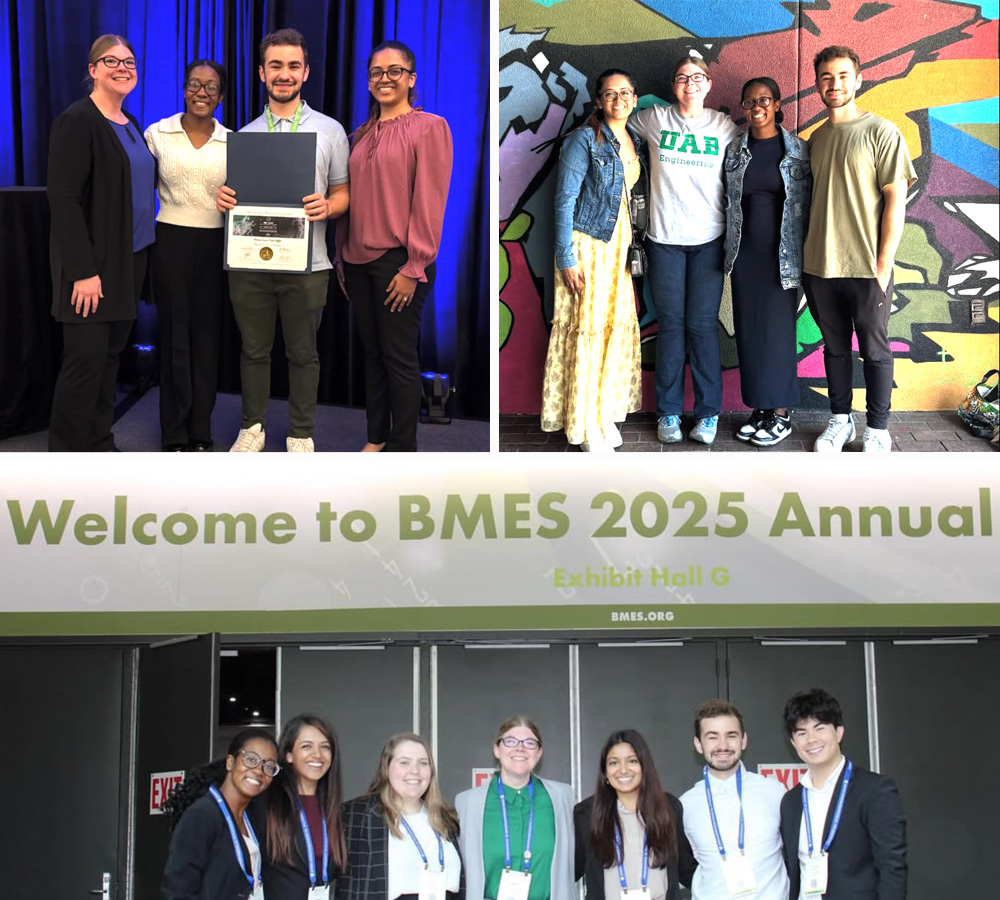 Sewell-Loftin lab members at the American Society of Mechanical Engineers’ Summer Bioengineering Conference in New Mexico in June 2025 (top two images), where UAB undergraduate biomedical engineering student Emerson Cutcliffe (top left image, holding certificate) placed third in the conference’s BS Student Paper Competition and at the Biomedical Engineering Society’s 2025 Annual Meeting in San Diego, California, in October 2025 (bottom image), where undergraduate student Connor Nguyen (far right) presented on his research and Sewell-Loftin received the Cellular and Molecular Bioengineering 2025 Young Innovator Award. Images courtesy Sewell-Loftin Lab
Why Sewell-Loftin takes undergraduates to conferences
Sewell-Loftin does not just host undergraduates in her lab. She prioritizes taking them with her to national conferences to give them a taste of the excitement of being surrounded by people who have dedicated their lives to science.
“That’s how I got my start,” she said. “I was a chemical engineering major doing biomaterials work on drug delivery for cancer research, and I went to the AIChE [American Institute of Chemical Engineers] conference. That is where I did my first poster presentation. My mom printed it out on an 8.5-by-11 piece of paper, and she still has it in her living room, 20 years later.”
Listening to conference presentations and meeting researchers, “I thought, there’s so much out there that I don’t know,” Sewell-Loftin recalled. “I also thought, ‘you mean that I could spend the rest of my life in a science lab trying to help people? That sounds awesome, please sign me up!’”