Update Your Information
You - our Nuclear Medicine and Molecular Imaging Sciences alumni - are important to us. Even after you are "gone" we hope you stay connected and stay in touch because we continue to have much to offer you. By filling out this form you will receive the latest updates regarding your School, your program and your former classmates.
Therapy Intensive
Welcome to the UAB Therapy Intensive!
Thank you for your interest in applying to the University of Alabama at Birmingham Nuclear Medicine and Molecular Therapy Intensive (NMMTI). The mission of the program is to provide qualified individuals with the knowledge and skills needed to succeed in both their clinical career and better prepare them for the future of Nuclear Medicine.
The NMMTI emphasizes a generalist approach to Nuclear Medicine and Molecular Therapy, so that students can apply these skills to many areas of therapy in the field. The week-long, fast-paced and intensive program includes lectures, hands-on skills, labs, and interactive activities.
Overview
Learn about this experience directly from those who attended previous events.
2026
2024
About the NMMTI
- When is it? The 2027 workshop will be held from April 19-23, 2027.
- Where is it? The NMMTI will be held at the University of Alabama at Birmingham, located in the heart of downtown Birmingham, Alabama.
- What costs are covered? All supplies, equipment, training materials and meals are provided to participants at no cost.
- When can I apply? The NMMTI applications are always open.
- When is the deadline to apply? The deadline to apply is December 1, 2026.
- When do you notify applicants? Notifications will be made February 2027.
Questions?
Email Krystle W. Glasgow, MIS, CNMT, NMTCB(CT), NMAA, FSNMMI-TS
Therapy Intensive Application

UAB Therapy Intensive
Thank you for your interest in applying to the University of Alabama at Birmingham Nuclear Medicine and Molecular Therapy Intensive (NMMTI). The mission of the program is to provide qualified individuals with the knowledge and skills needed to succeed in both their clinical career and better prepare them for the future of Nuclear Medicine.
The NMMTI emphasizes a generalist approach to Nuclear Medicine and Molecular Therapy, so that students can apply these skills to many areas of therapy in the field. The week-long, fast-paced and intensive program includes lectures, hands-on skills, labs, and interactive activities.
Requirements
- Must have a letter of recommendation from either their employer or SNMMI/SNMMI-TS Leadership.
- Must be a current SNMMI-TS Member.
- Must hold a current NM credential through the NMTCB and/or ARRT.
- Must be able to attend the entire program from beginning (Monday, April 19, 2027) to end (Friday, April 23, 2027).
- Must submit application by December 1, 2026, 11:59 p.m. CST.
If accepted, notifications will be made by February 2027.
Please forward questions and inquiries to: Krystle W. Glasgow, MIS, CNMT, NMTCB(CT), NMAA, FSNMMI-TS | UAB Nuclear Medicine and Molecular Imaging Sciences Program via
PLEASE NOTE: This form does not save progress. Do not begin filling out until you have your recommendation letter. You will be required to upload your recommendation letter and statement of purpose to submit this application.
Nuclear Medicine and Molecular Imaging Sciences
Please click on a link below to open a PDF version of the program handbook that corresponds with the chosen year.
2025 - 2026
2024 - 2025
2023 - 2024
2022 - 2023
2020 - 2021
2018 - 2019
2017 - 2018
2016 - 2017
Handbooks: M.S. in Nuclear Medicine and Molecular Imaging Sciences
Please click the button below to open a PDF version of the program handbook that corresponds with the chosen year.
Do you have questions that need answers? Do you want to know more about the Nuclear Medicine and Molecular Imaging Sciences program? You might find the answers you're looking for in our "Frequently Asked Questions." If you do have a question not listed here, please email
-
What is Nuclear Medicine and Molecular Imaging Sciences?
Nuclear Medicine and Molecular Imaging Sciences is a medical specialty that uses unique, safe, and painless techniques both to image the body and treat disease.
-
What is the average starting salary for an entry-level technologist?
Entry-level positions in nuclear medical technology range from $55,000 - $65,000.
-
What are some of the career opportunities available for nuclear medicine technologists?
Career opportunities in nuclear medical technology include not only clinical nuclear medicine technologists, but also as educators, research assistants, health physicists, hospital radiation safety officers, state inspectors, physicians, and sales representatives for nuclear instrumentation and radiopharmaceutical companies.
-
What are some of the employment opportunities available for nuclear medicine technologists?
Employment opportunities exist in medical centers; veterans and armed forces medical centers or hospitals; public health institutions; industrial, chemical, and biochemical research laboratories; and atomic power or nuclear instrumentation manufacturing companies.
-
What are some of the primary duties of a nuclear medicine technologists?
A nuclear medicine technologist (NMT) has direct patient contact when performing the nuclear medicine procedures and uses a variety of radiation equipment and computers to acquire data.
-
What are some other duties a nuclear medicine technologists might perform?
Other responsibilities of an NMT include quality control and preparation of radioactive drugs.
-
How do I apply?
Application is made through the UAB Graduate School. Graduate School admission forms are available from the UAB Graduate School.
-
When is the deadline to apply?
Early Admission deadline, for Fall enrollment, is February 15 for first consideration. International student admission deadline is April 30. Applications will be accepted up until July 1 on a case-by-case basis as program capacity allows. August 1 is the last deadline if space is available.
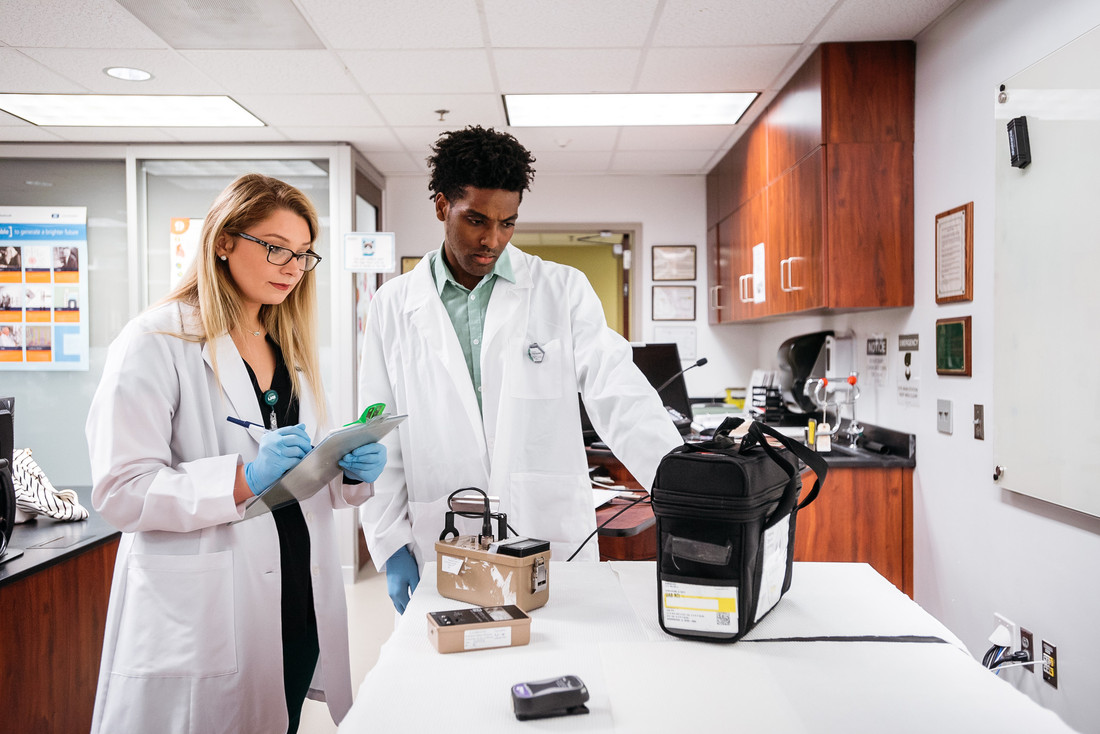 Students that graduate from the Master of Science in Nuclear Medicine and Molecular Imaging Sciences program are well prepared for a variety of different career paths.
Graduates with certifications are equipped to start working immediately as a nuclear medicine technologist, with further career options to work as multi-modality imaging specialist, nuclear regulatory commission license eligible radiation safety officer, or as an independent researcher.
Career and Salary Outlook for Nuclear Medicine
The U.S. Bureau of Labor Statistics projects the field to grow five percent faster than the average occupation through 2029.
-
How much does a Nuclear Medicine Technologist make in the United States?
The average Nuclear Medicine Technologist salary in the United States is $84,903 as of May 27, 2021, but the range typically falls between $76,307 and $92,887. Salary ranges can vary widely depending on many important factors, including education, certifications, additional skills, the number of years you have spent in your profession (www.salary.com).
-
How much does a Radiation Safety Officer make in the United States?
The average Radiation Safety Officer salary in the United States is $80,490 as of May 27, 2021, but the salary range typically falls between $70,042 and $92,455. Salary ranges can vary widely depending on many important factors, including education, certifications, additional skills, the number of years you have spent in your profession (www.salary.com).
-
How much does a Researcher make in the United States?
The average Researcher salary in the United States is $57,895 as of May 27, 2021, but the salary range typically falls between $51,787 and $70,382. Salary ranges can vary widely depending on many important factors, including education, certifications, additional skills, the number of years you have spent in your profession (www.salary.com).
Where The Jobs Are
The majority of graduates work in the hospital setting within a Nuclear Medicine Department. Others work in outpatient facilities and physician offices. Some students become travel technologists and work with a company to provide care to areas where access to care for patients is low. Some graduates choose to work in industry, helping to develop and train individuals on the latest technology in Nuclear Medicine and Molecular Imaging. Still, others go into research and help develop new Nuclear Medicine radiopharmaceuticals to help diagnose and treat diseases in patients. Our students are also eligible to become the Radiation Safety Officer for a hospital and help enforce radiation safety practices for employees.
1,000 Hours of Experience
One other unique aspect that the Master of Science in Nuclear Medicine and Molecular Imaging Sciences offers is that graduates receive about 1,000 hours of hands-on, clinical experience while in the program. These hours can be difficult to obtain outside of a program like this, and these clinical hours are valuable especially for our graduates that choose to further education in medicine. The Master of Science in Nuclear Medicine and Molecular Imaging Sciences is the gateway to success for many students at UAB.
Many students use this valuable clinical experience as a springboard for furthering their graduate education in medicine and biomedical sciences. Many of our graduates with their specialized knowledge and skills have gone on to medical, dental, and PA school or have pursued PhD studies or post-doctoral position.
Society of Nuclear Medicine and Molecular Imaging
The Society of Nuclear Medicine and Molecular Imaging has "What Patients Need to Know About Nuclear Medicine and Molecular Imaging," a more detailed look at what technologies a Nuclear Medical Technologist might work with.
Application Deadlines:
December 1 – First consideration; students begin the program in the fall semester
August 1 - Last deadline if space available
Application Fees:
- Domestic applicants and green card holders: $50
- International applicants: $60
Instructions for Completing the Application
Prospective students may apply at any time during the year; however, students begin program courses in either the fall or spring semester. Applications are submitted online through the UAB Graduate School. All admissions documents (test scores, transcripts, immigration documents, WES, etc.) must be sent to the UAB Graduate School.
Official transcripts from each institution where college credit was received can be mailed to:
UAB Graduate School
LHL G03, 1720 2nd Avenue South
Birmingham, AL 35294-0013
Transcripts can be submitted electronically by choosing University of Alabama at Birmingham - Graduate Admission or using the email
Example for Completing Application:
- For which of the following are you applying? Master’s Degree
- Intended program of study: Nuclear Medicine and Molecular Imaging Sciences
- Concentration: Not Applicable – Selected program does not offer concentrations
- Term: Fall 201X
Requirements
-
Prerequisite Requirements
- Precalculus Trigonometry - 3 hours
- Introductory Chemistry I and II with Labs - 8 hours
- Pathophysiology - 3 hours
- Human Anatomy and Physiology - 8 hours
- Statistics - 3 hours
- College Physics I and II - 8 hours
- Medical Terminology - 3 hours
- Health Care System - 3 hours
-
Application Requirements
- Students must have a BA or BS degree from a regionally accredited institution, meet all graduate school requirements and be accepted to the graduate program.
- Admission to the program will be dependent on successful completion of all prerequisite coursework.
- A minimum cumulative undergraduate grade point average of at least 3.0 (A = 4.0).
- A minimum cumulative grade point average of 3.0 in the program prerequisite courses, with a minimum grade of C in each.
- Interview with faculty.
- Clinical observation which is arranged by the Nuclear Medicine and Molecular Imaging Sciences Clinical Coordinator, Krystle Glasgow.
- Satisfactory screening on health data questionnaire by the UAB Medical Center Student Health Service if accepted.
-
International Requirements
Please visit the Graduate School's International Admissions page for information about deadlines, requirements, English proficiency exams, and the application process.
-
Essential Functions
The following skills are needed by applicants to the Nuclear Medicine and Molecular Imaging Sciences program. Applicants and students should possess these abilities, or with the help of compensatory techniques and/or assistive devices, be able to demonstrate the ability to become proficient.
Manual dexterity (use of extremities for patient care purposes):
- Wrists (both): grasping, pulling, twisting
- Hands (both): fingering, holding, (rotation)
- Arms (both): pushing, extending, cutting
- Sensation: palpation, auscultation percussion
- Capable of hearing voices of normal range in the presence of background noise
- Visual Perception: depth acuity (corrected to 20/40)
- Ability to distinguish shades of gray/color
Physical Strength:
- To support another person
- To position another person
- To transfer/ambulate with walker, cane, crutches, bed, wheelchair
- To stand for long periods of time
- To perform CPR; resuscitation
- To walk at a rapid pace for eight hours
Interpersonal:
- Able to function - consult, negotiate, share - as part of a team skills:
- Able to use communication skills
- Able to respond to others' requests
- Willing to accept direction and supervision
- Perform duties while under stress
- Ability to operate and maintain equipment (e.g., nuclear medicine instrumentation, ventilator, electronic monitor, etc.)
Students requesting disability accommodations must do so by filing a disability accommodation request with UAB Disability Support Services.
Application Review Process
After an application window has been opened, applications are reviewed at program deadlines. Applicants will be interviewed by NMMIS faculty.
Additional Information
Learn more about tuition and fees on the School of Health Professions website.
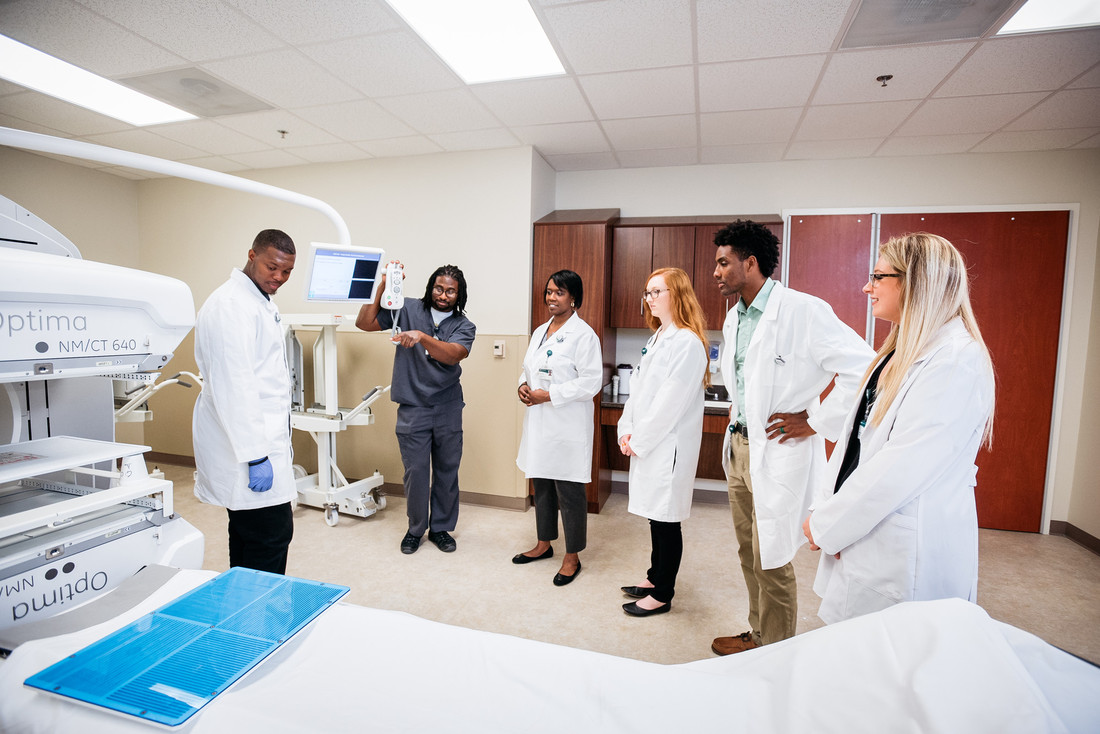 The purpose of program evaluation is to systematically study, investigate and appraise the effectiveness of the Nuclear Medicine and Molecular Imaging Sciences program in order to ensure that the program continues to provide a signature educational program that produces graduates who are prepared to be leaders in their field. Graduate outcomes are indicators of program effectiveness, demonstrating the extent to which a program achieves its goals.
Reported Data
Programmatic graduate outcomes data reported on the Joint Review Committee on Educational Programs in Nuclear Medicine Technology (JRCNMT) website include: 5-year time period of current report; graduation rate; The American Registry of Radiologic Technologists (ARRT) credentialing success; Nuclear Medicine Technology Certification Board (NMTCB) credentialing success and job placement rate.
-
Program Mission
The mission of the Master of Science in Nuclear Medicine and Molecular Imaging Sciences (NMMIS) program in the School of Health Professions at the University of Alabama at Birmingham (UAB) is to provide comprehensive didactic and clinical educational experiences reflecting 21st century workforce demands that prepare graduates to be competent practitioners and innovative leaders within the nuclear medicine profession.
-
Program Goals
- Provide students with the knowledge and skills necessary for the practice of nuclear medicine in one of the chosen specializations as an imaging specialist, or radiation safety officer, or independent researcher.
- Provide students with the knowledge necessary to pass national certification.
- Provide health care employers with competent graduates.
- Offer educational activities and materials to the health care community.
- Provide help for students with future graduate school request.
-
Student Learning Objectives
- The graduate will demonstrate the knowledge required for an entry-level nuclear medicine technologist.
- The graduate will apply theories, principles, and skills to demonstrate clinical proficiency in diverse clinical settings.
- The graduate will apply leadership, educational and management strategies that can be used in the health care profession.
- The graduate will effectively collaborate as an interprofessional health care team.
- The graduate will demonstrate advanced research skills by designing studies, analyzing data, and communicating findings effectively.
Program Outcomes:
Post-Baccalaureate Accreditation approval is maintained through 2024 from the JRCNMT.
Graduate achievement data is an indicator of program effectiveness, demonstrating the extent to which a program achieves its goals. The current report on graduate achievement data, identified by program, is available on the JRCNMT website by clicking on the following link: Graduate Achievement Report.
-
NMMIS Program First Time Pass Rate for NMTCB Certification
Year UAB NMMIS Program National Average for Equivalent Programs National Average Overall 2009 100% 94% 90% 2010 93% 92% 88% 2011 94% 93% 91% 2012 88% 91% 89% 2013 100% 91% 88% 2014 89% 90% 88% 2015 92% 91% 87% 2016 82% 89% 83% -
UAB NMMIS Applicant and Class Data
NMMIS Applicant and Class Data 2011 2012 2013 2014 2016 Applications Received n/a 34 28 38 5 Enrolled 21 20 16 19 5 Average Entering GPA 3.56 3.21 3.14 3.07 3.07 *2015 - No entering class data due to transition from BS to MS degree.
-
UAB NMMIS Cohort Data
NMMIS Cohort Data 2011-2013 2012-2014 2013-2015 2014-2016 Enrolled 21 20 16 19 Academic Attrition 2 2 3 1 Personal Attrition 1 0 0 0 Graduated 18 18 13 17 Graduated Rate 86% 90% 81% 89% -
UAB NMMIS Graduate Employment and Education Outcomes
UAB NMMIS Graduate Outcomes 2012 2013 2014 2015 2016 Employed in NMT 57.1% 68.8% 38.5% 67% 90% Enrolled in Education Program 30.8% 14.3% 23.0% 0.0% 5%
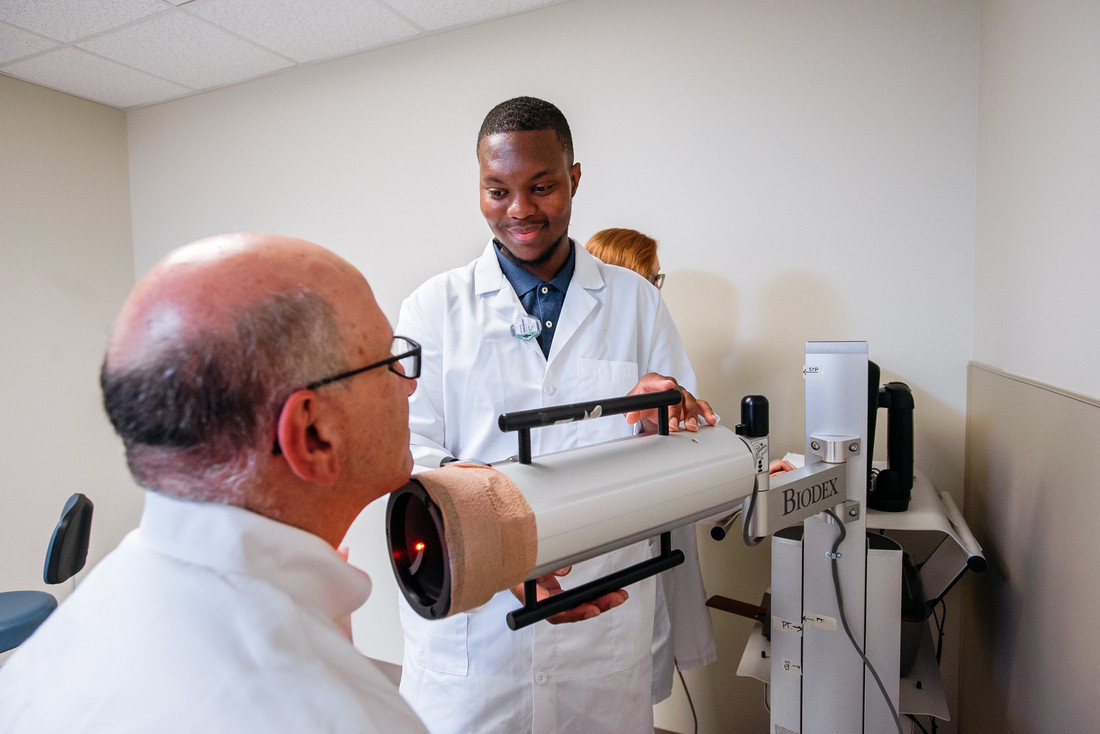 Clinical education is a major component of the Nuclear Medicine and Molecular Imaging Sciences professional phase program. This allows you to get firsthand and hands-on experience in the clinical setting. Earning real world practical experience as part of your overall education will give you an edge. This enables you to become an entry level technologist by the time of graduation through completing documented clinical competencies and experiences while furthering your career as an Imaging Specialist, or medical radiation safety officer, or as a researcher.
Alabama Facilities Affiliated with Nuclear Medicine and Molecular Imaging Sciences
- Baptist Medical Center Princeton, Birmingham, AL
- Brookwood Baptist Medical Center, Homewood, AL
- Cardinal Health Nuclear Pharmacy, Birmingham, AL
- Brookwood Diagnostic Center, Birmingham, AL
- Cardiology P.C., Birmingham, AL
- Children’s of Alabama, Birmingham, AL
- Cullman Regional Medical Center, Cullman, AL
- Birmingham VA Medical Center, Birmingham, AL
- Grandview Medical Center, Birmingham, AL
- St. Vincent’s East, Birmingham, AL
- St. Vincent’s P.E.T. Center, Birmingham, AL
- Shelby Baptist Medical Center, Alabaster, AL
- Cardiology Clinic, The Kirklin Clinic of UAB Hospital, Birmingham, AL
- UAB Advanced Imaging Facility, Birmingham, AL
- UAB Hospital
- Medical West, affiliate of UAB Health System, Bessemer, AL
- UAB Hospital, Birmingham, AL
- Walker Baptist Medical Center, Jasper, AL
- Walker Medical Diagnostics, LLC, Jasper, AL
- Decatur Morgan Hospital, Decatur, AL
- Heart South Cardiovascular Group, PC, Alabaster, AL