
Qualifying Exams
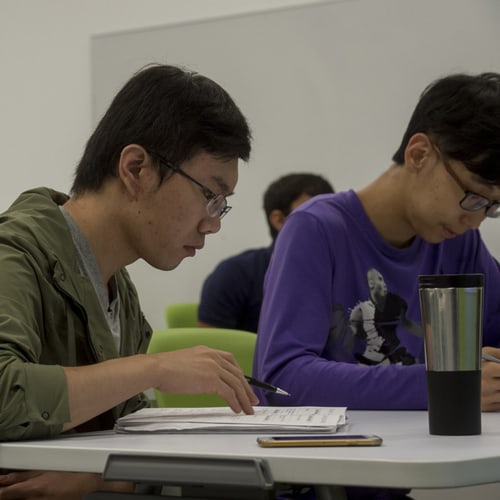
All Ph.D. students must pass two qualifying exams. One exam covers Mathematical Analysis (MA 640 and MA 641). The other exam covers Linear Algebra and Numerical Linear Algebra (MA 631 and MA 660). Each exam is three and a half hours long.
Scheduling an Exam
The examinations in Mathematical Analysis and Linear Algebra are given during two periods each year (one in May and one in August). During each period a student may take one or both of the exams, subject to the following restrictions:
- each exam may be attempted no more than twice, and
- students may participate in exams during no more than three periods.
Spring 2026 Schedule
- Mathematical Analysis: Monday, May 11, 8:30 a.m. - 12:00 p.m.
- Linear Algebra: Wednesday, May 13, 8:30 a.m. - 12:00 p.m.
Fall 2026 Schedule
- Mathematical Analysis: Monday, August 10, 8:30 a.m. - 12:00 p.m.
- Linear Algebra: Tuesday, August 11, 8:30 a.m. - 12:00 p.m.
Exam Topics
-
Mathematical Analysis
- sup and inf for subsets of R, lim sup, lim inf for real sequences, Bolzano- Weierstrass theorem, Cauchy sequences.
- Continuous functions - min-max, intermediate value theorem, uniform conti-nuity, monotone functions.
- Derivative - mean value theorem, Taylor’s theorem for real functions on an interval.
- Riemann integration for functions on an interval. Improper integrals. Integrals depending on parameters.
- Sequences of functions - pointwise and uniform convergence, interchange of limits.
- Series of functions - M -test, differentiation/integration, real analytic functions.
- Metric spaces - open and closed sets, completeness and compactness, Cauchy sequences, continuous functions between metric spaces, uniform continuity, Heine-Borel and related theorems, contraction mapping theorem, Arzela-Ascoli theorem.
-
Linear Algebra
Linear Algebra
- Vector spaces over a field, subspaces, quotient spaces, complementary spaces
- bases as maximal linearly independent subsets, finite dimensional vector spaces
- linear transformations, null spaces, ranges, invariant subspaces, vector space isomorphisms
- matrix of a linear transformation, rank and nullity of linear transformations and matrices
- change of basis, equivalence and similarity of matrices, dual spaces and bases
- diagonalization of linear operators and matrices
- Cayley-Hamilton theorem and minimal polynomials, Jordan canonical form
- real and complex normed and inner product spaces, Cauchy-Schwarz and triangle inequalities
- orthogonal complements, orthogonal sets, Fourier coefficients and the Bessel inequality
- adjoint of a linear operator, positive definite operators and matrices
- unitary diagonalization of normal operators and matrices, orthogonal diagonalization of real symmetric matrices
- bilinear and quadratic forms over a field
Numerical Linear Algebra
- Triangular matrices and systems, Gaussian elimination, triangular decomposition;
- the solution of linear systems, the effects of rounding error;
- norms and limits, matrix norms;
- inverses of perturbed matrices, the accuracy of solutions of linear systems;
- iterative refinement of approximate solutions of linear systems;
- orthogonality, the linear least squares problem, orthogonal triangularization, the iterative refinement of least squares solutions;
- the space Cn, Hermitian matrices, the singular value decomposition, condition;
- eigenvalues and eigenvectors, reduction of matrices by similarity transformations, the sensitivity of eigenvalues and eigenvectors;
- eduction to Hessenberg and tridiagonal forms;
- the power and inverse power methods, the explicitly shifted QR algorithm, the implicitly shifted QR algorithm;
- computing singular values and vectors, the generalized eigenvalue problem A−λB.
Recent Exams
All previous Real Analysis and Linear Algebra exams are available for local students, but you can see a few recent exams.
Typical Curriculum for the Doctor of Philosophy Degree
The current curriculum contains regular courses only. All courses are 3 credit hours. The grade for each course must be an A or B. Research hours are Pass/Fail. The description of the courses can be found in the Graduate Catalog.
Occasionally, other optional courses can be taken and counted towards the degree.
Modifications are possible with the approval of your graduate committee and the graduate program director. For more information, please, contact the graduate program director Dr. Yulia Karpeshina at
Year I
Fall
- MA 640: Mathematical Analysis I. Required.
- MA 631: Linear Algebra. Required.
- MA 685: Probability Theory. Required.
Spring
- MA 641: Mathematical Analysis II. Required. Prerequisite: MA 640. Minimum grade: B
- MA 660: Numerical Linear Algebra. Required. Prerequisite: MA 631. Minimum grade: B
- MA 670: Topology I. Required. Prerequisite: MA 631. Minimum grade: B
Summer
- MA 642: Calculus of Several Variables. Required. Prerequisite: MA 541. Minimum grade: B
- MA 637: Graph Theory and Combinatorics. Not required.
- 600 or 700 level, 3 credit hours: Special reading topics, Non-Diss Research/Comp Prep, or Dissertation Research. Not Required.
Year II
Fall
- MA 650: Differential Equations. Required. Prerequisite: MA 642. Minimum grade: B
- MA 648: Complex Analysis. Required. Prerequisite: MA 642. Minimum grade: B
- MA 645: Real Analysis I. Required. Prerequisites: MA 642 and MA 670. Minimum grade: B
Spring
- MA 646: Real Analysis II. Required. Prerequisite: MA 645. Minimum grade: B
- MA 655: Partial Differential Equations. Required. Prerequisite: MA 642 or MA 650. Minimum grade: B
- 700 level, 3 credit hours: Special reading topics, Non-Diss Research/Comp Prep, or Dissertation Research. Required.
Summer
- MA 687: Advanced Probability. Required. Prerequisite: MA 585. Minimum grade: B
- 700 level, 3 credit hours: Special reading topics, Non-Diss Research/Comp Prep, or Dissertation Research. Required.
- 700 level, 3 credit hours: Special reading topics, Non-Diss Research/Comp Prep, or Dissertation Research. Required.
Year III
Fall
- MA 668: Numerical Analysis I. Required.
- 3 credit hours: A course in Minor. Required.
- 700 level, 3 credit hours: Special reading topics, Non-Diss Research/Comp Prep, or Dissertation Research. Required.
Spring
- MA 632: Abstract Algebra. Required.
- 3 credit hours: A course in Minor. Required.
- 700 level, 3 credit hours: Special reading topics, Non-Diss Research/Comp Prep, or Dissertation Research. Required.
Summer
- MA 688: Advanced Statistics. Required.
- 700 level, 3 credit hours: Special reading topics, Non-Diss Research/Comp Prep, or Dissertation Research. Required.
- 700 level, 3 credit hours: Special reading topics, Non-Diss Research/Comp Prep, or Dissertation Research. Required.
Year IV
Fall
- 3 credit hours: A course in Minor. Required.
- 700 level, 3 credit hours: Special reading topics, Non-Diss Research/Comp Prep, or Dissertation Research. Required.
- 700 level, 3 credit hours: Special reading topics, Non-Diss Research/Comp Prep, or Dissertation Research. Required.
Spring
- 3 credit hours: A course in Minor. Required.
- 700 level, 3 credit hours: Special reading topics, Non-Diss Research/Comp Prep, or Dissertation Research. Required.
- 700 level, 3 credit hours: Special reading topics, Non-Diss Research/Comp Prep, or Dissertation Research. Required.
Year IV Summer and Year V
MA 798: Non-Dissertation Research and Preparation for Comp and MA 799: Dissertation Research. 24 hours of 799 research is required over at least two semesters. 12 of these hours must be 799 research hours. Only 12 hours of 798 can be substituted for 799.
Admissions
Only students with a firm foundation in Advanced Calculus, Algebra, and Topology are considered for immediate admission to the Ph.D. program. A student lacking this background will be considered for admission to our Master's program. Upon passing the qualifying exam a student may transfer to the Ph.D. program.
Applicants should have at least a B average in their previous work. Letters of evaluation play an important role in our assessment of a student's qualifications.
Application Requirements
 To apply for admission you have to provide:
- academic records,
- three letters of recommendation,
- a personal essay,
- a CV or resume.
There are more requirements for international students, which can be found on the Graduate School's International Applicants page.
The graduate school charges an application fee which cannot be waived. All applications are submitted online via the TargetX application portal. The required recommendation letters must also be submitted using the application portal.
- Submit official TOEFL test score (for international applicants only) to Institution code 1856.
Application Deadlines
We admit new applicants for the Ph.D. program only in the Fall semester. However, it is necessary that your complete application is received by the Graduate School at least six weeks before the beginning of the Fall term. Graduate school application deadlines are available on their admissions requirements website. Moreover, to ensure full consideration for financial support for the academic year (mid August — mid May) we should receive your application by March 15.
Application Questions
If you have any general questions about the online application process, contact the Graduate School:
Address:
UAB Graduate School
LHL G03
1720 2nd Avenue South
Birmingham, AL 35294-0013
USA
E-Mail:
Phone: (205) 934-8227
Program Questions
If you have questions about our mathematics program and financial support, please contact us directly:
Address:
Department of Mathematics
University of Alabama at Birmingham
1402 10th Avenue South
Room #4005
Birmingham, AL 35294-1241
USA
E-Mail:
Phone: (205) 934-2154
Program Requirements
The following benchmarks have to be passed on your way to the Ph.D. degree:
- Passing of the qualifying exam. This is an exam in Mathematical Analysis and Numerical Linear Algebra. If you are admitted directly into the Ph.D. program, you are expected to take this exam by the end of the first year at the latest.
- Completing 54 semester hours of courses at the 600 or 700 level. The minimum acceptable grade in each course is a B. The selection of courses must be approved by your supervisory committee and the Joint Program Committee that administers the program. At least 18 hours must be in a major area of concentration, while at least 12 hours have to be in a minor area of study in a subject outside mathematics. Other course requirements can be found at the catalog link below.
Doctoral Degree Requirements - Passing a language or tool of research exam. The exam content is determined by your Ph.D. committee.
- Passing the comprehensive exam, consisting of a written and an oral part.
- Completion of 24 semester hours of research-based work over a minimum of two semesters in candidacy which can be designated as either:
- A minimum of 24 semester hours in 799 dissertation research OR
- A minimum of 12 semester hours in 799 dissertation research AND, either during or before candidacy, 12 semester hours in other appropriate research-based coursework which has been approved by the graduate student’s program
- Preparing a dissertation that must be a genuine contribution to mathematics.
Courses
A list of courses is available in the UAB Graduate Catalog.
Time to Complete
Coursework may be finished within two years after the Qualifying Exam. Research should be started while coursework is still underway. Typically, work on the thesis itself takes 12-18 months. Therefore, depending on your background, it can take four to six years to obtain both the M.S. and the Ph.D. degree.
Ph.D. in Applied Mathematics
 Are you ready to take the next step in your career? We are preparing students interested in an academic career in a college or university, as well as students interested in a career in business, industry, or government.
A Focus on Research
As a UAB Mathematics doctoral student, you will study a fairly broad spectrum of pure and applied mathematics, and also take an outside minor relating your area of interest in an applied area such as computer science, physics or biostatistics. The department has extensive outside grant support that funds research and doctoral work. You can expect to interact not only with our faculty but with the greater mathematical world. We encourage attendance at professional meetings, and also encourage interaction with faculty at other universities across the U.S. and abroad.
Ready to Learn More?
We invite you to explore this site to learn more about the Ph.D. in Mathematics. If you have any questions, contact:
- Graduate Program Director Yulia Karpeshina through email at
This email address is being protected from spambots. You need JavaScript enabled to view it. . - Graduate Recruiting Coordinator Dr. Keren Li through email at
This email address is being protected from spambots. You need JavaScript enabled to view it. .