-
SDH Toolkit
We maintain a SDH Toolkit with scales, indices, and instruments to measure various individual- and area-level social determinants of health.
To access the toolkit:
- UAB Employees: UAB employees and students can access the toolkit using the link above and their Blazer ID/password.
- External Users: Those without a “@uab.edu” email address, can access the toolkit by contacting Joy Ledvina at
This email address is being protected from spambots. You need JavaScript enabled to view it.
-
Geographic Information System (GIS)
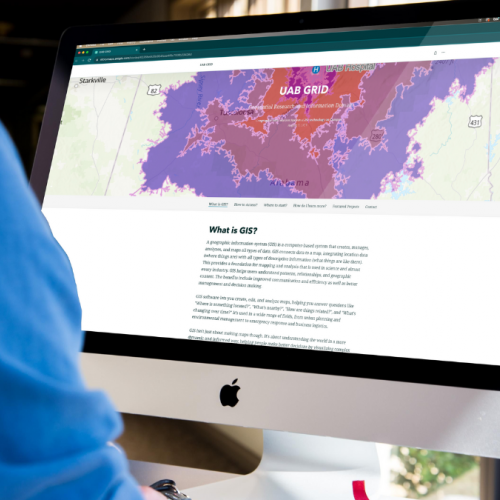
ArcPro and ArcGIS Online, as well as other Esri desktop, mobile, and cloud-based geospatial technology, are freely available for geocoding, geo-mapping, data visualization, and analysis. To learn more, visit the UAB Geospatial Research and Information Domain (GRID) website.
-
Online Learning Modules on the Use of Esri ArcGIS Products
Curated Learning Plans are available by signing in to Esri training using one’s UAB GIS username and password (Note: This is not your Blazer ID). Learning Plans offer a sequenced way of learning specific content and skills via readings, videos, and hands-on resources, and allow individuals to choose learning paths tailored to their need.
-
SDH Core Description for Grant Submissions
The UAB Social Determinants of Health (SDH) Institutional Research Core provides expertise and services that help investigators quantify the effect of social and environmental risks for disease etiology, progression, management, and outcomes. These services include:
- Consultations on individual- and area-level SDH measures, data, and methods
- Geocoding and linking addresses to Census geography
- Integration of area-level SDH measures with data from EHR, patient registries, research cohorts, and other clinical or research data
- Geospatial analysis and mapping
- Statistical analysis
- Access to resources such as SDH Toolkit and Esri ArcGIS products for geocoding, mapping, data visualization, and analysis
Services are requested through the Core’s website, and users receive a monthly e-newsletter. Weekly drop-in consultations are offered, as well as the use of a geocoding computer equipped with ArcGIS Pro and StreetMap Pemium. The Core, located on the 8th floor of the BDB, includes a team of six: Director, Co-Director, Director of Data Analytics, Director of Geospatial Services, Director of Operations, and a Statistician
Since 2023, the SDH Core has nearly tripled its investigator base to 112 faculty from 6 UAB schools and 3 other UAB units. The Core also provides services to several UAB Centers, Institutes, and Center grants, including:
- Institute for Cancer Outcomes and Survivorship (ICOS)
- Center for Clinical and Translational Science (CCTS)
- U54 Center for Cancer Control in Persistent Poverty Areas (CARES)
- Regional Pediatric Preparedness Network (PPN)
- T32 Support for the Improving Health Equity Across the Lifespan (iHEAL)
- Center for the Study of Community Health (CSCH)
- Live HealthSmart Alabama
Since 2023, the Core has supported the submission of more than 50 grant proposals that have brought to the University $33.5 million in research funding. A monthly training series on the health impacts of the exposome, launched in January 2026 through the CCTS Training Interdisciplinary & Emerging Research Scholars (TIERS) program, has reached more than 120 investigators from 11 academic health centers, research institutes, and universities across Alabama, Louisiana, and Mississippi. An undergraduate Honors College course on social epidemiology was launched Fall 2026. In collaboration with the CSCH and the CCTS, the Core is implementing the Spatial Technologies for Recruitment Innovation and Decentralized Engagement (STRIDE) initiative, which identifies optimal locations for clinical trial recruitment and facilitates decentralized recruitment by community residents trained and IRB-certified in human subjects research.