
The Department of Mechanical Engineering (ME)at UAB has a long history of pursuing interdisciplinary research projects with support from industry and government agencies and in collaboration with other departments at UAB, other universities, and national laboratories.
Some examples of research conducted by the department include:
Computational Fluid Dynamics
Traditionally, computational fluid dynamics techniques are developed for aerodynamics applications. Our research focuses on the application of CFD techniques to traditional, non-traditional, and multi-disciplinary applications.
Energy Systems
Current projects include heat pumps; energy use index study of UAB campus buildings; feasibility study of distributed generation system for UAB buildings; internal combustion engine based tri generation of heating, cooling, and power; and concentrated PV thermal management.
Geologic Storage of Carbon Dioxide
Separation of carbon dioxide from the products of combustion of fossil fuels in large industrial facilities such as electric power plants and injection of the carbon dioxide for permanent storage in suitable geologic formations underground is a practical approach to slowing the accumulation of carbon dioxide in Earth's atmosphere and its contribution to climate change.
Computational Structural Mechanics
Our CSM research includes static and dynamic analyses of complex solid bodies using computational approaches such as finite volume, finite element, discrete element, and meshless methods. The focus of this group is on applications involving large strain, high strain rates, and strong shocks occurring in impact events.
Barber Laboratory for Advanced Safety Engineering and Research (BLASER)
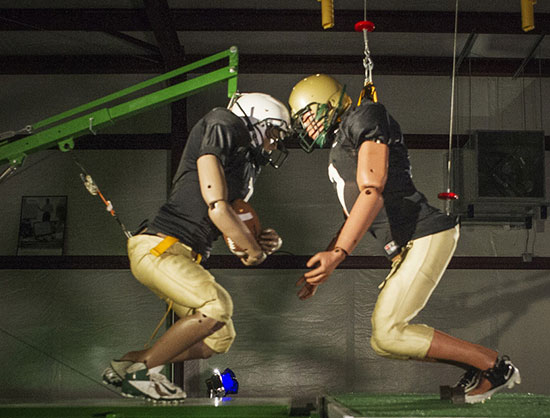
Our BLASER research includes dynamic evaluation of real-life impact events using explicit finite element analysis and physical testing. The focus of this group is crash energy management and enhancing crashworthiness on applications in automotive and sports safety.
Vehicle and Robotics Engineering Lab (VREL)
VREL is a research facility dedicated to vehicle and robotics engineering research, with a focus on developing a cross-disciplinary, multi-domain systems engineering approach to engineer vehicle and robotic intelligent physical/mechatronic systems. We work in partnership with other academic institutions, industry, governmental research agencies, and intergovernmental international organizations.