A Painful Knee Injury Inspires SOE Researcher to Reconsider Structural Reliability
In the 20th century, a comic book writer watched how steel beams transformed city skylines and imagined a Superman with bones as strong as steel.
Today, a researcher at the UAB School of Engineering is imagining a modification that could give those strong steel buildings the resiliency of a human body.
Seyed Hooman Ghasemi, Ph.D., an assistant professor in the Department of Civil, Construction, and Environmental Engineering, is advancing two complementary research efforts backed by nearly $160,000 in combined support. His team is exploring ligament-inspired, torsion-resistant connections that could link steel components in buildings much as ligaments connect bones and tissues in the human body.
Ghasemi has spent his career studying structural reliability in modern construction. But he says he began to think of structural reliability in a different way when he had a first-hand experience with a structural failure; not at a construction site, but on a soccer field.
“Several years ago, I was playing soccer, and I ruptured my anterior cruciate ligament, or ACL,” Ghasemi said. “Through conversations with the doctor, I learned more about the ACL and PCL (posterior cruciate ligament), which are the elements that control the torsion if you suddenly change movements.”
While the rigid bones give legs their form and their strength to carry a body’s weight, Ghasemi says, it’s the elasticity of ligaments that allows a moderate amount of torsion without breaking bones.
When looking at recent cases of catastrophic building collapses, Ghasemi looked at the failure of his ACL and wondered if a ligament could perform a similar function in steel construction.
How a human leg is superior to a steel column
In any steel construction, you have rigid steel beams connected to columns, which are connected to baseplates. These connections provide the enormous amount of strength required to build massive skyscrapers, bridges, and other modern structures.
But in recent years, there have been instances where buildings collapsed unexpectedly, and those disasters occurred seemingly without warning.
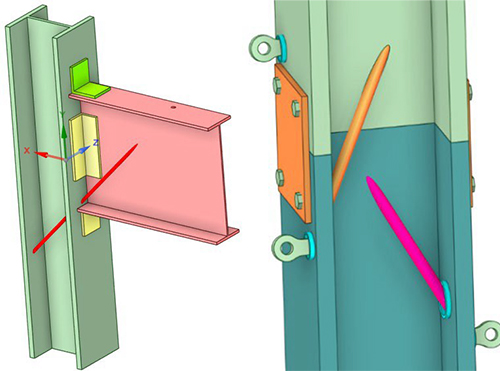 This illustration shows proposed human-inspired connection mechanisms. At left, a beam to column connection, and at right, a column-to-column connection inspired by knee-ligament anatomy.“One of the biggest issues of structural failure is the unbalanced loading scenario, or UBS,” Ghasemi said. “In some parts of the world, this is caused by seismic activity, but we also see it from heavy snowfall or, in this area, storms such as tornados and hurricanes.”
When storms put an excessive amount of pressure on building components, whether roofs, walls, or foundations, the rigid connections can break under the strain, leading to a progressive collapse. Ghasemi’s idea is to design ligament-inspired connections that will connect steel components. While these connections would not prevent collapse on their own, future integration with sensors could help monitor torsional demands and provide earlier warning of unusual loading.
“Ideally, we will be able to install sensors that will help us figure out the amount of pressure on building components,” Ghasemi said. “If we have connectors that function like the ACL and PCL in the leg, then they can provide both strength connection and flexibility in a torsional event. If we see that these connections are affected by torsion, we can address the problems while still in the safe zone. In an extreme event, that ligament will sacrifice itself to take the energy of the loads, just like my ACL did on the soccer field. Currently, if we see that something is happening to the main structural components, it often means there is no time to treat that or retrofit that structure, because there may already be a progressive collapse.”
What are the next steps in putting this idea into practice?
Two distinct but complementary research proposals will support the project: a $79,482 award from the Alabama Research and Development Enhancement Fund (ARDEF) and an equal $79,482 commitment from the American Institute of Steel Construction (AISC). While AISC’s contribution also serves as matching support for ARDEF, the two organizations are independent, and their research efforts share the same overarching objective. AISC is a nationally respected leader in steel design specifications and standards and a sponsor of competitive research. Together, the awards total $158,964 and will help Ghasemi and his team develop and evaluate the concept.
“Our preliminary results suggest that ligament-inspired connections could help improve resistance to torsional failure,” he said. “The early findings are encouraging, but additional testing and evaluation are needed to understand their performance across different conditions.”
Another challenge will be to identify the type of material that would be best suited for this purpose. Ghasemi and his team of graduate students have used steel strands in early tests, but Ghasemi says other materials are being considered. “The idea is to have torsional failure in this ligament before anything else, so some higher fiber material would be more beneficial than stiff elements like steel,” he said. “So the next steps would be testing different types of materials and further analysis.”
From there, Ghasemi says he will experiment with location of hinge bolts based on current guidelines. “We would have to look at system reliability to determine the best locations for connections and how many are needed, and that might vary widely depending on different building configurations.“
If Ghasemi’s studies show that his concept is viable, more funding would be needed to ramp this into a product that could be introduced to the construction industry.
“There is a long way to go before this could be put into practice,” Ghasemi said, “but if our early results were to hold up, it could be a remarkable innovation for future construction.”