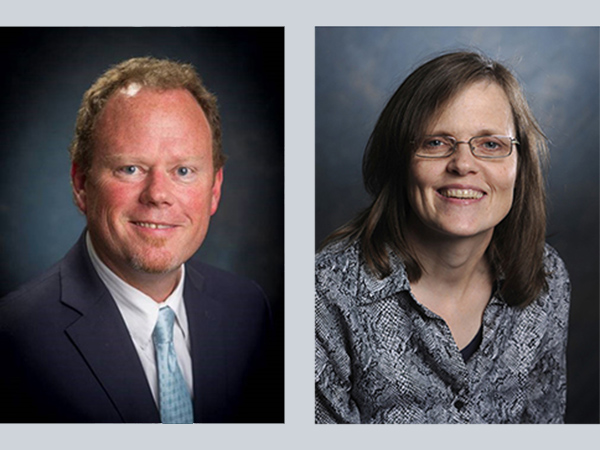
Robin Foley, Ph.D., joined the UAB School of Engineering faculty in 1990. Alan Eberhardt, Ph.D., arrived a year later. In those days, life at UAB was a little different. The university, barely 20 years old, was still largely a commuter school. And the two junior faculty members were “junior” in more ways than one, walking into a school where they were often several years younger than their students.
This year, Foley and Eberhardt are retiring from UAB with more than 70 combined years of teaching, leaving legacies that include thousands of engineers who have called them professors, colleagues and friends.
“It is impossible to overstate the contributions Alan and Robin have made during their time at UAB,” said School of Engineering Dean Jeff Holmes, M.D., Ph.D. “including tens of millions of dollars in research, new masters programs, new partnerships across campus and across the country, and award-winning teaching and mentoring. Generations of UAB engineering students first learned about the properties of materials from Robin, and every biomedical engineering graduate in UAB’s history designed devices to improve medical research and care under Alan’s guidance.”
In addition to their many contributions, Holmes says both professors have a passion for engineering and a gift for making their respective disciplines come alive for young people.
It’s worth noting that, when asked to reflect on their careers at UAB, both have vivid memories of what it feels like to be a newcomer in need of mentorship.
“When I showed up to teach my first class, the majority of the students were wearing suits and ties with Alabama Power/Southern Company badges,” Eberhardt recalled. “I was the youngest person in the room, and it freaked me out.”
Foley had a similar experience. In those days, a significant number of students had full-time jobs and took classes part-time. While that had some drawbacks, Foley said it provided her an unexpected resource. “I could ask for input about teaching the class and get great advice,” she said. “The older students also demonstrated professional behavior for the younger students, so the class make-up was fun.”
While the makeup of UAB’s student body tends to be younger than in 1990, Foley says those early experiences helped shape her teaching philosophy, which has proven helpful in recent years, as she found more young students working full time and also taking a full course load. “They work full-time to pay for living, but they have to take a full load to get financial aid,” she said. “It’s extremely challenging and I’ve significantly adjusted my teaching to make it work for them.”
As a materials engineer focused on metals casting and research, Foley was engaging with a well-established academic discipline with roots that go back to the city of Birmingham’s founding. Eberhardt, by contrast, joined a biomedical engineering department that was still a decade away from offering an undergraduate degree program.
From a background in civil engineering, Eberhardt carved out a niche for himself in biomedical engineering. He created a biomechanics laboratory where he studied implantable devices and assistive technologies.
“Even though engineering disciplines seem very different, the fundamental principles are largely the same,” Eberhardt said. “A civil engineer looks at the structure of a bridge and finds a fault or a weakness; a biomedical engineer may look at a hip or an artificial implant and make the same calculations about what will cause it to fail.”
The versatility of biomedical engineering is a theme throughout Eberhardt’s career, which has been marked with collaborations with students and faculty from other disciplines, such as rehabilitation science and business. In addition to his role as professor, he served several years as the school’s Associate Dean and as the BME Assistant Chair/Director of Education. In addition, he has helped shape the department’s Capstone Senior Design course, which often focuses on marketing/entrepreneurship in addition to design.
“I really enjoyed the mix of work,” he said. “To fulfill the mission of teaching, research, and service, there is always something interesting to occupy your time.”
For Foley, the metals casting lab has become a home base, and her work with students in that space is the reason she stuck with it for 35 years. “I have loved working at UAB,” she said. “I love that we have diversity in our student population, including financial diversity. It’s rewarding to help a first-generation student.”
Eberhardt echoed that sentiment. “I had lived in about 10 different places before I came to Birmingham, and I really found my home here.”
While both professors may be officially retired, neither expects to leave the school entirely. Eberhardt plans to continue teaching a few select courses, but allowing more time for fishing. Foley says she plans to continue research. I love working in the lab, doing research and processing data,” she said. “It’s my happy place, and I love the flexibility that UAB has provided me to do research supported by industry.”