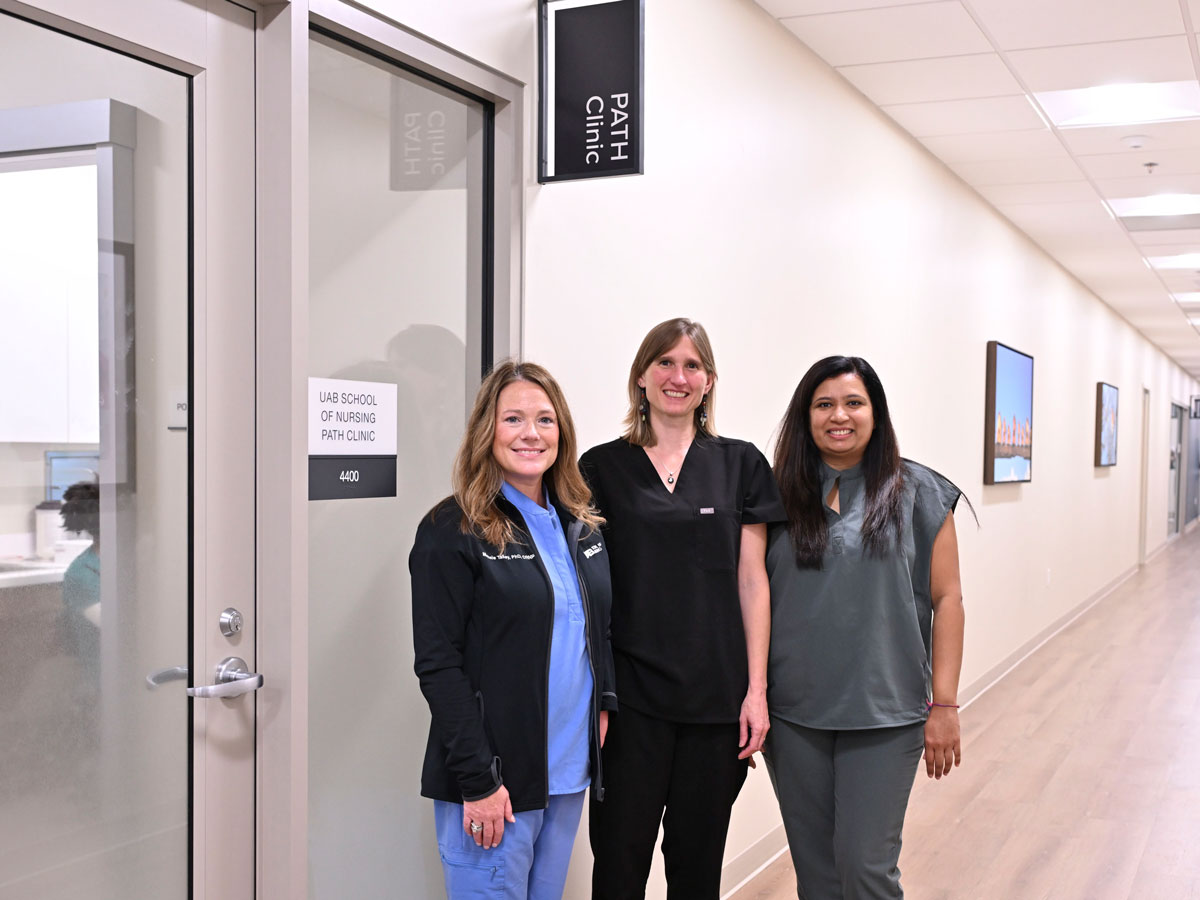
By Teresa Hicks
With its recent relocation to new clinical space at Cooper Green Mercy Health Services, the University of Alabama at Birmingham School of Nursing PATH (Providing Access To Healthcare) Clinic has strengthened its ability to provide quality care for some of Alabama’s most vulnerable diabetes patients. The space’s modern, welcoming environment is designed to support both clinical excellence and patient comfort while continuing to provide a pathway toward stability, confidence and a healthier future for those living with diabetes.
Alabama ranks first in the nation in the prevalence of diabetes. For individuals with this and other chronic conditions, the most fragile point in recovery often begins after being discharged from the hospital. Though medically stable, many patients lack insurance, transportation or a primary provider for follow-up care—gaps that can send them back to the hospital before they fully recover.
Established in 2011, the PATH Clinic cares for patients with diabetes discharged from UAB Hospital who lack health insurance or adequate health insurance, many of whom also are experiencing significant financial hardships or homelessness. It was founded on the belief that continuity of care is essential, regardless of income or circumstance. Providing patients more than a medical home it also is a conduit for wrap-around services, including testing supplies, medication and access to healthy foods.
Community impact
For many patients, PATH has become more than a clinic; it has become a long-term partner in their health journey.
"What makes the PATH Clinic special is our interprofessional team’s shared commitment to meeting patients where they are,” said the clinic’s lead nurse practitioner Assistant Professor Bela Patel, DNP, CRNP, NP-C (MSN 2014, DNP 2019). “We don’t just manage diabetes, we build relationships, remove barriers and walk alongside our patients toward long-term stability and health."
PATH’s coordinated approach has provided more than a decade of consistent, personalized care for Tywanda Ceasor. After being diagnosed with diabetes, she lost access to health insurance and the continual medical care she relied on for survival.
“Not having insurance was my biggest barrier,” Ceasor said. “Because I have diabetes, access to medical care is crucial. The PATH clinic filled that gap for me.”
Without coverage, even routine care became difficult. “I was a patient elsewhere when I was diagnosed with diabetes,” she said. “But when I lost my insurance and was unable to cover my medications, it was recommended I come here for support and care.”
Over time, PATH addressed not only Ceasor’s medical needs but also the barriers that threatened her stability. “Beyond my medical needs, when I lost transportation, PATH provided bus passes,” she said. “They also referred me to places like UAB Blazer Kitchen and other resources for food and utilities.”
Recognizing that health encompasses both physical and emotional well-being, the clinic also connected her with mental health support. “When I first came to PATH, I was deeply depressed, but talking to the mental health nurses here helped me a lot,” Ceasor said.
With PATH’s support, she regained confidence and stability. “I feel much better,” she said. “Having continuous care has been amazing.”
Team members say that by addressing mental health needs, screening for depression and distress, and connecting patients with counseling and support, their overall lives improve.
PATH Clinic nurse practitioner and Assistant Professor Cori Cunningham O'Neal, DNP, CRNP, AGNP-C (BSN 2010, MSN 2014, DNP 2017), said, “I have seen firsthand how PATH helps transform lives. Patients who once relied on the ER now have a medical home where they are known, supported and followed closely. Patients feel heard and valued, leading to better outcomes, fewer hospitalizations and a renewed sense of hope and empowerment.”
At the core of the clinic’s impact and success is its interprofessional model of care. Patients are supported by a collaborative team that includes nurse practitioners, physicians, pharmacists, dietitians, social workers, behavioral health specialists, optometrists, care coordinators and physical therapists, as well as student learners from each discipline, ensuring their needs are addressed comprehensively and the next generation of interprofessional providers are prepared to transform lives.
Nurse Clinic Manager Alison Hernandez, PhD, MPH, RN (BSN 2005), said, “By bringing together diabetes care providers with optometry, physical therapy, and social work, our model effectively addresses the whole picture, preventing common complications and ensuring access to essential medications and other resources. Our team is highly motivated because getting to know our patients as people is incredibly rewarding.”
Patient-centered care strengthening the health system

To date, the clinic has served 1,183 patients and supported more than 15,268 patient visits, reflecting the School’s commitment to serving the community's need and the trust patients place in PATH’s services.
PATH also has helped patients save over $2.3 million in medication costs in FY2023 and $2.6 million in FY2024. These savings reflect the clinic’s ability to connect patients with essential medications, supplies and pharmaceutical support they might otherwise be unable to afford, reducing both financial strain and preventable hospital readmissions.
Beyond improving individual health outcomes and ensuring there are services in place to help patients get their life-saving medications and supplies, the clinic also has demonstrated a measurable, positive financial impact for the UAB Health System.
By reducing emergency department reliance, the clinic helps prevent costly hospital readmissions for the patients it serves. In FY 23, the PATH Clinic provided total direct cost savings of $2,125,958 to the UAB Health System. Similarly, in FY 24, total direct cost savings were $2,368,828.
The PATH Clinic opened under the leadership of former Associate Dean for Clinical and Global Partnerships, Professor Emerita Cynthia Selleck, PhD, RN, FNP, FAAN (PhD 1987). Current Associate Dean for Clinical and Global Partnerships and Professor Michele Talley, PhD, ACNP-BC, FAANP, FNAP, FAAN (MSN 2005, PhD 2015), has served as Director of the PATH Clinic since 2016. Under Talley’s leadership, PATH has continued to strengthen its coordinated, team-based model of care, expanding access while maintaining a focus on continuity, quality outcomes and long-term patient support.
Recently, PATH was named the Alabama State Nurses Association’s 2025 Outstanding Healthcare Organization, recognizing its leadership in improving access, outcomes and equity in patient care.
“Our team’s approach is grounded in doing what is best for patients by providing timely, evidence‑based care in the right setting and keeping unnecessary costs down,” Talley said. “Although care is free, our ability to document improved health outcomes and long-term cost avoidance is what has elevated this nurse-driven, population-health practice to a true best practice.”