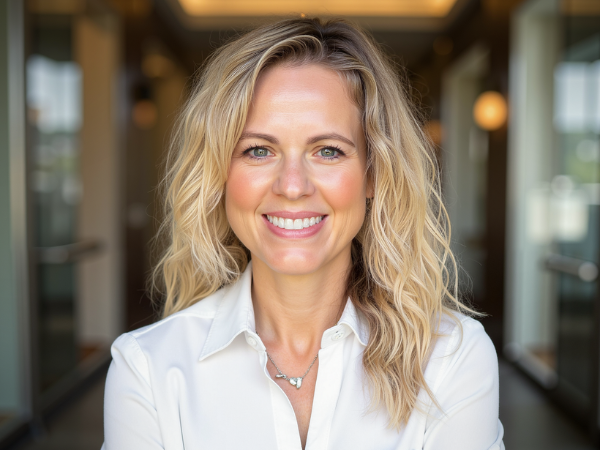
Jennifer Maples, OD, FAAO, graduated from the UAB School of Optometry in 2004 and has spent the past two decades caring for patients in a variety of clinical settings, with special interests in medical optometry, specialty contact lenses and dry eye disease. Following graduation, she completed a residency at the James H. Quillen VA Medical Center. She is board certified by both the American Board of Optometry and the American Board of Certification in Medical Optometry and is a Fellow of the American Academy of Optometry (FAAO).
Today, Maples practices full-scope medical optometry at Marietta Eye Clinic in Cartersville, GA. She is also the founder of Eye Teach LLC, an educational company dedicated to helping health care professionals and students thrive both personally and professionally. Whether caring for patients, mentoring students or speaking to audiences, her passion is helping people care for others without losing themselves in the process.
Q: What sparked your interest in optometry?
A: It actually took me a while to figure out what I wanted to do. I knew I loved science and math, but I also knew I wanted to work with people and teach. I've always been fascinated by the human mind and even considered becoming a psychiatrist. At the same time, I loved solving puzzles and always thought it would be fun to be a detective. Looking back, the common thread was always the same—I was curious. I wanted to understand how things worked, why people thought and behaved the way they did, and then pass what I'd learned on to others.
As I explored optometry, I had the opportunity to shadow my optometrist, Dr. John Pino. What really stuck with me was his passion. Even after more than 20 years in practice, he was excited about new developments in the field and genuinely connected with every patient he saw. Watching him, I realized optometry offered everything I was looking for—a career built on curiosity, lifelong learning, and genuine connection with patients.
Dr. Pino has since passed away, but I remain grateful for the example he set and the role he played in helping me discover my calling.
Q: What do you enjoy most about working with patients?
A: Of course, I love the diagnostic side of optometry—solving problems, figuring out what's going on, and finding the right treatment. But what I enjoy most is the dopamine hit that comes when I really connect with a patient and they feel seen, heard, and understood. It just feels a little like magic to me.And sometimes, the patients who are the hardest to connect with are the most rewarding. I don't see it as being performative or trying to "win someone over." I see it as a challenge to understand what's underneath the frustration or resistance. There's this moment when a patient's expression changes and you can almost see them thinking, "Oh. She's actually listening. She gets it." That moment never gets old.
Q: How have you seen the profession of optometry evolve since you graduated in 2004, and what changes have had the greatest impact on patient care?
A: I've seen tremendous change over the past 20-plus years—from advances in how we diagnose disease and share information to expanded scope of practice in many states. I've also watched more ODs take their work beyond the exam room through education, advocacy, leadership, research, and innovation. And I think optometry has earned greater recognition and respect among our fellow healthcare providers.
For patients, one of the most significant changes has been accessibility. They have more options than ever for where and how they receive eye care. As those options grow, we have to make sure convenience doesn't come at the expense of quality and that patients understand the difference between a refraction and a comprehensive eye examination.
Like any profession facing disruption, optometry will continue to adapt. Technology will change how some aspects of eye care are delivered, and that's where I believe ODs have an unfair advantage. The human side of being a physician becomes more important—not less. No matter how we deliver care, our ability to create genuine connection and help patients feel seen, heard, and understood will continue to be one of the most important things we do.
Q: What inspired you to create Eye Teach LLC and focus on helping students improve their performance under pressure?
A: I remember how stressful optometry school could be. In a rigorous doctoral program, you're studying for exams, preparing for practicals, seeing patients in clinic, and navigating all the other demands of life—not just for a few stressful weeks, but layered over four years. I was one of those students who knew how to put my head down, work hard, and push through.
Looking back, I realize how much easier some of those years could have been if I had slowed down long enough to notice how much pressure I was under and how it was affecting the way I thought, felt, and performed—instead of just trying to push through it.
Over the years, I've learned that awareness changes everything. When you notice that you're becoming overwhelmed, it creates space for choice. You can intentionally regulate your stress response and decide what you need next. Sometimes you need to reset, sometimes you need to rest or recharge, and sometimes you just need to get yourself into a better headspace before moving forward.
As a student, anxiety was often at the wheel, and I didn't realize I had tools that could help me take back the wheel. I wish I had known how to interrupt the doom spirals, reset, and approach high-pressure situations with more intention and confidence.
That's a big part of what inspired Eye Teach. I want students to learn those skills much earlier than I did—not so they can eliminate stress, but so they can recognize what's happening, regulate their response, and approach high-pressure situations with greater confidence, clarity, and choice.
Q: What is the top advice that you provide students with about managing stress in optometry school?
A: Start by learning how your own mind and body respond to stress. The body can outpace the mind, so learn to pay attention to the signals it gives you. Maybe your shoulders creep toward your ears, your jaw clenches, or your heart starts beating faster. Then notice what's happening in your thoughts. Are you replaying something over and over? Catastrophizing? Getting pulled into a doom spiral?
The more familiar you become with your own nervous system, the earlier you can recognize those signals. And noticing them earlier gives you time—time to pause and ask, "What do I need right now?"
What you need can vary from day to day depending on the type and level of stress. Lengthening your exhale can be helpful. For example, you might breathe in for a count of four and exhale for a count of six. The idea is to make your exhale a little longer than your inhale. Orienting can also help. This simply means looking around and noticing your surroundings. You might look for objects of a particular color, for example. Other times, you may need to work with your thoughts. I encourage people to get curious about anxiety rather than fighting it. You can even have a little conversation with it: "I know you're trying to protect me. Thank you. What would make you feel safe right now?"
Stress is going to be part of optometry school. The goal isn't to never feel stressed. It's to notice what's happening sooner, give yourself time to respond, and choose what you need next.
Q: Who were the people at UABSO who influenced and guided you the most?
A: There were so many people at UABSO who influenced me, but two moments in particular still stand out more than 20 years later.
I believe we were in our second year and taking CEVS, the course where we were learning and being evaluated on the clinical skills involved in performing an eye examination. A group of us was working with Dr. Kent Daum, and we were all incredibly stressed about an upcoming practical. In our minds, failing the practical had already become failing the course, getting kicked out of optometry school, and essentially watching our futures fall apart.
Dr. Daum quietly listened to us catastrophize and then, very seriously, said something to the effect of, "And then what? It wouldn't be the end of the world."
I remember being stunned. Here was one of our professors telling us that failing wouldn't be the end of the world! But the more I thought about it, the more I realized he was right. Even the outcome I was so afraid of wouldn't be the worst thing that could ever happen to me. That simple question helped me step outside of the spiral and put the situation back into perspective.
Dr. Gerald Simon influenced me in a different way. He was always so calm, cool, and collected, particularly when dealing with patients. I remember him telling us about patients who would come in wanting a refund because their glasses were bent or damaged. Rather than accusing someone of mishandling them, he might gently say something like, "Now, Mrs. Jones, do you think you might have fallen asleep in your glasses and rolled over on them?" Somehow, the patient could admit what had happened without feeling embarrassed or defensive.
I didn't have the language for either lesson at the time, but I've carried both with me throughout my career. It's interesting to look back now and realize how much those seemingly small moments helped shape the way I think about stress, communication, and connection today.
Q: During your time as a student, which activities or experiences had the most significant impact on your professional journey, and why?
A: Attending professional meetings like SECO, AOA, and Academy had a big impact on me as a student. I didn't grow up in a family that traveled much, so the travel itself was exciting. But what really stayed with me was the experience of being surrounded by so many people who were passionate about optometry.
Of course, there were always a few people sitting in the back reading the newspaper and just trying to get their CE hours! But for the most part, those meetings felt incredibly energizing. I was surrounded by optometrists who were excited to keep learning, improve the way they practiced, share ideas, and build relationships with one another.
As a student, those experiences gave me a sense of belonging to something much bigger than optometry school. I began to see our profession as a community—one where continuing to learn matters, but so do the relationships and connections we build along the way. Looking back, I think those early experiences helped shape the way I've approached my own career: keep learning, stay curious, and stay connected.
Q: What advice would you give current UAB School of Optometry students who want to excel academically while maintaining their well-being?
A: I know it's been said a thousand different ways, but probably because it's true: you have to take care of yourself first. We sometimes put the cart before the horse and think we'll rest, exercise, connect with people we love, or take care of ourselves once we've finished everything else. In optometry school, as in life, there will always be something else.
Your well-being isn't in competition with your academic performance. It doesn't just support it; it's a requirement for sustained performance. You're not a machine—and frankly, even machines eventually break down when they're pushed continuously without maintenance. If you want to perform well over four demanding years, you have to regularly check in with your mind and body and pay attention to what you need.
So work hard. Study hard. Care deeply about doing well. But also sleep, move your body, make time for the people and things that remind you who you are outside of optometry, and ask for help when you need it. Taking care of yourself isn't something you earn after you've performed well. It's part of what allows you to perform well in the first place.
Q: What is something that might surprise people to learn about you outside of optometry and Eye Teach LLC?
A: For someone who spends a lot of time talking about mindfulness and nervous system regulation, I have a surprisingly high tolerance for dark television. Give me a series like Ozark, Yellowjackets, or Breaking Bad and I'm hooked. Apparently, nothing says "regulated nervous system" is quite like watching fictional people make increasingly terrible life choices.