
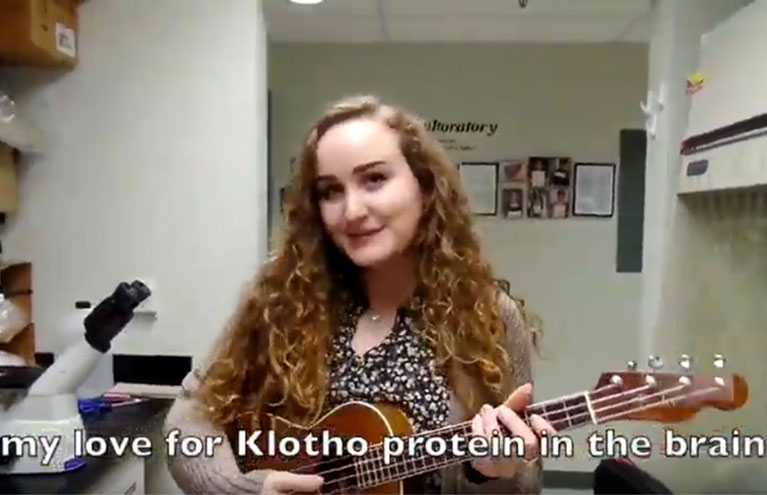
 The Video Research Awards (VRA) is a video presentation competition for undergraduate research students at the University of Alabama at Birmingham.
Why should students enter?
- Students participating in undergraduate research need to be able to communicate effectively about their work, even as they move on from UAB and head out into their careers.
- Our office wants to help UAB students present their ideas and tell their stories to people in their respective fields and elsewhere.
- First place: $1,000, second and third place: $500.
Why videos? Short videos are great communication style in today's world of social media, and short presentations are similar to giving a TED talk. Both of these styles are great for talking about your research and why it matters, without overwhelming your audience.
What are the Spring 2026 Deadlines?
- April 13: Deadline for VRA Interest Form
- April 19: Videos must be uploaded to Canvas
- April 20-22: Public voting on Canvas
- April 23-24: Voting by judges
How it Works
- Students create two-minute videos summarizing their research.
- The community votes and the top vote getters move to the second round.
- The top three students selected by a panel.
Who Can Enter?
Any UAB undergraduate student involved in research in any major. Individual projects or projects you have completed with a professor or inside a lab are eligible. Group projects are also eligible if you follow the group project checklist:
- Ensure everyone involved with your project agrees to enter the competition.
- Before entering, students must agree on how the award money will be divided among members of the group.
How to Submit a Video
Submit your initial submission form by April 14. You are responsible for the creation and upload your video to Expo canvas by April 20. There are no format restrictions — you can talk directly to the camera, discuss you work with another person, or even use graphics and animations to make the video visually appealing.
Judging is based on:
- The hook: Does the student get the audience's attention and make them want to learn more?
- The narrative: Does the student tell a story of their methods, or where they are going as a researcher?
- Merit and quality: Do the research methods suggest rigorous or creative work?
- Accessibility: Is the student targeting a general audience?
Voting
Public voting will occur via Canvas from April 23 through 24. Then a panel of judges will score the top six videos and choose winners.
Video Tips and How-Tos
You can gain insight on how to create a winning video by watching the winners of previous VRA competitions, as well as videos from undergraduate researchers at other universities. You can also explore these resources for guidance:
Past Videos
2021 Winning Videos

FIRST PLACE: Cindy Nguyen, "The Epigenetic Effects of Exercise on a Rodent Model of TLE"

SECOND PLACE: Dante James, "Entropy Production of a Single Driven Qubit"
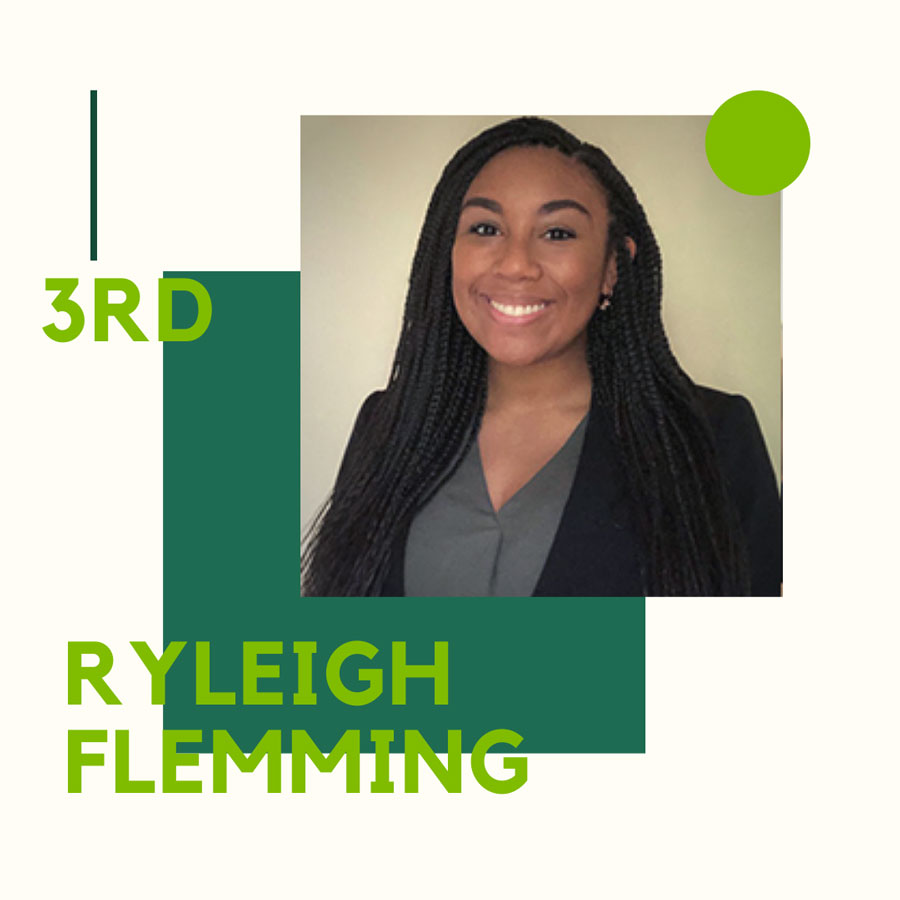
THIRD PLACE: Ryleigh Flemming, "Breaking the Barries of Traditional Service Learning in a Pandemic"
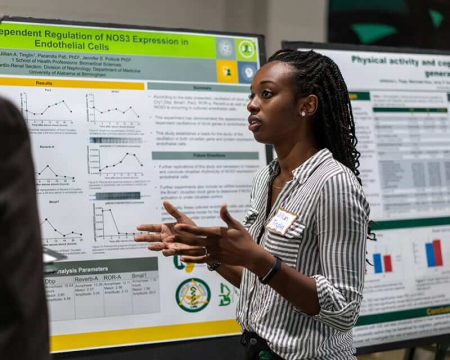
The UAB Expo celebrates excellence in research, creative activity, and scholarship by showcasing the academic endeavors of undergraduate students.
Why should you participate?
- Practice and strengthen your presentation skills.
- Engage with like-minded peers, exchanging research experiences, and ideas.
- Receive feedback from both peers and faculty.
- Add an impressive addition to your resume/CV that can improve applications to graduate and/or professional schools.
Upcoming Expo
The Fall 2026 Undergraduate Research Expo will run November 30 - December 4, 2026. Abstracts are due by 11:59pm on November 16, 2026. Once your abstract is submitted you are automatically registered for the expo.
Submit Abstract Opens an external link.
Special Note for Expo
We know that research is an ever-changing process with various highs and pitfalls. Our goal is to put on the best expo we can, allowing for largest ease for presenters and space for all of us to work. Noting this, we cannot accept late submissions. With limited physical space and the various tasks that contributes to running a successful hybrid event, we will not be able to accommodate submissions after the deadline. Please help our office out and submit your research on time. We are here to help with every step of the process, just reach out and ask. Thank you!
Fall 2026 Expo Schedule
- November 16: Abstracts due
- November 30 - December 4: Online Expo
- December 1: In-person Oral Presentations
- Sterne Library - Rooms 163 and 174
- 8 a.m. - 1 p.m.
- December 3: In-Person Poster Presentations
- UAB Alumni House
- Session A: 9:00 a.m. - 10:30 a.m.
- Session B: 11:00 a.m. - 12:30 p.m.
- Session C: 1:30 p.m. - 3:00 p.m.
Expo Schedule Steps
- Submit your abstract by the deadline. After all abstracts have been submitted, you will be assigned a number for submission purposes and registered for the Canvas course. Look for the invitation to join the course.
- Create your presentation! Poster presentations and Oral presentations can be virtual or in person. For more specific requirements please follow these guidelines.
- Judges and the community can join online or in person. Both can leave comments online or ask questions in person.
- Winners will be announced the following week.
Accessibility Info
To request accessibility accommodations for the expo, please contact:
- Students — Disability Support Services at (205) 934-4205 or
This email address is being protected from spambots. You need JavaScript enabled to view it. - Faculty/Staff — AWARE Program at (205) 975-9973 or
This email address is being protected from spambots. You need JavaScript enabled to view it.
Registration for UAB members for the online component can be found below. If you are planning on attending the Expo in person, no registration is required.
Register for Expo Opens an external link.
Get Involved with the Expo
We are seeking judges and volunteers for the Expo! Judging the Expo provides students with a platform for practicing and strengthening presentation skills, sharing work, exchanging research experiences and ideas, as well as receiving feedback. In addition to this being a positive experience overall, it becomes an impressive addition to any resume when applying for fellowships and research placements.
Volunteers will assist with the setup and breakdown of the poster presentations, signing in presenters and judges, moderating oral presentations, and more. Please register all shifts that you are able to serve. All volunteers will receive a t-shirt!
Note: Undergraduate students are not eligible to judge the Expo. Only UAB faculty, staff, graduate students, and local community members are eligible to judge. If you are an undergraduate student who would like to assist, please sign up to volunteer.
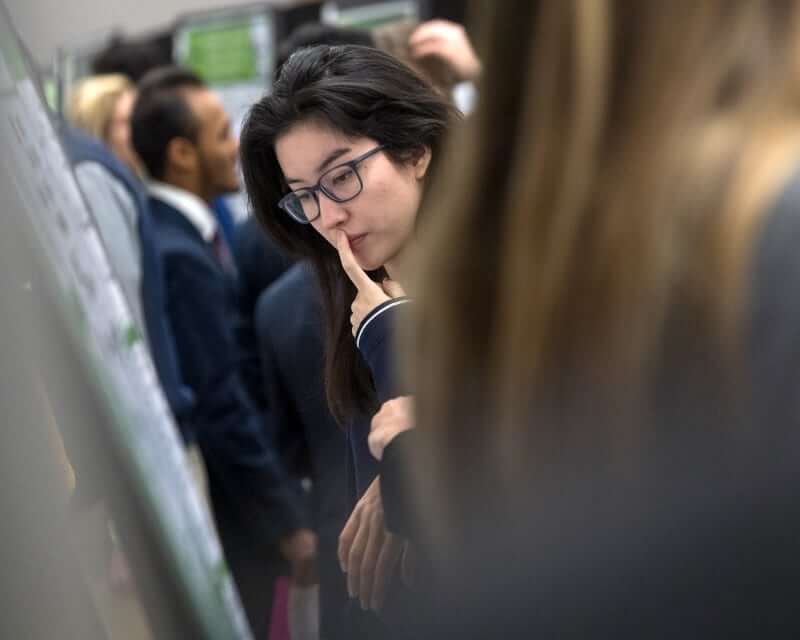 Participation in the undergraduate expo requires completion of a submission form, or abstract. An abstract is a concise summary of your completed project that provides a snapshot of it as a whole. The abstract should be written in 250 words or less (not including title, authors, and department).
Tips for Submission
- Involve your mentor at each stage of the process, from idea to final presentation. Your mentor will be your greatest source of productive feedback.
- Your reader/audience might not share your discipline or background so it is important to be concise and informative. Use defined sections, data representations, explanations, and summations (as appropriate per discipline).
- Looking at models of abstracts within your discipline will be beneficial when you are writing yours. Abstracts do not need to include references, parenthetical citations, footnotes, or a works cited page.
- Please proofread and rehearse your presentations (poster and oral) with your mentors and peers to adjust your timing, pace, and tone, and for incorporating feedback.
Abstract and Presentation Guidelines
There are several concepts to keep in mind when you are creating your abstract for submission. Following them can increase your chances of being accepted to present at the Expo.
At the Expo, you will be able to present your research in two formats: poster presentations and oral presentations (research talks).
-
Abstract Guidelines
Consider your motivation/rationale for your project.
- What did you set out to do and why?
- Why is it important/significant/interesting?
- What problem does the work attempt to solve, or what intellectual or theoretical gap does it aim to fill?
Think about your methods/procedure/approach.
- What did you do and how?
- What is the scope of the project?
- What models or specific approaches did you use?
- What sources of evidence did you rely on?
How are you going to talk about your results/conclusions?
- What did you find/learn/conclude?
- A presentation of a scientific project may include specific data.
- Other presentations may discuss the findings in a more general way.
What are the implications of your work?
- What does it mean, and how does it relate to what else is known about your subject?
- How does this work add to the existing body of knowledge?
- What are the implications for the problem/issue you identified?
Abstract Examples
-
Poster Presentations
Poster Presentation - A poster is a single slide, when presented online, or physical poster for in person presentations. Poster presentations must be recorded but we will give students the opportunity to present posters live if they are interested. The presenter walks the audience through the different sections of the poster followed by questions from the audience. In the recording, the presenter will walk through each section of the poster. The presentation is a minimum of 5, maximum of 10 minutes.
A poster must be printed when presented in person. The presenter walks the audience through the different sections of the poster followed by questions from the audience. The presentation is a minimum of 5, maximum of 10 minutes.
Judging Forms
The following forms are for judges, but you can use them to see how your poster presentation will be judged.
-
 creative arts presentations
 - science presentations
- service learning presentations
- works-in-progress presentations
- oral presentations
Tips
- Poster design and assembly will take longer than you expect.
- Aim to have your poster done several days in advance to give yourself plenty of time for editing and practice.
- Use one of the official UAB poster templates (not required).
- Depending on the font style, the font size should generally be no smaller than 24.
- Divide your content into short chunks of text. Numbered or bulleted lists are easy to read.
- Examples of discrete sections that can be included in a poster: title, author name(s) and affiliations, abstract, introduction/background, methods, results, discussion, conclusion, references, and acknowledgements.
- Figures, graphs, photos, and diagrams should be labeled and relevant to the topic.
- Omit distracting, superfluous decorations.
- Handouts are optional, but they can be used to provide detailed information for which there is no room on the main poster. Posters should be reasonably accessible to an educated but non-expert audience.
- Posters should be no larger than 40" x 60" (landscape or portrait) and will be assigned to either an easel or a table for display. Presenters will be provided with 40" x 60" cardboard tri-fold poster boards. These poster boards will be available on the day of the Expo.
- Posters can be printed at the UAB Heersink School of Medicine.
Additional Resources
-
-
Oral Presentations
Oral Presentation - A series of slides that last a minimum of 10 minutes and a maximum of 12 minutes, with 3 minutes for questions from the audience immediately following. Aspects such as creativity, discovery, integration, application, innovation, and entrepreneurship — along with enthusiasm, accuracy, and smooth delivery — are key. We encourage students to present oral presentations live but we do understand if they are not able to and will give them the choice to record an oral presentation.
Here's some general advice to keep in mind when creating an oral presentation.
- Use one of the UAB PowerPoint presentation templates.
- Content versus presentation time is a delicate and important balance.
- Aspects such as creativity, discovery, integration, application, innovation, and entrepreneurship — along with enthusiasm, accuracy, and smooth delivery — is key.
- The abstract and work to be presented does not need to be a finished product; however, it is imperative that it is logically presented and clearly demonstrated.
- Preparation will take longer than you expect. Aim to have your presentation done several days in advance to give yourself time to rehearse and edit.
Requirements and Advice
- Oral presentations will be no more than 15 minutes — 12 minutes of presentation and a three-minute question and answer session.
- A moderator will be present at each session to introduce you to the audience and keep track of your allotted time. You will receive a two-minute warning to let you know that your 12-minute time limit is about to expire.
- Include these sections: Introduction, Aim(s), Method(s), Result(s), Conclusion(s), and Reference. This is a generalized format with the understanding that presentation of material included in this section will differ across disciplines.
- Present evidence in support or in contradiction of the thesis.
- Discuss the larger significance of the research.
- The general rule is to review no more than one slide per minute.
- Handouts may be helpful for both you and the audience, although they are not required.
- You should use your prepared remarks or notes as a guide. You are not expected to memorize presentations, but you should try to make frequent eye contact with the audience.
PowerPoint Tips
- Keep slides clutter free.
- Use a dark font on a light background. Be sure to use a font size that is readable at a distance when projected.
- Italics, script, and the use of all caps should be used sparingly.
- Use of animation, clip art, sound, or other design elements are not critical and should be kept to a minimum.
Visual Aid Resources
Technology (a projector and screen) will be available for students selected to give an oral presentation. Please take note that you are responsible for the following:
- If you want to use a provided laptop, save your presentation to a portable USB flash drive and bring it with you.
- You may bring your own laptop.
- If you are using a Mac, it is your responsibility to bring an appropriate VGA adapter.
-
Online Presentations
Online Presentations - The online option for the UAB Expo was created to offer the opportunity for UAB students to present their research, service-learning projects, or creative activity in an online format instead of presenting in person.
The Online Expo allows you to present in one of three formats:
- Online Poster Presentation:
- A poster is a single slide. Poster presentations must be recorded. In the recording, the presenter will walk through each section of the poster. The presentation is a minimum of 5, maximum of 10 minutes. You should record yourself on camera for the presentation to make it more personable.
- Online Oral Presentation
- A series of slides that lasts a minimum of 10 minutes and a maximum of 12 minutes. Aspects such as creativity, discovery, integration, application, innovation, and entrepreneurship — along with enthusiasm, accuracy, and smooth delivery — are key. You should record yourself on camera for the presentation to make it more personable.
- Video Essay:
- What is a video essay? “Video essays combine different forms of media such as video (film), audio (voice-over, music, sounds), and text to study or analyze a topic. Many have structures similar to a written essay, with an introduction, body, and conclusion. An effective video essay will have a strong thesis or argument.” Augustana Mikkelsen Library These video essays can be creative in nature but should include an artistic statement to assist the judge and audience in understanding that it is a creative approach.
Posting your Presentations - Use Kaltura to share video presentations with people outside the UAB community (including family members). For that reason, you must upload your video to Kaltura and embed it in the discussion board using one of the following methods:
- Record using Kaltura desktop recorder, upload to Kaltura, and embed in the discussion board. Use this guide to record and upload with Kaltura.
- Record using Zoom, upload to Kaltura, and embed in the discussion board. Use this guide for the Zoom and Kaltura process.
- Record using another program, upload to Kaltura, and embed in the discussion. Use this guide to upload and embed an MP4.
- Note: If you have already created a narrated PowerPoint and you have a Windows-based device, use this guide Links to an external site.to save it as a video then upload into Kaltura. PowerPoint for Mac does not have this option. If you have a Mac, you can record your presentation using Kaltura Capture Links to an external site.
- (Note: If you have any issues recording or uploading using Kaltura or embedding your video on the discussion board, contact eLearning Links to an external site.for assistance.)
- For both Poster and Oral presentations, judges will leave comments and questions in the discussion forum for each presentation. Make sure to check daily for these questions so that you can answer them to the best of your ability. This will create an online conversation similar to in-person presentations.
- If you are only presenting in person you do not need to upload anything to Canvas.
- Online Poster Presentation: