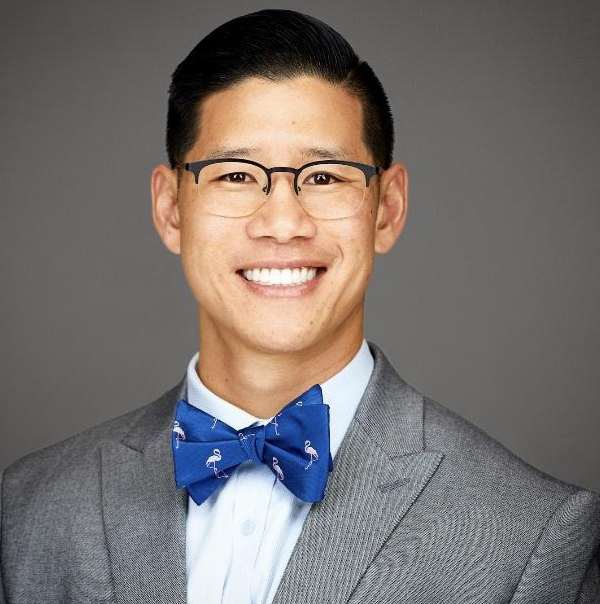
 Dr. John Le, an Oral and Maxillofacial Faculty at UAB SODJust over a year after completing his residency in the oral and maxillofacial surgery program here at UAB, Dr. John Le has returned to serve in a full-time position as the department’s newest faculty member. While his background includes extensive laboratory research experience in dental school and elsewhere, Dr. Le is now pivoting to research in a clinical setting, and has intentions of testing the capabilities of artificial intelligence (AI) and its potential to help clinicians become more efficient healthcare providers.
Background:
Dr. Le attended dental school at the University of Michigan where he received his degree in 2018. Upon graduating dental school, he matched into residency at UAB, where he spent the next six years under the tutelage of faculty members like Dr. Anthony Morlandt and Dr. Yedeh Ying before moving on to the University of Florida for a fellowship in head and neck oncologic and microvascular reconstructive surgery. He finished his fellowship and returned to UAB in August of 2025, where he now serves as assistant professor in the Department of Oral and Maxillofacial Surgery.
Introduction to oral surgery:
Dr. Le’s interest in oral and maxillofacial surgery began early in dental school through foundational clinical experiences that shaped his career direction.
“[At] the University of Michigan, we had a head and neck anatomy lab that was pretty much led by oral and maxillofacial surgeons or faculty. And in that lab…the people there, the instructors were very nice… very easily approachable, and then they informed me to shadow oral and maxillofacial surgery early as a dental student. So, for me, I went into the operating room (OR) with the oral surgeons when I was a first year, and then pretty much did that consistently through all four years of dental school. I would round with them and be in the OR participating in surgeries and helping assist where needed. So based on that, I knew I wanted to do oral surgery, and at the same time, my favorite ones I worked with were head and neck oncologists - microvascular surgeons. So because of that, I wanted to go specifically to UAB because of Dr. Morlandt’s training in Jacksonville, Florida, with Dr. Rui Fernandes, as well as Dr. Ying’s training, which he did with Dr. Eric Dierks in Portland, Oregon.”
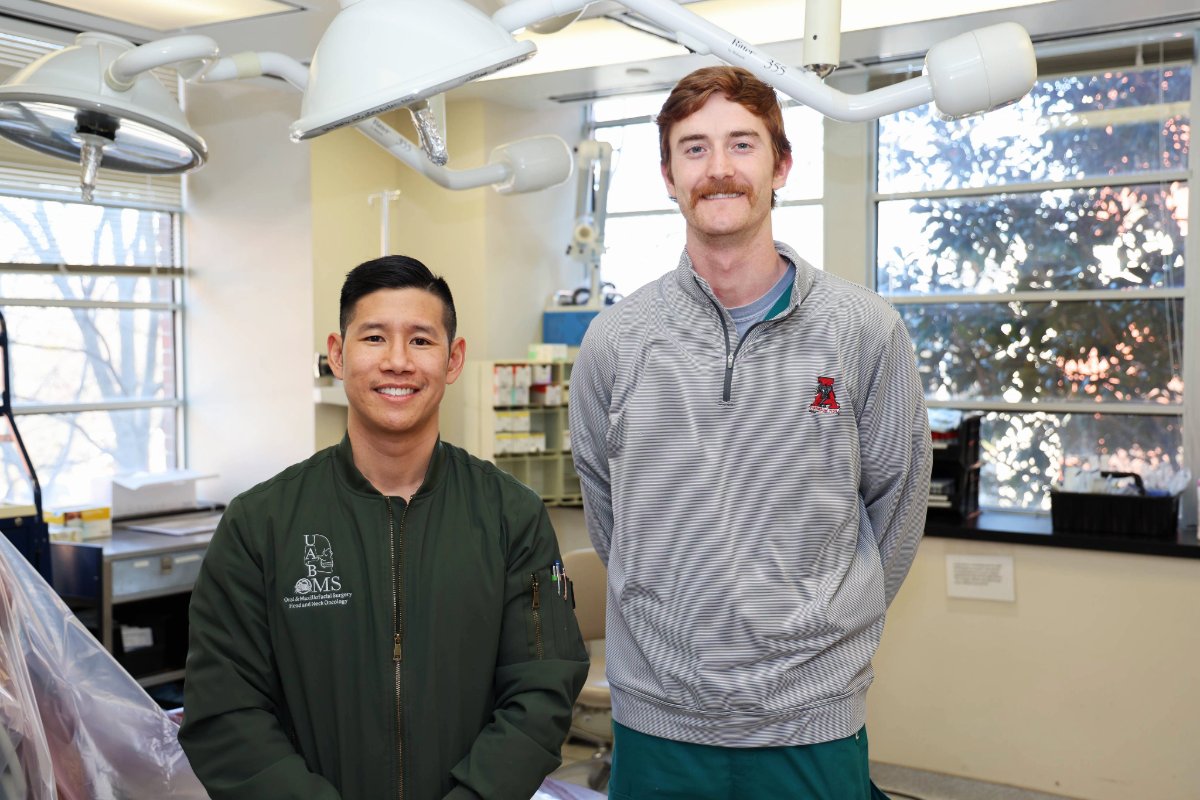 Dr. Le and Jack Shepherd in the OMFS clinic at the UAB School of DentistryThese experiences ultimately solidified Dr. Le’s commitment to pursuing oral and maxillofacial surgery and influenced his decision to train at UAB under mentors whose expertise aligned with his goals.
Research at the NIDCR:
In the midst of all of his OR shadowing, Dr. Le also found time for research and went so far as to take a gap year in between his third and fourth year of dental school in 2016, which he spent in Bethesda, Maryland, at the National Institute for Dental and Craniofacial Research under the tutelage of Dr. Janice Lee. Their efforts ultimately contributed to a July 2025 paper titled “Skeletal Maturity and Age- Related Changes in Immune Cells and Circulatory Factors Impair Large-Scale Bone Regeneration,” published in Aging Cell. Le and his fellow researchers first looked at the relationship between age and bone regenerative capacity in human patients, as well as in in vivo systems used to study human disease.
“We wanted to see what truly affects the ability of the cells to generate bone. Is it the donor? Does that affect it, or is it the environment we place them in? That’s one portion. And then after we figured that out, then… we wanted to see, can a young model or a young microenvironment’s circulation rescue an old one? So, we did that by performing a parabiosis study, which means we [linked the circulatory systems of younger and older, healthy biological systems], connected their circulation together and looked at the ability for [bone tissue] to regenerate.”
Le and his fellow researchers ultimately concluded that “under heterochronic parabiosis in which both [in vivo systems] underwent the same controlled intervention, a systemic pro‐regenerative response is exclusively triggered in immature [in vivo systems] and is capable of rescuing bone regeneration in mature [in vivo systems] otherwise unable to regenerate spontaneously.” 1 This could have significant future implications for a field that currently relies on major reconstructive surgeries such as “free flap” procedures which UAB is so well-known for to restore major hard and soft tissue defects in hundreds of cancer patients every year. Patients who have large head and neck tumors removed rely on skilled oral and maxillofacial surgeons like Dr. Le to use hard and/or soft tissue grafts from body parts like the leg or arm to reconstruct the oral cavity and jaw and restore critical function and aesthetics:
“Free flap reconstruction…can be very challenging in cases where the cancer’s very big, and after the tumor has been resected, the defect can be quite large and involve multiple subunits of the mouth. However, I think that while this may be challenging, it can also be thought-provoking and fun because it requires me to consider which tissue options (nearby or distant) are best to reconstruct the defect.”
Clinical research and surgical outcomes:
Now that Dr. Le is a full-time practicing surgeon, his research endeavors have taken a different route:
 Birmingham Skyline at Sunset. Photo by: Dr. Bright Chang“Since starting residency, then fellowship, and now as faculty, I’m primarily performing clinical research. A lot of the patients that I’ve worked with through these studies mainly are patients of Drs. Morlandt and Ying, who I work with now, but they were my mentors when I was a resident. These are patients who have had head and neck pathology, which include benign and malignant tumors. From a reconstructive standpoint, we look at the patient’s quality of life as it relates to speech and swallow outcomes, dental rehabilitation and overall satisfaction. From an oncologic standpoint, we look at disease control, recurrence rates, and overall survival. Additionally, we explore any complications that may be related to the surgery or adjuvant treatment completed (e.g., radiation and chemotherapy).”
Research into AI and oral surgery:
Dr. Le’s research extends into the integration of emerging technologies, particularly artificial intelligence, within postoperative workflows.
“We are currently looking into how we can use AI to aid in the assessment and management of surgical wounds. For example, we can feed an AI chatbot photos of surgical wounds and prompt it to assess the photo and provide wound care recommendations. We will send the same photos to our healthcare providers and compare their assessment and outcomes with the chatbot. As we build on the photo database and provide relevant data for the chatbot, it may eventually be able to accurately analyze a surgical wound and provide appropriate recommendations for care. This AI-driven screening process can potentially decrease non-urgent calls to our nursing and provider teams.”
de Almeida LY, Dietrich C, Hanner AS, McTighe KM, Martin D; NIDCD/NIDCR Genomics and Computational Biology Core; Fairbanks T, Link TM, Le JM, Curry N, Jani P, Gao X, Yu W, Mariani FV, Duverger O, Lee JS. Skeletal Maturity and Age-Related Changes in Immune Cells and Circulatory Factors Impair Large-Scale Bone Regeneration. Aging Cell. 2025 Oct;24(10):e70177. doi: 10.1111/acel.70177. Epub 2025 Jul 21. PMID: 40685942; PMCID: PMC12507423.
Story originally published in Vol IV, Fall 2025 Bridging the Gap, a newsletter of the UAB Local Student Research Group.