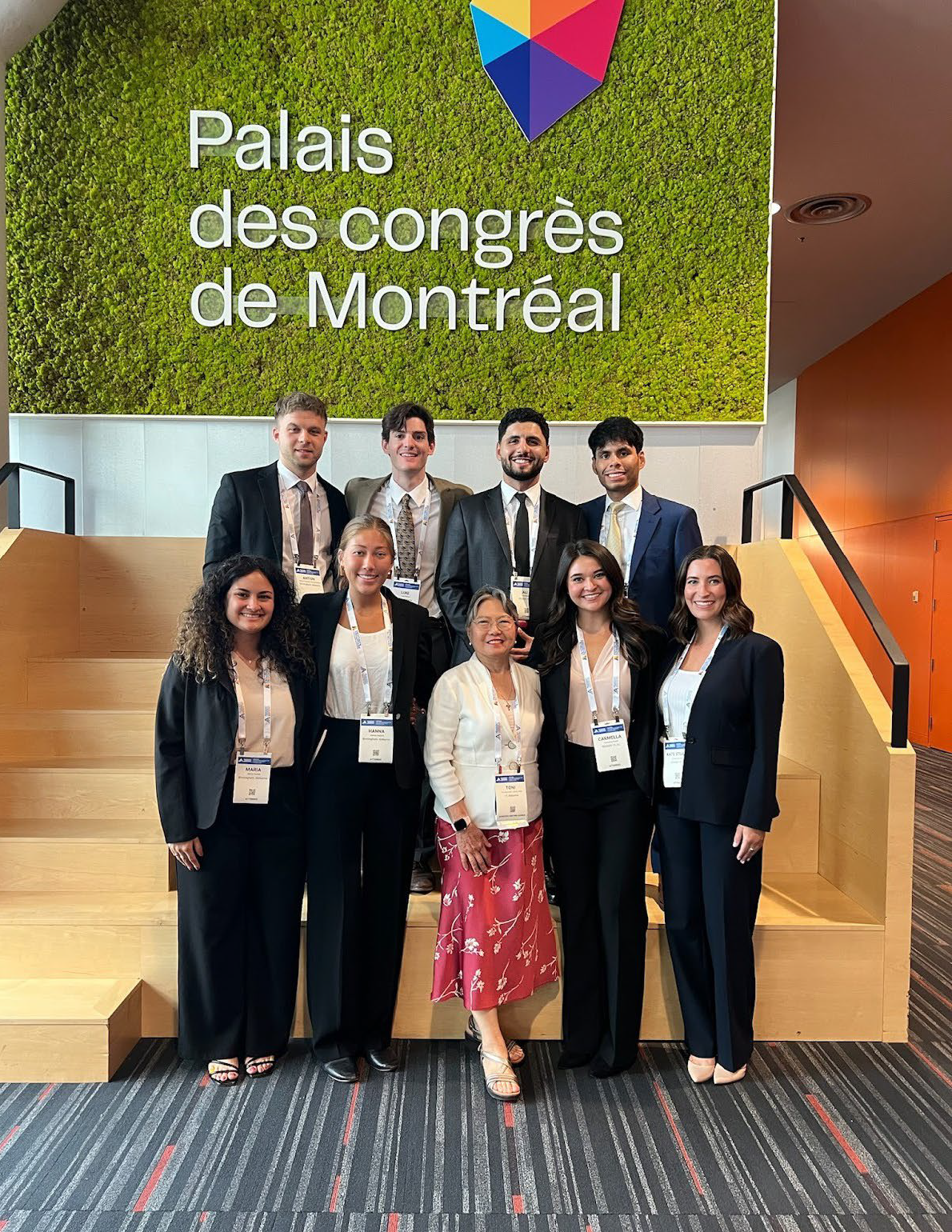
 Each year, the Academy of General Dentistry (AGD) hosts a scientific session highlighting continuing education, practice management, research, and vendors curated for general dentists across North America seeking to expand their skills and knowledge. This year’s session took place from July 9-12 at the Palais des congrés de Montréal in Montréal, Canada. The conference welcomes not only practicing and retired dentists, but also office staff and dental students, eager to learn and engage in research. The UAB School of Dentistry proudly sent eight students, who collectively submitted seven abstracts to the session’s online e-poster competition. Of these, five were selected as top-twelve finalists for in person presentations, and three went on to receive awards: two first-place and one second-place recognitions. This year’s strong UAB representation reflects the school’s commitment to maintaining research as a cornerstone of dental education. By engaging in projects that span from clinical application to emerging technologies, these students are helping to bridge the gap between classroom learning and real[1]world practice. UAB’s Local Student Research Group (LSRG) was privileged to speak with some of the presenting students. Highlights from their work are featured below.
Hanna Sepsick (D4)
At the AGD 2025 Annual Conference in Montréal, Hanna presented a novel case on the complex management of dentofacial deformity in a patient with the rare 15q11.2 microdeletion (Burnside-Butler syndrome). Her work highlighted the first documented use of a two[1]stage surgical approach to correct midface hypoplasia in a patient with this condition. The first stage included simultaneous LeFort III and LeFort I osteotomies with midface distraction, followed by definitive orthognathic surgery with LeFort I and bilateral sagittal split osteotomies. The case underscores the critical role of a multidisciplinary team in achieving remarkable functional and aesthetic outcomes and highlights the importance of tailored treatment for patients with rare genetic syndromes.
Luke Denton (D4) and Edwin Rojas (D4) – 2nd Place; Systematic Literature Review
Their project, Balancing Efficacy and Safety: Chlorhexidine, Sodium Hypochlorite, and Ozone Therapy as Endodontic Irrigants, examined the benefits and limitations of three irrigating agents used during root canal therapy. While sodium hypochlorite is a common irrigant used to eliminate bacteria, it can have unwanted side effects, like tissue damage. An alternative, chlorhexidine, has proven effective at eliminating common canal bacteria, may alter dentin’s properties, and has limited efficacy in eroding organic material. Ozone therapy has been an emerging alternative, due to its wide range of antimicrobial effects and minimal toxicity but is maximally effective when administered with other irrigants. Findings of their research showed that while sodium hypochlorite remains highly effective, medium concentrations yield strong antibacterial effects with fewer risks. The combination of sodium hypochlorite and ozone therapy demonstrated enhanced antibacterial outcomes, suggesting potential for improved safety and efficacy in endodontic practice. Ultimately, further research is required to explore the possible benefits of combining ozone and sodium hypochlorite while minimizing toxic effects.
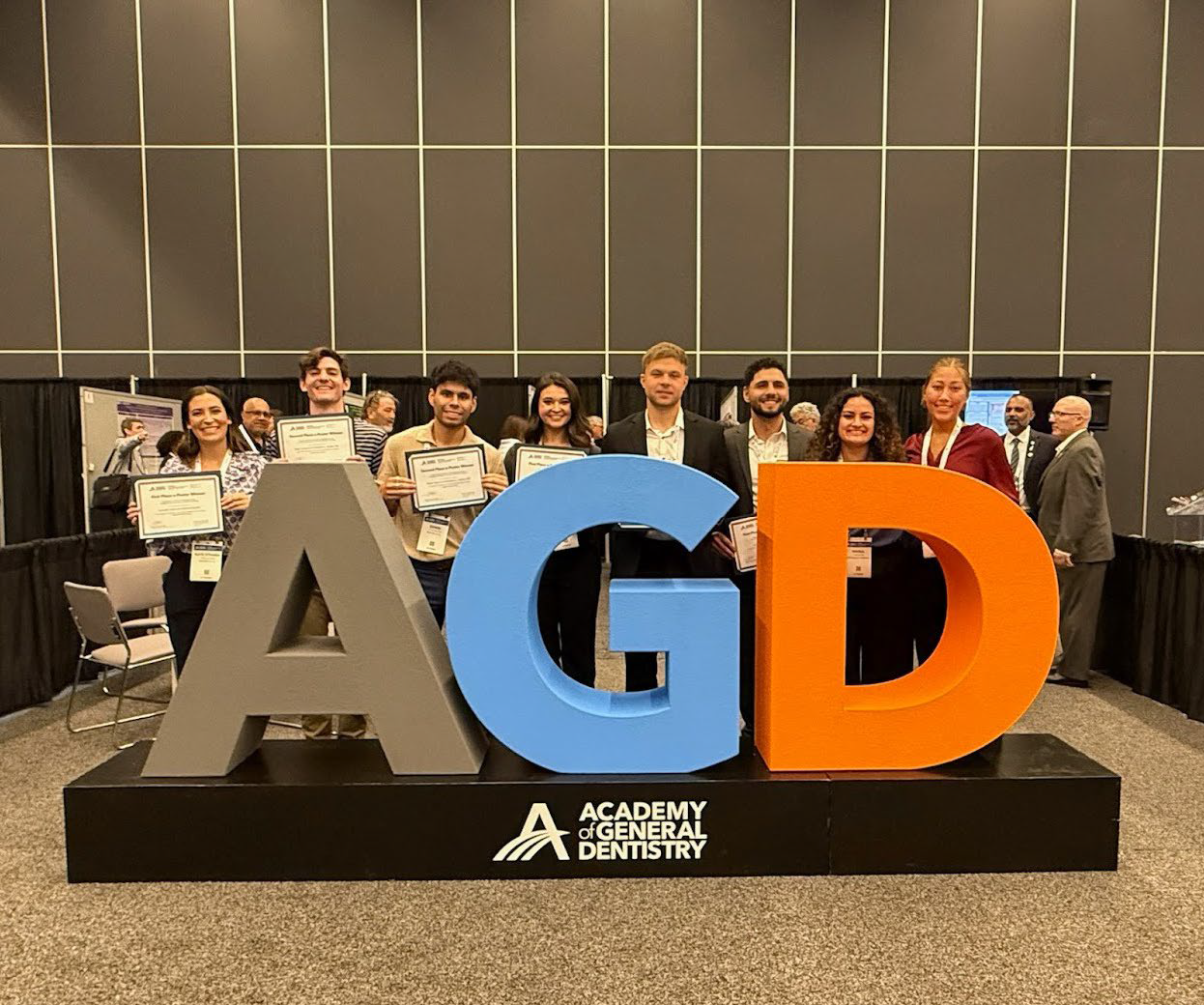 Carmella Clark (D4) and Kate Stuardi (D4) – 1st Place, Scientific / Clinical Research
Their award-winning study, Shear Bond Strength to 3D-Printed Crowns After Various Surface Treatments, explored how different surface preparations affect bonding strength in 3D-printed crown materials. Two different 3D printed crown materials were treated with varying combinations of materials including sandblasting with 50-micron alumina and surface coatings of silane and/or universal adhesive. Bonding of the crown material was simulated by filling a plastic cylindrical mold with composite and light curing, followed by 8 weeks of storage in 37C water. After this time period, the “crowns” were debonded and shear bond strength was calculated. Statistical analysis revealed that sandblasting and application of a primer significantly increased bond strength for both types of 3D printed crown materials. As the use of 3D printed crowns in dentistry continues to increase, this study helps to solidify the best workflow for the cementation process.
Anton Poznyak (D3) and Ali Nazari (D3) – 1st place, Systematic Literature Review
Their project, Artificial Intelligence in Interproximal Caries Detection: A Review, assessed the diagnostic accuracy of AI in interpreting bitewing radiographs for detecting interproximal caries. Reviewing 25 retrospective and experimental studies, they found that AI demonstrated strong diagnostic potential, often outperforming traditional methods, particularly in improving early detection and reducing clinician variability. While results are promising, the authors note that larger, more diverse datasets and real-world clinical validation are needed before AI tools become a standard part of caries detection.
Celebrating Student Research Excellence
The UAB Local Student Research Group is incredibly proud to highlight the accomplishments of these dental students. Conducting and presenting research at the student level cultivates a lifelong commitment to discovery and innovation. These values are what continue to advance the field of dentistry and strengthen UAB’s legacy of excellence. Beyond the individual accolades, these achievements reflect a culture of mentorship and curiosity that defines the UAB School of Dentistry. Through faculty guidance, access to state-of-the-art research resources, and collaboration among peers, students are not only expanding their scientific understanding but also contributing meaningful advancements to patient care. Their success at this year’s AGD conference serves as both an accomplishment and motivation to continue UAB’s spirit of inquiry that continues to shape the future of dentistry.
Story originally published in Vol IV, Fall 2025 Bridging the Gap, a newsletter of the UAB Local Student Research Group.