UAB DENTISRTY IMPACT
Behind the Beak

How UAB Dentistry’s expertise helped restore a zoo bird’s missing beak
Written by Lynne Jarreau | Photo by Andrea Mabry
One day, Chris Seidenfaden walked into Dr. Michael Kase’s office with an unusual request.
“We need to discuss a patient.”
The patient was not human.
A veterinarian from the Birmingham Zoo had contacted Seidenfaden about a green aracari named Beauregard who had lost part of his upper beak. The injury affected one of the bird’s most important tools for eating, climbing, grooming, and interacting with his environment. The question was simple: Could UAB School of Dentistry help?
The answer ultimately became a custom-designed prosthetic beak that allowed Beauregard to return to normal activities. The project attracted attention well beyond Birmingham, including recognition by the Association of Zoos and Aquariums, which shared the story with its international audience.
But the prosthetic itself is only part of the story.
Behind the beak was a team of dental specialists, laboratory experts, and years of investment in digital dentistry, all working together to solve a challenge few would expect to arrive at a dental school.
What's in a name?
When the project began, the bird hadn't yet received a permanent name.
Beauregard had originally been slated for another zoo, where staff would have named him after his arrival. But after his beak injury, he remained at the Birmingham Zoo, and zoo staff invited the UAB team to help choose a name.
They landed on Beauregard, inspired by Violet Beauregarde from Charlie and the Chocolate Factory.
The inspiration came from the bird's appetite for blueberries. During his recovery and before receiving his prosthetic beak, zoo staff fed him plenty of blueberries to help maintain his nutrition. The extra treats worked so well that Beauregard reportedly put on a little extra weight from all the "help."
An unexpected patient
For Kase, a maxillofacial prosthodontist and associate professor in the UAB Department of Oral & Maxillofacial Surgery, and Seidenfaden, a dental prosthetist in the UAB Department of Restorative Sciences, the first challenge was understanding their patient.
There were immediate questions.
Was Beauregard still growing? Would a prosthesis need to be replaced over time? What was a bird’s beak actually made of? Could dental materials bond to it? If not, how could the prosthesis be secured?
“We had so many questions,” Kase said.
The logistics added another layer of complexity. Unlike a traditional patient visit, every appointment required close coordination with zoo veterinarians and staff. The bird needed to be sedated, and the team had limited opportunities to gather information during each visit.
The bird's care was overseen by the UAB Animal Resources Program throughout the treatment process.
“The first time we brought him in for imaging, the zoo brought its own imaging equipment,” Kase said. “Following that visit, we worked with the zoo to complete the remainder of the appointments on site.”
Those early appointments focused on observation and research.
“Simply, I tried to learn as much about the bird and its function as possible,” Seidenfaden said. “How he uses his beak. What type of makeup the beak is. And the general weight of a normal beak.”

Photo credit: Andrea Mabry
Meet the team
The team behind the beak
- Chris Seidenfaden, Dental prosthetist (Digital design, fabrication, materials, workflow development)
- Dr. Michael Kase, Maxillofacial prosthodontist (Treatment planning and clinical management)
- Dr. Jay Ponto, Oral and maxillofacial surgeon (Fixation and surgical expertise)
- Dr. Abdullah Albaghli, Prosthodontic fellow
- Dr. Russell Smith, Prosthodontic fellow
Solving the problem
As the team learned more, they discovered that many of the same principles used in prosthodontics applied directly to their new patient.
The beak is composed largely of keratin, the same protein found in human fingernails. The zoo provided beak material for testing, allowing the team to evaluate bonding options and determine which dental materials would perform best.
“Normal dental materials used every day in human patients fit the bill,” Seidenfaden said.
The team also knew bonding alone would not be enough. Unlike a human patient, Beauregard could not be instructed to be careful with a new prosthesis. Durability and retention would be critical. After evaluating options, the team selected small fixation screws commonly used in oral and maxillofacial surgery to provide mechanical retention.
“Given the inability to communicate with the bird to tell him to be gentle, we assumed we would need mechanical retention as well,” Kase said.
Color became another unexpected consideration.
“We learned that the beak coloration was very important,” Kase said. “Birds visually recognize and evaluate colors.”
Every decision required balancing multiple factors including fit, weight, durability, appearance, and function.
“The real research started then,” Seidenfaden said. “Finding things that were comparable and compatible.”
Advanced digital dentistry at work
Although the case was unusual, the technology and workflow were familiar.
 Chris holding the prosthetic beak for Beauregard. Photo credit: Andrea MabryThe team initially attempted to capture a digital scan. Because of the bird’s anatomy and clinical circumstances, traditional impressions proved to be the better option.
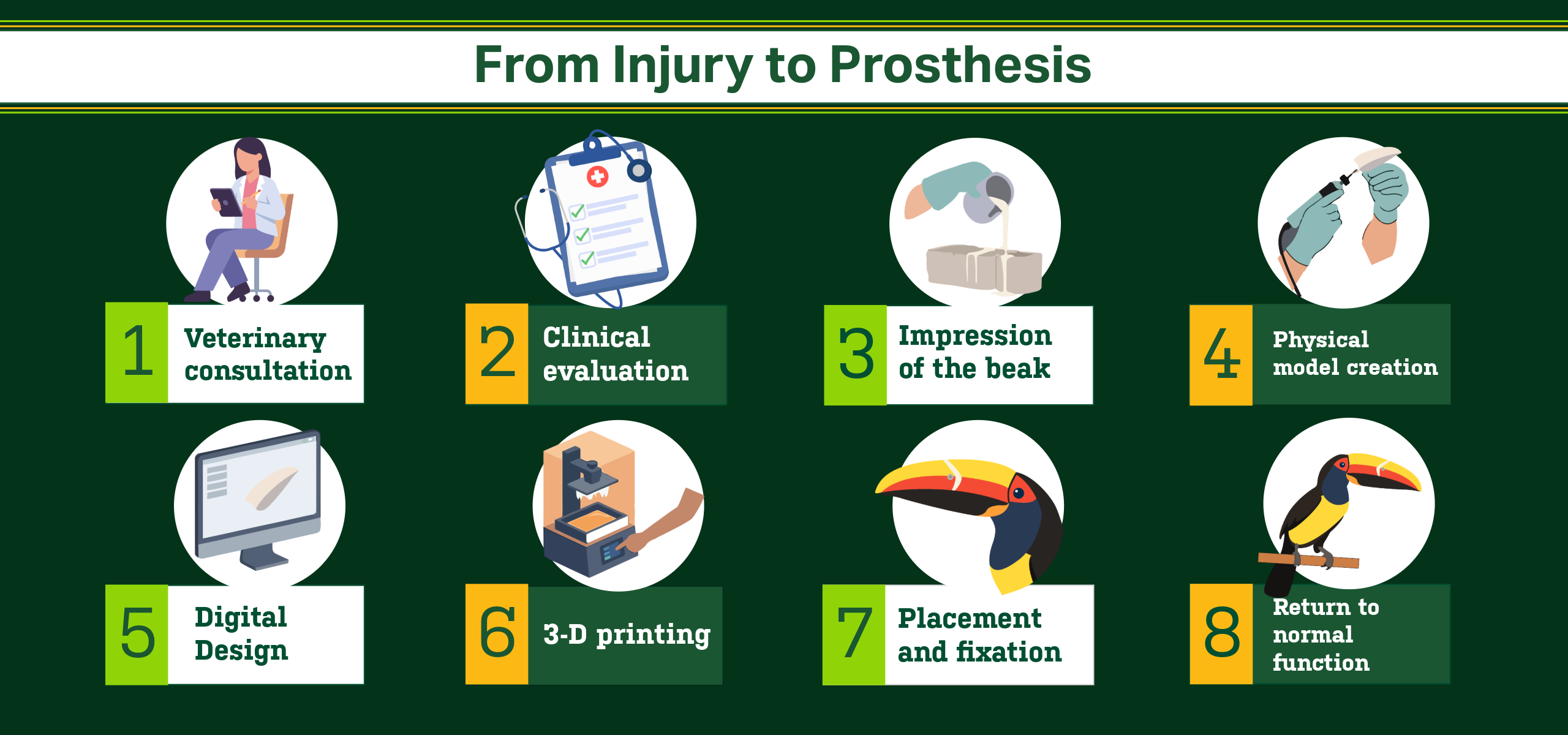
Seidenfaden created an impression of the bird's beak, then used it to produce a physical replica that was scanned into a digital model. From there, the process looked very much like advanced prosthodontic care for a human.
The prosthesis was designed digitally, refined on a computer, and fabricated using 3D printing technology available within the School of Dentistry’s laboratory facilities
While the case was unusual, the expertise behind it was years in the making. Over the past decade, the School of Dentistry has expanded its digital dentistry and laboratory capabilities through investments in advanced design, manufacturing, and fabrication technologies. The D. Thomas Winstead Student Laboratory helped establish an environment where faculty, residents, and laboratory specialists could develop expertise in digital workflows, custom prosthetics, and patient-specific solutions.
Technology played an important role, but Kase emphasizes that expertise remained the driving force.
“The only reason we are doing these is because of Chris,” Kase said. “His ingenuity and skill make this all possible.”
Kase also credits Dr. Jay Ponto, also of UAB Oral & Maxillofacial Surgery, whose surgical expertise helped with placement of the fixation screws, along with prosthodontic fellows Dr. Abdullah Albaghli and Dr. Russell Smith, who contributed to planning, treatment, documentation, and ongoing scholarly work related to the case.
Did you know?
Fast facts
- Beauregard is a green aracari.
- The beak is composed largely of keratin.
- Dental bonding materials were tested before treatment.
- Color matching was an important part of the design.
- The final prosthesis fit without adjustments.
A perfect fit
After months of planning and preparation, the prosthesis fit immediately.
“Actually no,” Kase said when asked whether adjustments were needed after placement. “This one fit like a glove and required no adjustments.”
Today, Beauregard is adjusting well.
“He is doing great,” Kase said. “Can fly with ease, has been able to eat his normal diet, and is overall back to normal as far as a prosthodontist can tell of an animal.”
Because the bird had completed his growth, the team designed the prosthesis as a long-term solution.
“We feel the retention is quite adequate for his use of the beak,” Kase said. “So it should be there for the long haul.”
The same principles, a different patient
Beauregard’s story captured attention because it is unusual. The expertise behind it is not.
 Dr. Kase and Chris working together in the prosthodontics lab at the UAB School of Dentistry. Photo credit: Mary SimsEvery day, UAB’s prosthodontic and maxillofacial prosthetic teams apply the same principles to help patients recovering from cancer, trauma, and congenital conditions regain function and quality of life. Understanding anatomy. Selecting materials. Designing custom solutions. Solving complex problems.
Before treatment began, Kase said the team first needed to understand “who” Beauregard was and what purpose the beak served. That approach reflects the foundation of prosthodontic care.
The patient happened to be a bird.
The process was pure prosthodontics.