
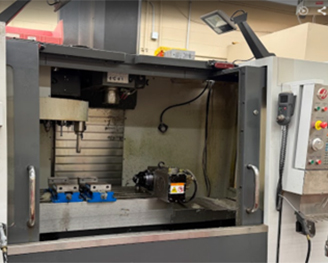
 This multi-axis CNC machine is one of the pieces of specialized equipment in use in the UAB Machine Shop.The UAB Machine Shop, located in the School of Engineering, provides design, fabrication, and repairs for the UAB research and teaching community. Equipped with multiple vertical mills, lathes, computer numerical control (CNC) mills, welding equipment, and a variety of other standard shop tools, the shop supports a wide range of material, device, and machine fabrication needs.
Shop Administrator and Lead Machinist John Wagner has extensive industry and academic experience fabricating a wide-range of machines and parts as well as assessing and implementing custom repairs. Reach out to him for your research needs as well as needs for your teaching program.
 Contact John Wagner for more information.
205-934-4393
The Bachelor of Science in Engineering degree program in Engineering Design is accredited by the Engineering Accreditation Commission of ABET, under the commission’s General Criteria and Program Criteria for Electrical, Computer, Communications, Telecommunication(s) and Similarly Named Engineering Programs.
Program Educational Objectives
The Educational Objectives of the Engineering Design are the following:
- Achieve one or both of the following:
- establish careers in engineering or other professional fields in which they apply their critical thinking and problem-solving skills.
- earn or be enrolled in a graduate or professional degree program.
- Pursue opportunities for professional growth, development, and service.
- Contribute to the advancement of society.
Student Outcomes
Upon completion of the BSEED program, our graduates will have:
- 1. an ability to identify, formulate, and solve complex engineering problems by applying principles of engineering, science, and mathematics
- an ability to apply engineering design to produce solutions that meet specified needs with consideration of public health, safety, and welfare, as well as global, cultural, social, environmental, and economic factors
- an ability to communicate effectively with a range of audiences
- an ability to recognize ethical and professional responsibilities in engineering situations and make informed judgments, which must consider the impact of engineering solutions in global, economic, environmental, and societal contexts
- an ability to function effectively on a team whose members together provide leadership, create a collaborative and inclusive environment, establish goals, plan tasks, and meet objectives
- an ability to develop and conduct appropriate experimentation, analyze and interpret data, and use engineering judgment to draw conclusions
- an ability to acquire and apply new knowledge as needed, using appropriate learning strategies.
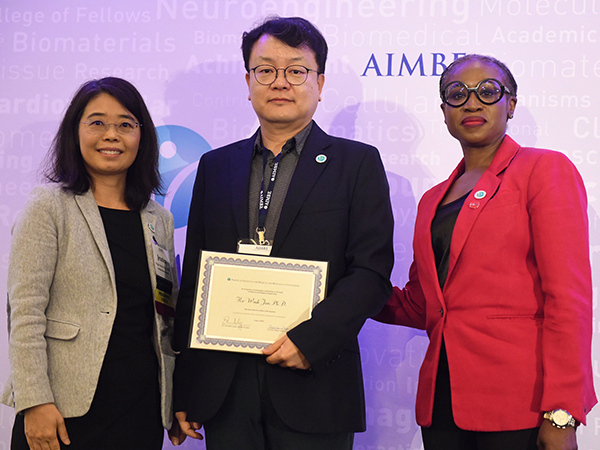
Ho-Wook Jun, Ph.D., a professor in the Department of Biomedical Engineering at the University of Alabama at Birmingham (UAB), was recently inducted into the American Institute for Medical and Biological Engineering (AIMBE) College of Fellows.
Read more: Ho-Wook Jun Inducted into the 2025 Class of the AIMBE College of Fellows

- Proposal Due Date & Time Calculator
This tool calculates the due date and time to OSP for both the complete final and "ready to submit" proposal based on a given sponsor deadline date and time. The tool also provides the date when the Officer Review Summary will be returned to the PI. The output automatically updates when any of the input fields are changed. Note that all times used and displayed here are US Central Time.
Version: 2024.09.10.001 (Compatibility) Browser Compatibility:
This tool does not support Internet Explorer (IE) 8 or earlier. If you are using IE 9+ or Safari, you may have to manually type your date into the date field above using the standard format "YYYY-MM-DD". Lastly, you may have to "Allow blocked content" for IE to run the JavaScript in this tool.Sponsor Deadline:
MM/DD/YYYY
hh
mm
AM/PM
Wednesday
Holidays/Weekends/NIH Office Closures:
Please see the NIH Policy regarding due dates on Holidays/Weekends/NIH Office Closures. If the NIH due date falls on one of these days, be sure to modify the Sponsor Deadline in this calculator accordingly.Complete Final Proposal
due by or before:
Thu Oct 31 2024
08:00 AMOfficer Review Summary
to PI by or before:
Fri Nov 01 2024
05:00 PM"Ready to Submit" Proposal
due by or before:
Tue Nov 05 2024
12:00 PM
Unanticipated circumstances can prevent students from continuing their education and achieving academic success. To help cope with such circumstances, the School of Engineering has established the Engineering Student Assistance Fund.
This fund will provide temporary financial assistance (ranging from $50-$150) to eligible students who are experiencing unforeseen hardships that could immediately impact their ability to remain enrolled in school until the end of a term. Examples of qualifying emergency situations include:
- Death in the family
- Victim of a crime or accident
- Loss of property or income
- Unanticipated educational expenses (beyond tuition and fees)
The Engineering Student Assistance Fund is not intended to replace or supplement financial aid or scholarship. Interested students can submit a request by filling out the application below and emailing it to
Eligible Expenses
Grants can be used for a variety of expenses that are necessary to support a student’s well-being. Examples of eligible expenses include:
- Unanticipated educational expenses (transportation, equipment/software, etc.)
- Utilities
- Food
- Medical care
- Childcare
Ineligible Expenses
Examples of ineligible expenses include standard Student Account charges, such as
- Tuition
- University fees
- Residence hall rent
- Meal plan*
*Students who are experiencing food insecurity may seek assistance from Blazer Kitchen at the Hill Student Center.
Additional Resources
Students who encounter emergency expenses or extreme hardship may also be eligible for a microloan from the UAB Regions Institute for Financial Education (RIFE). This is a separate program from the Engineering Student Assistance fund. Students must apply separately for this fund. More information can be found by clicking here.
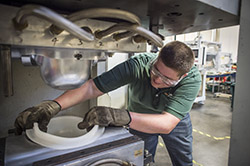 YOU CAN HELP: Does your company hire summer interns? The School of Engineering is looking for alumni partners who will commit to at least one position for a qualified UAB student. If you are interested in partnering with us, contact Desland Robinson today at
Beginning this fall, the School of Engineering is making those opportunities an official part of its undergraduate programs by offering guaranteed internships to all incoming students following their second year of engineering coursework.
To be eligible for a guaranteed internship, students must participate in the Career Readiness Program, a new initiative launched this fall by the SOE Office of Career Services.
“Our location in Birmingham gives us a great advantage over other schools because there are so many local companies that hire students for engineering internships and co-ops,” said SOE Dean Jeff Holmes, M.D., Ph.D. “With so many companies headquartered within minutes of campus, we realized there is an opportunity here for us to make a guarantee that few engineering schools in the country can match.”
A Spot for Every Student
In order to make an official guarantee, Holmes said he first had to make sure of two things: that there were enough opportunities for students in all of UAB’s undergraduate Engineering majors, and that students would be adequately prepared to provide value to the companies through their work as interns.
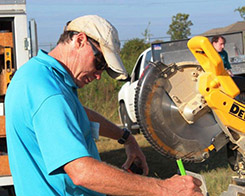 For the first requirement, Holmes looked to Career Services Director Desland Robinson, who over the past seven years has placed UAB Engineering students in hundreds of jobs with more than 165 engineering companies. “We already knew that an average of 60 percent or more of our students were participating in internships each year,” Robinson said. “In some fields, such as civil engineering, that percentage was already much higher, but it was lower in other fields such as biomedical engineering, where many of our students focus on laboratory research in preparation for graduate or medical school.” Recognizing the importance of those research experiences, Robinson worked to integrate those opportunities into the guaranteed internship program, while simultaneously reaching out to alumni to expand our network of corporate internships.
In parallel with expanding their list of internship opportunities, the Career Services team considered how to best prepare students for the experience. To that end, Robinson worked with Career Services Assistant Director Molly Kate Lallone to develop the Career Readiness Program. “This program ensures that our students are fully prepared to experience a professional work environment so that they can get the most out of their internship,” said Lallone. “Students will be required to attend one Career Preparedness Seminar each semester, but we will also work with them to create opportunities for alumni mentoring, job shadowing, networking, and other activities to help them become career ready.”
Students who complete the Career Readiness Program will receive certificates granting them eligibility for a guaranteed internship in their field of choice.
“Hands-on, real-world experience is important for engineering students for many reasons,” Holmes said. “It helps students find their passion, deciding which disciplines and professional roles are the best fit for them. It also provides motivation by showing students how what they are learning in class applies in the field, and it introduces them to local companies and contacts, often leading to job offers when—or even before—they graduate.
His pitch to future engineers? “Most of us go into engineering because we want to help shape the world around us, so why wait until you graduate? Come to UAB and start building your future – and ours – now.”
Sidebar:
Career Readiness Program at a Glance
Goal: Empower students early in their academic career to prepare them for their desired career path and to help them gain confidence in their selected majors.
Who can participate: All engineering or pre-engineering students.
Timeframe: Four semesters, followed by a one-semester internship (typically summer after sophomore year)
Focus: Career and self-development, communication, critical thinking, inclusion, leadership and professionalism, teamwork, and technology.
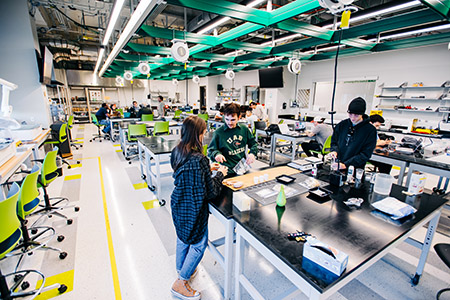 The Engineering Design x Prototyping (DxP) Lab is an open-access workspace where approved engineering students can work independently or in teams on class projects or related extracurricular activities. The lab includes ample workspace, as well as tools for basic and more advanced fabrication including shop tools (hand tools, saws, drills, sanders), 3D printers, soldering supplies, electronic components, laser cutters, a water jet cutter, sewing supplies, and more. The space also offers storage space for approved ongoing projects. Learn more about some of the exciting work done at the DxP Lap from this Peek inside the School of Engineering's showpiece lab.
Potential uses of space include collaborative brainstorming, rapid prototyping, electronics work and basic fabrication/prototyping. Once approved, students can access the space during the open hours and can use many of the tools without direct supervision. During much of this time, the DxP Lab is staffed with dedicated student assistants to provide assistance and training on the equipment. The use of power tools, advanced 3D printers and machining equipment will require supervision by the lab director, course instructor, or other approved faculty members.
Students who are interested in accessing the lab should follow the instructions below to complete the required training and submit their request.
Requesting Access
The DxP Lab is available to engineering students and students enrolled in engineering courses. Its primary use is for students to work on projects as part of their engineering coursework, or with engineering student organizations. Use for personal projects and by non-engineering students will be evaluated on a case-by-case basis based on resource requirements and educational merit.
Training records, access requests, and other communications are managed through a dedicated Canvas course for the lab. Please follow these self-enrollment instructions to enroll in the course titled “DxP Lab Information and Training (2025 - 2026).” Once enrolled, complete the assignments in the “Start Here” module.
 Hours and Location
Gorrie Hall 2209 and 2211
7 a.m. until 7 p.m.
- Room 2209 is intended for unsupervised student space and is available to approved students during the building's normal operating hours (7 a.m. until 7 p.m. during the semster)
Questions?
For additional questions about the DxP Lab, policies for use, or issues with access requests, please contact