
Tell us what you're doing after graduation!
Complete the First Destination Survey today.
Schedule an Appointment
You can schedule an appointment to meet with a UAB Career center team member. Log into Handshake and select the "Career Center" tab. Then click the "Appointments" box to get started.
Walk-In/Drop-In
The UAB Career Center offers a virtual “walk-in/drop-in” service available to UAB students without an appointment. The virtual walk-in/drop-in hours are Monday through Friday from 9:00 a.m. until 4:00 p.m. on a first come, first served basis. Click the yellow box below to access the walk-in/drop-in service via Zoom.
Cancellation and No-Show Policy
for Scheduled Appointments
If you need to reschedule or cancel your appointment, please notify our office 24 hours in advance. This allows our staff to offer your appointment time to another student, who is in need of our services. Failure to cancel your appointment within 24 hours, more than once, will result in losing your appointment privileges for the semester; however, you may still utilize our drop-in services.
The term networking usually provokes feelings of dread or anxiety in college students. For most students, the term networking evokes images of talking to people you don’t know. For others, networking is seen as a onetime event that you do when you need a job.
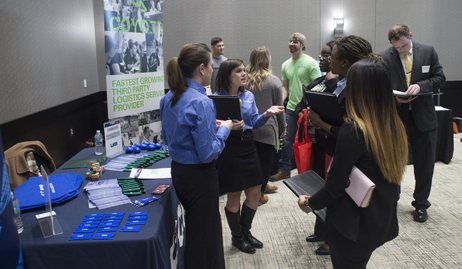 With these common misconceptions about networking, it is no wonder that college students tend to avoid networking all together. The good news is that these are misbeliefs and it isn’t as bad as one might think.
College students should focus on building relationships with people in their own area of study first. Overtime, all professionals expand their networking outside of their current job, but that level of complexity is not required for the entry-level employee.
1
The most common and obvious people to start networking with are:
- Campus recruiters for all of the companies that recruit from UAB
- Human Resources personnel at companies that do not have campus recruiters
- Managers within organizations in your area of study or area of interest
- Employees who are already doing the job you want
- Do not network solely with the companies you want to work for, expand your network to a large variety of organizations in your industry.
2
- Set up a LinkedIn account, look at the accounts of other professionals to ensure that your page makes a dynamic first impression (you can use staff in UAB’s office of Career & Professional Development as examples)
- Send personalized LinkedIn connection requests. Do not use the standard request message provided by LinkedIn.
- Modify your Twitter account to be personable and appropriate all in one, then follow campus recruiters at a minimum. Many recruiters will post a job opening on Twitter the minute it opens, days before it might show up on the company website.
3
Online networking is possible and effective, but it doesn’t complete the entire process. Meeting people in person is how you create your reputation and make friends with other professionals. That saying “it’s all in who you know” exists for a reason.
- Log into your HireABlazer account and plan some on-campus networking in advance. Click on the box that says EVENTS to see what is coming up for the semester.
- Use local Young Professional (YP) organizations and their events to meet people the industry(s) that are of interest to you. Here are some great local examples:
- Birmingham Urban League YP
- Alabama Humanities Foundation
- Young Nonprofit Professionals Network Birmingham
- Young Professionals of Birmingham
- The Rotaract Club of Birmingham
- Young Pioneers of Birmingham – In support of REV Birmingham
- Birmingham Public Library Young Professionals
- Young Education Professionals (YEP) Birmingham
- Conferences are an ideal place to network. Most UAB students are attending conferences as co-presenters or poster session participants anyway, so use that opportunity to collect business cards, connect with the people you meet at the conference via LinkedIn and Twitter accounts that you prepared in Step One, and ask people about their work. Refer to our section on informational interviewing for some sample questions to ask complete strangers.
How can the office Career & Professional Development Help You?
Our department has fulltime staff who connect with employers in the community solely for the benefit of UAB students. Come talk to your career advisor for information on programs, events, how to build relationships, and what to say to someone you have never met before. Networking can be uncomfortable for some people, talking to a UAB career advisor will put you at ease and inspire you to get started.
 Myth : A CV and a resume are interchangeable.
Fact: A CV means that you must have a lot of experience and accomplishments already and for that reason, the document is expected to be longer than one page.
A CV is typically used for positions in academia, but may be requested by a business organization as well.
Common Sections that are Included on a CV:
- Personal Information
- Education
- Teaching Experience
- Research Experience
- Publications
- Conference Presentations
- Certifications
- Memberships in Professional Organizations
- Licensure (if applicable)
- Awards and Honors
- Funding Received (ex. research grants/funding)
- Additional Training
- Post-Doctoral Fellows
A curriculum vitae is a comprehensive document that details all of your past education and professional competencies and experiences. Although it is similar to a résumé, there are several key differences:
Résumé
Summary of key experiences that is targeted to a specific field
To demonstrate the skills and experience necessary to fill a specific role
1 or 2 pages, depending on experience
When applying for a position in industry, non-profit, or public sectors
Should be tailored for each job to which you apply
VS
WHAT IT IS
GOAL
LENGTH
WHEN TO USE IT
TAILORING
CV
Complete account of professional and educational history
To demonstrate academic achievements and scholarly potential
As long as needed, but usually at least 3 pages, depending on experience
When applying for positions in academia and research
Tailoring is not needed, but can still be used
How can the uab career center help you?
The most common mistake with the CV is a shortage of information. Make an appointment with a career advisor to review the first draft of your CV. We will talk through all of your experiences to identify areas of relevance that may be missing and help you tell the story of your accomplishments.
You got an interview, CONGRATULATIONS! This is where it all comes together. This is where you let those interviewing you get to know who you are and what you will contribute if they hire you. You should go into an interview prepared to tell a story, prepared to help the interviewer visualize you as a future employee.
Steps to Prepare for the Interview

RESEARCH THE COMPANY
This sounds simple, but it requires some thought. You should know the mission and vision of the organization, you should know who the people are and what role they play, and you should know enough about the company to engage in informed dialogue during your interview.

STUDY THE JOB DESCRIPTION
Every job description has a list of qualifications and responsibilities. You should be able to talk about yourself and what you have done in the past that demonstrates your knowledge of every qualification, competency, and responsibility in the job posting.

PRACTICE
You should do a practice interview every time. Using some standard behavioral-based interview questions, have an experienced person conduct a mock interview with you, someone who will give you good feedback.
What are behavioral-based interview questions?
 These are questions that ask you about your past performance in a particular situation. These questions often start with “tell me about a time you…” or “what did you do during your internship to…”
Behavioral-based interview questions should be answered using the CAR formula:
C CONTEXT : Explain the situation in which you were required to act
A ACTION : Describe what you did specifically to solve a problem or create a new outcome
R RESULT : Talk about the outcome and what your learned. Connect this to the job you are applying for to help the interviewer visualize how you will perform if they hire you.
VIEW BEHAVIORAL-BASED INTERVIEW QUESTIONS
How can the uab Career center help you?
Come in for a 1-on-1 Mock Interview :
There is no better way to prepare for an interview than to go through a mock interview with your career advisor. Rarely does a student walk out of this appointment without a profound change in their approach to interviewing.
Use Big Interview:
This is an online tool that allows you to practice interviewing in the comfort of your own dorm or while sitting on the campus green. You can access Big Interview using your BlazerID and password.
Did you know?
- Recruiters spend an average of just six-seconds scanning a resume before deciding to call the candidate in for an interview (LinkedIn, 2017)
- The average job opening attracts 250 resumes (Glassdoor)
- Only 14.9% of hires are made from a job board candidate. Most (39.9%) are made through employee referral programs. (Jobvite)
- 75% of hiring and talent managers use recruiting software and/or applicant tracking software when hiring. (Capterra)
- 45% of recruiter’s state that resumes will get rejected for not including a cover letter and 37% for not sending follow-up letter after an interview (UpToWork, 2018)
Your resume should be deliberately written to briefly and effectively communicate your experience. Whether you’re applying for a part-time position, volunteer opportunity, internship, or a full-time job, you want your resume to professionally reflect your qualifications. We’ve provide a few resume samples to get you started.
For more detailed information on writing a resume, check out the UAB Career Guide.
Résumé Samples:
- Education
- Biology
- Communication
- Philosophy
- Psychology
- Physics
- Biochemistry
- Computer Engineering
- Chemistry
- Public Health
- Engineering
- Student-Athlete
- Political Science Pre-Law
- Kinesiology
- Federal
- Marketing
- Industrial Distribution
- Economics
- General Management
- Business
- More samples coming soon.
Résumé Fundamentals
- Name and Contact Information
- Education
- Relevant Coursework
- Experience
- Skills and Certifications
- Awards and Accomplishment
- Free of spelling and grammatical error
- Avoid high school information (after your first year in college)
- Include data, numbers, percentages or amounts
- Avoid personal pronouns like “I” or “my”
- Proofread by three people (one of them should be your Career Consultant)
- Use strong action verbs and power words
- Consistent in formatting, font, and content
- Neat, well-organized, and easy to read
- Updated and current
How Can the UAb career center Help You?
Appointments and Drop-In Scheduling
Drop-In Hours (No Appointment Necessary)
Students can "walk/drop-in" Zoom space to meet with a Peer Career Advisor (PCA) without an appointment. Copy and paste this URL, https://uab.zoom.us/j/3932859514#success, into your browser to access our Walk/Drop-In space Mondays through Fridays from 9 a.m. to 4 p.m. when academic classes are in session.
Appointments
Students can schedule an appointment with a Peer Career Advisor (PCA) by logging into your Handshake profile. Once in your Handshake profile, click on "Career Center." Then select the "Appointments" tab. Click on the "Schedule A New Appointment" box. Select the "UAB Career Center" as the category. Follow the remaining prompts until you schedule your desired appointment date and time.
UAB Career Center Hours
Mondays through Fridays from 8 a.m. to 5 p.m. except when the University is closed.
Get Experience While you are in school
Be sure to talk to your career advisor early so that you know how to make this experience work for you long-term. Your career advisor can help you identify what information you need to put on your resume, can help you ask for a reference letter before the experience ends, and can provide you with tips on how to be a top performer during your experience.
- Job shadow someone who is in the job you want
- Participate in a mentoring program
- Complete an internship (or two) – find opportunities on HireABlazer
- Engage in research on campus
- Volunteer both on and off campus

How can the office of Career & Professional Development help you?
When it comes to the subject of experience while in school, talking to a career advisor as your first step is always the best approach because you can ask questions that are specific to you. Schedule an appointment or stop by during our walk-in hours.